
Lahori Ahmadi Elders Affirming Prophethood of Mirza Ghulam Ahmad AS
Introduction
This will be a compilation of various quotes regarding Nabuwaah which show that Maulvi Syed Ahsan Amrohi RA and other Lahori Elders affimed the Qadiani Ahmadi Position over the Lahori Position prior to the split. Qadhi Muhammad Yusuf Peshawari RA, Sahabi of Masih Maud and Amir Jamaat Peshawar wrote a book wherein he showed that the Lahori Ahmadi elders prior to the split had the same belief as the Rabwah group. he following is evidence taken from Hadrat Qadi Muhammad Yusuf (ra), (early Pashtun Sahabi and later Amir Jama’at Peshawer) book Nabuwaat fil Ahadith. Since Maulvi Muhammad Ali had great influence among the Pashtuns of the Frontier, Qadhi Sahib, representing the Qadian branch wrote books in response to the Lahoris and many Lahoris converted back to Qadiani branch, most famous being Maulvi Ghulam Hasan Khan Peshawari RA, Father in Law of Mirza Bashir Ahmad RA
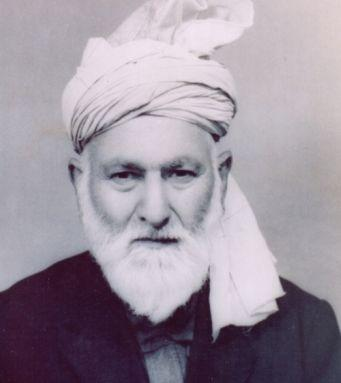
Hadrat Qadi Muhammad Yusuf (ra), early Pashtun Sahabi and later Amir Jama’at Peshawer,
I will show some of the references that Qadhi sahib presented:
.Qadhi sahib writes:
Mawlawi Muhammad Ali of Qadian, His Companions, Former Adherents, and Opponents
Mawlawi Muhammad Ali of Qadian, his companions, some retired individuals, Khawaja Kamal-ud-Din (Advocate, Lahore), and Mawlawi Hasan Ali. Then, the proprietor of the Sabz Marghazar publication, and others: Yaqub Beg of Qadian, and Muhammad Din Shah Sahib, residents of Lahore—and Mawlawi Muhammad Ahsan Sahib, who is now the editor of a journal, by agreement of Hazrat Mirza Muhammad Ahmad (the Second Khalifa)—due to personal animosity and the instigation of the Khalifa’s deputy, have completely altered the statement/claim from the center. They object to this Hazrat, claiming that after his appointment, he has fabricated the notion of prophethood and declared it a lie, and that he considers those outside the Shariah, the Quran, and our leader Muhammad (peace be upon him) as something merely invented.
I have presented all these statements in my writings with references. (See my booklet of March 1914*) that those outside the Shariah and the community are worthy of being killed by God—and in my view, our leader, Hazrat Ghulam Ahmad (peace be upon him), has not said anything of this sort.
Reference 1 – Paigham-e-Sulah October 16, 1913
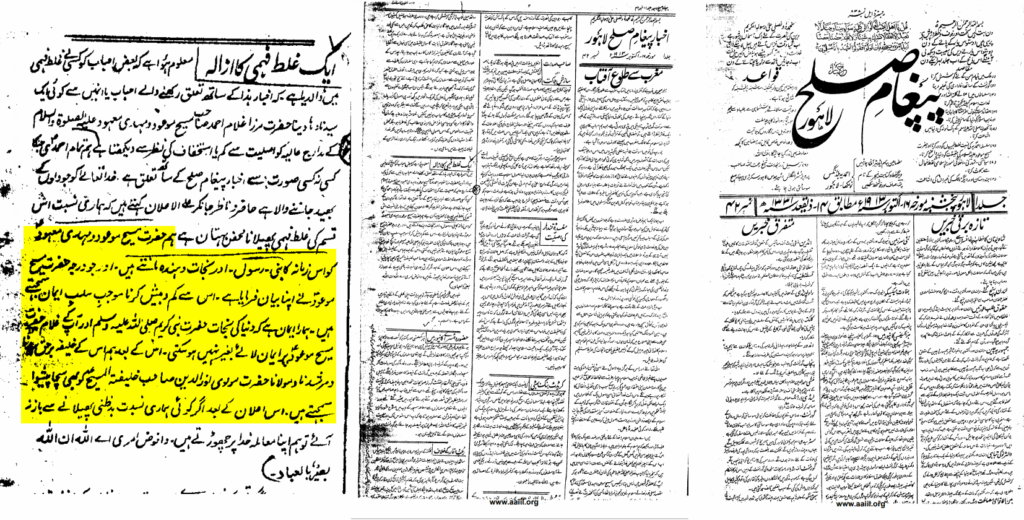
Dr Mirza Yaqub Beg and Dr Syed Muhammad Husayn write:
We, all Ahmadis, who are in some way or another connected with the Paigham e Sulah newspaper, knowing God Almighty, who knows the secrets of hearts, as the present and the watcher, declare in the highest degree that we believe in the Promised Messiah and the Promised Mahdi (peace be upon him) as the Prophet, Messenger and Savior of this age. And we consider anything more or less than the status that the Promised Messiah has described as his own to be a denial of faith.Paigham-e-Sulah October 16, 1913
Reference 2 – Paigham-e-Sulah Sep 7, 1913
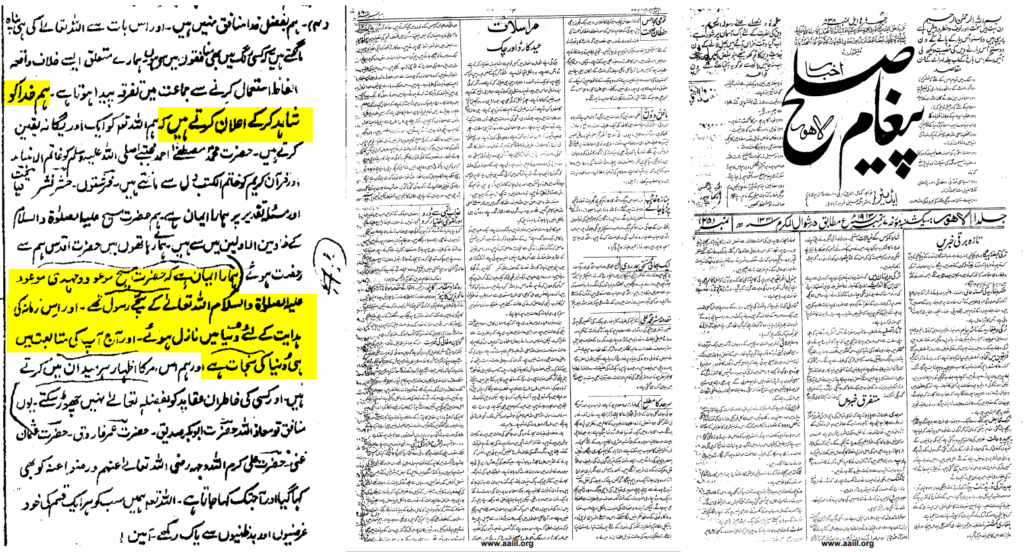
4 – The announcement of Mirza Yaqub Beg and Dr. Syed Muhammad Husain Sahiban is present in the newspaper Paygham dated September 7, 1913, titled “Are We Hypocrites?” In this article, regarding Hadhrat Ghulam Ahmad (peace be upon him), they publish the following sworn statement:
“We call God as witness and declare that… our faith is that Hadhrat Masih Maud Mahdi (peace and blessings be upon him) was a true Messenger of Allah the Exalted and was sent into the world for the guidance of this age. And today, in following him lies the salvation of the world.”
Paigham-e-Sulah Sep 7, 1913
Reference 3 – Risālah Attibyān fi Istehlālişşibyān – July 1908
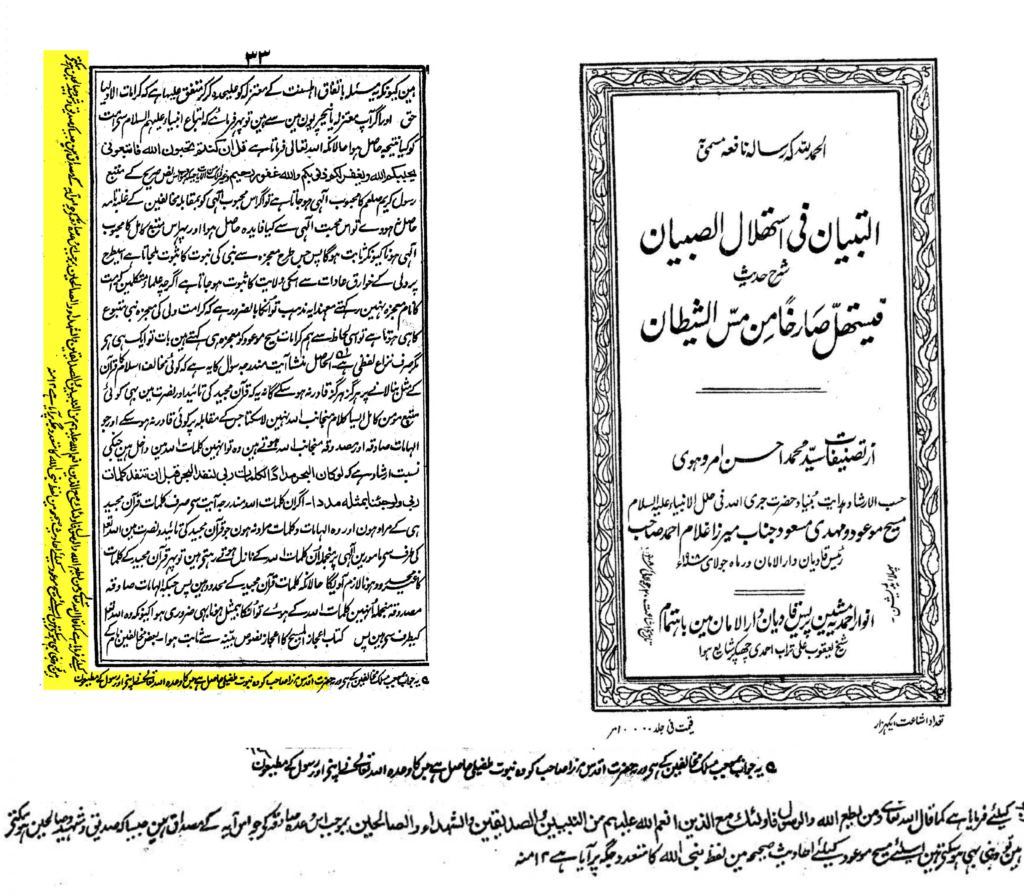
Former Wahhabi Scholar, Maulavi Muhammad Ahsan of Amroha RA writes:
The holy personage “Mirzā Şahib” has attained that secondary dependent nubuwwat [Nubwwat-e-Tufaili] which had been
promised for those who follow Allah and the Holy Prophet sa.
As Allah the Most High says:
وَمَنْ يُطِعِ اللَّهَ وَالرَّسُولَ فَأُولَئِكَ مَعَ الَّذِينَ أَنْعَمَ اللهُ عَلَيْهِمْ مِّنَ النَّبِيِّنَ
وَالصَّدِّيقين والشُّهَدَاء وَالصّلحينَ . . . .And whoso obeys Allah and this Messenger of His shall be among those on whom Allah has bestowed His bless-ings, namely, the Prophets, the Truthful, the Martyrs, and the Righteous. (al-Nisa’, 4:70)
According to this verse, those who are the embodiment of this promise can be şiddiq, shahīd, or șālihin. And so also they can also be Ańbiyā’, for this reason the Promised Messiah as has been called Nabiullah at many places in authentic ahādīth.
(Footnote, Risālah Attibyān fi Istihlālişşibyān Sharḥ Ḥadīth Yastahillu Ṣārikhan min Mas ash-Shayṭān,p. 33 July 1908) – The Treatise of Clarification on the Crying of Children: An Explanation of the Hadith ‘He Cries Out Due to the Touch of Satan’
Reference 4 – Ummat-e-Muhammadiyyah main Nabuwaat
Syed Muhammad Ahsan Amrohi RA wrote a Risala in 1913 called Ummat-e-Muhammadiyyah main Nabuwaat, (Prophethood in the Ummah of Muhammadi) on page 499, he in it he expresses aqaid which Maulvi Muhammad Ali Condemns.
Ummat-e-Muhamadiyyah main Nabuwaah by Mawlana Muhammad Ahsan Amrohi
A Non Ahmadi said: Ahmadi Lectuerers have created a new idea of Ghayr Tashri’i Nabuwaah (Non Legislative Nabuwaat)
Mawlana Sayyid Muhammad Ahsan Amrohi RA writes in response:
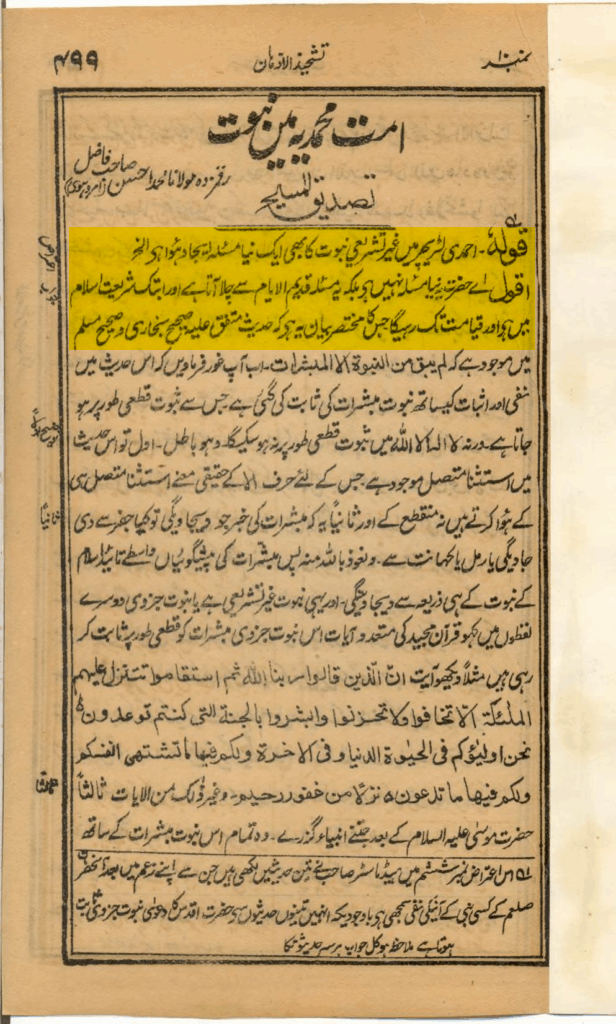
Response: Respected,this is not a new idea while the idea has been ongoing since ancient times and has been in Islamic Sharia until now and will remain until the Day of Judgment
Tasheez ul Adhan, Ummat-e-Muhammadiyyah main Nabuwaat, October, 1913 p. 499
This directly conflicts what Muhammad Ali said in his book “Nabuwaah fil Islam”:
Qadhi sahib notes the contradiction:
Maulvi Muhammad Ali says:There is no prophet after me” means that there is absolutely no prophet after me. Neither the law bearing nor the non-lawbearing. – Al-Nubawwah fi al-Islam, page 114.
Then he says that prophethood, legal and non-legal, are equally closed. Page 115.Then on page 116 he has categorically denied it.
Between the two, who is truthful?
Reference 5 – Ummat-e-Muhammadiyyah main Nabuwaat
Mawlana Sayyid Muhammad Ahsan Amrohi RA writes in response:
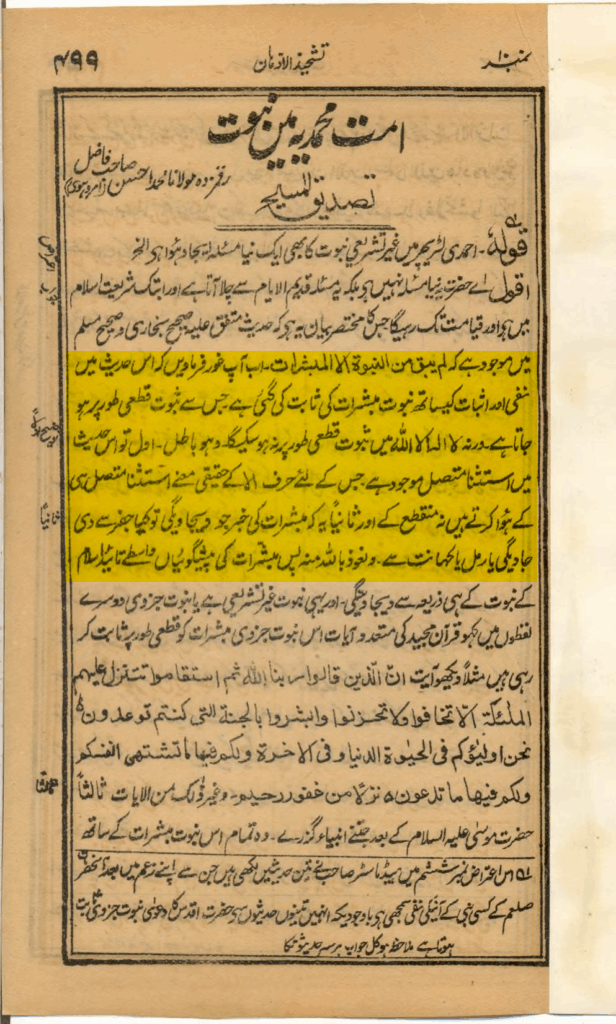
2 – ‘Nothing remains of prophethood except the glad tidings (Al-Mubashshirat)…’ In this hadith, prophethood of mubashiraat is established through negation (Nafi) and affirmation (Ithbaat) , which results in a definitive proof. Otherwise, in ‘La ilaha illallah,’ a definitive proof could not be established. And He (Allah) is the Hidden. Firstly, in the hadith, there is a connected exception (Istithna Muttasil) , for which the true meanings of ‘except’ (illa) apply only to the connected exception, not the disconnected one. Secondly, will the news of the glad tidings be given through the science of letters (Jafr), or through geomancy (Raml), or through divination (Kahana)? We seek refuge with Allah from that.”
Qadhi sahib notes:
Footnote (2): Maulvi Muhammad Ali, in An-Nubuwwah fi al-Islam, pages 193-194 and then from 197 to 200, has made a great unsuccessful effort [to prove] that, firstly, prophethood cannot be established for the glad tidings (Al-Mubashshirat). And if this effort fails, then only righteous dreams (Ru’ya Salihah) can be meant—which exist in every believer—and [thus] 1/46th of prophethood is proven. Third, it should not be called prophethood, but rather sainthood (Wilayah). Fourth, if compelled to accept it, then only prophethood in a linguistic sense should be accepted.
Which of the two is truthful?
Reference # 6 – Ummat-e-Muhamiyyah main Nabuwaat
Mawlana Sayyid Muhammad Ahsan Amrohi RA writes in response:
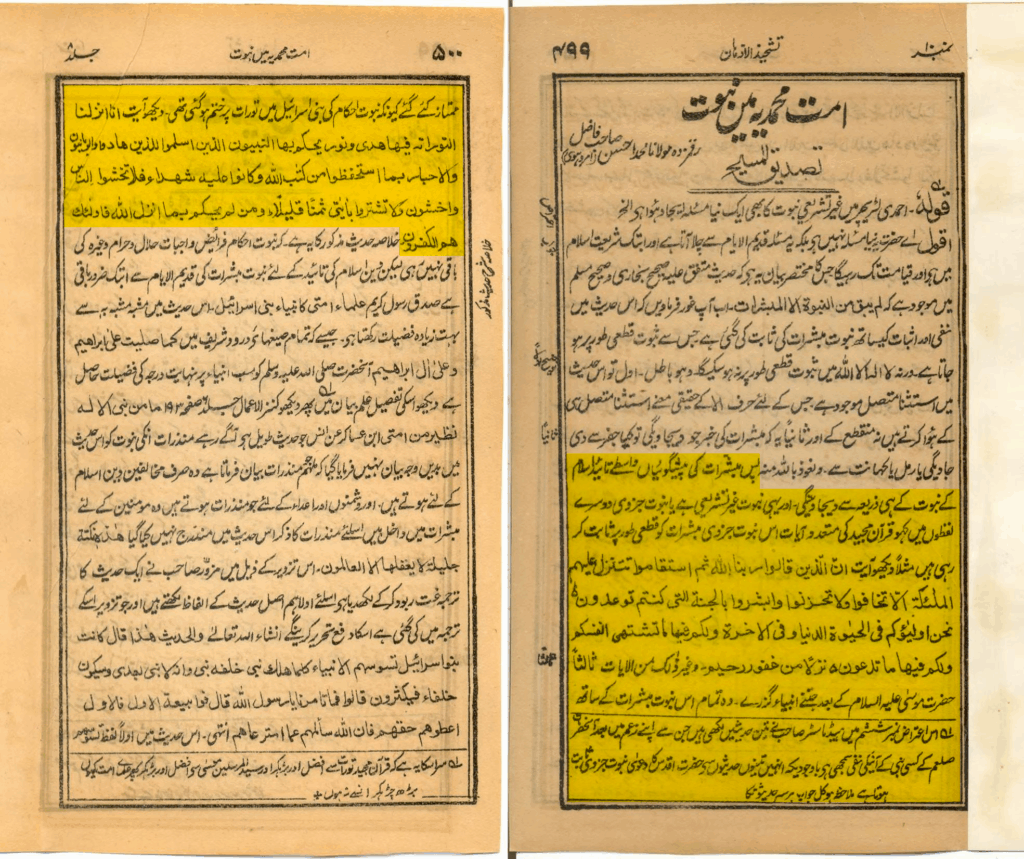
The prophecies of glad tidings are given through the medium of prophethood for the confirmation of Islam. And this is non-legislative prophethood. This is partial prophethood, or in other words, several verses of the Holy Quran definitively prove this partial prophethood of glad tidings. For example, see:
Indeed, those who say, ‘Our Lord is Allah,’ and then remain steadfast, the angels descend upon them, [saying], ‘Do not fear, nor grieve, but receive glad tidings of the Paradise which you were promised. We are your allies in the life of this world and in the Hereafter, and you will have therein whatever your souls desire, and you will have therein whatever you request, as a hospitality from the Forgiving, the Merciful.’”
And other verses like these.
Thirdly, all the prophets who came after Prophet Moses (peace be upon him) were with this prophethood of glad tidings(Mubashiraat). They were distinguished because the prophethood of commandments ended with the Torah among the Children of Israel. The verse: “
Indeed, We sent down the Torah, in which was guidance and light. The prophets who submitted [to Allah] judged by it for those who were Jews, as did the rabbis and scholars by that with which they were entrusted of the Scripture of Allah, and they were witnesses thereto. So do not fear the people but fear Me, and do not exchange My verses for a small price. And whoever does not judge by what Allah has revealed—then it is those who are the disbelievers.”
Reference # 7 – Ummat-e-Muhamiyyah main Nabuwaat
Mawlana Sayyid Muhammad Ahsan Amrohi RA writes in response:
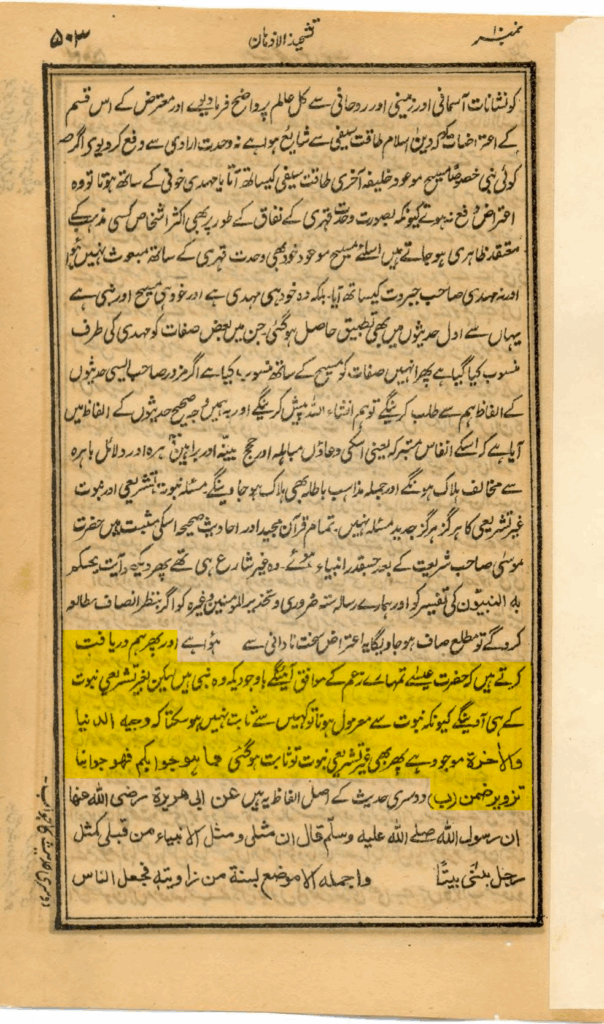
Prophet Isa (Jesus), the Promised one, will be a non-legislative Messenger. Then we ask: Prophet Isa will come according to your belief, despite the fact that he is a prophet, but he will come with non-legislative prophethood. Because his being removed from prophethood cannot be proven anywhere, as “Wajihan fi al-dunya wa al-akhirah” (illustrious in this world and the Hereafter) exists for him. Even then, non-legislative prophethood is proven. So, whatever your answer is, that is our answer. – Page 503
Reference # 8 – Ummat-e-Muhamiyyah main Nabuwaat
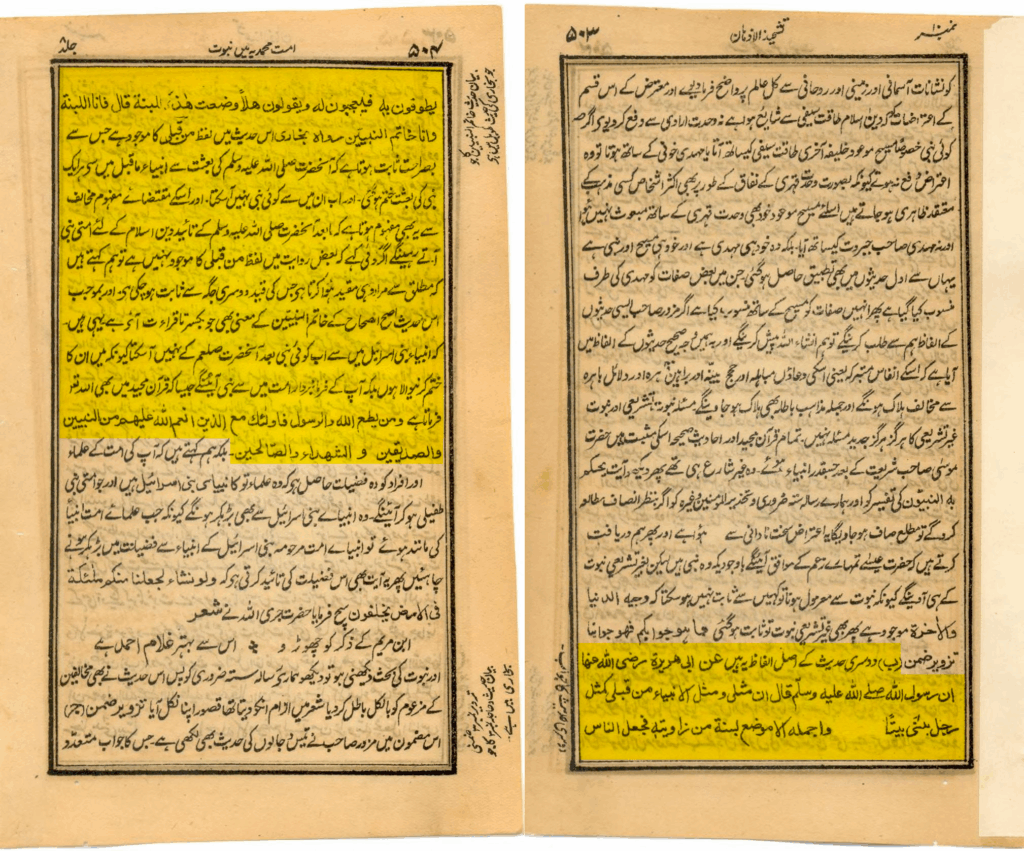
Mathali wa mathalu al-anbiya’i min qabli” (My example and the example of the prophets before me) In this hadith, the words “min qabli” (before me) are present, which clearly prove that with the advent of the Holy Prophet (peace and blessings of Allah be upon him), the advent of every prophet from among the previous prophets came to an end. Now none of them can come… After the Holy Prophet, for the support of the religion of Islam, Ummati (from the community) prophets will continue to come… This meaning is also derived from the word “Khatam al-Nabiyyin” in the recitation with a Kasra (Khātim, meaning seal/ornament) found in the Sahih Ahadith: that now, after the Holy Prophet (peace be upon him), none of the prophets of the Children of Israel can come to Islam, because he is the one who sealed them. Rather, prophets will come from among the followers of the Holy Prophet (peace be upon him), just as Allah the Almighty states in the Holy Quran: “Man yuti’i Allah wa al-rasul” (Whoever obeys Allah and the Messenger). – Page 504
Reference # 9 – Ummat-e-Muhamiyyah main Nabuwaat
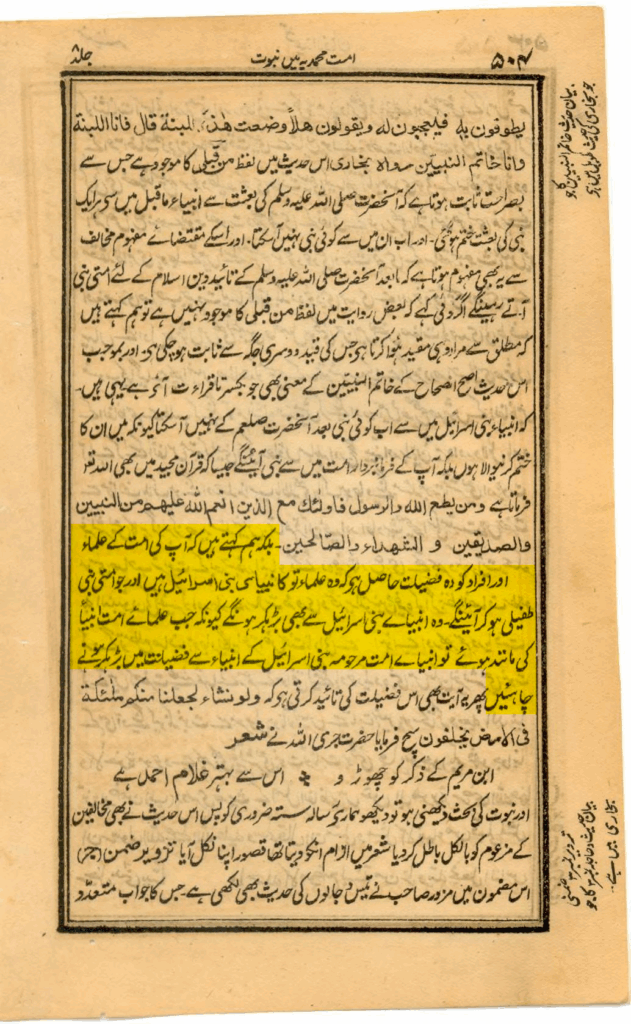
The prophets of the Ummah of Muhammad are superior to the prophets of the Ummah of Musa. The Ummati prophets who will come as subordinate will be greater than the prophets of the Children of Israel. Because when the scholars of this Ummah are likened to prophets, then the prophets of this blessed Ummah should be greater in excellence than the prophets of the Children of Israel. – Page 504
Reference $# 10 – mmat-e-Muhamiyyah main Nabuwaat
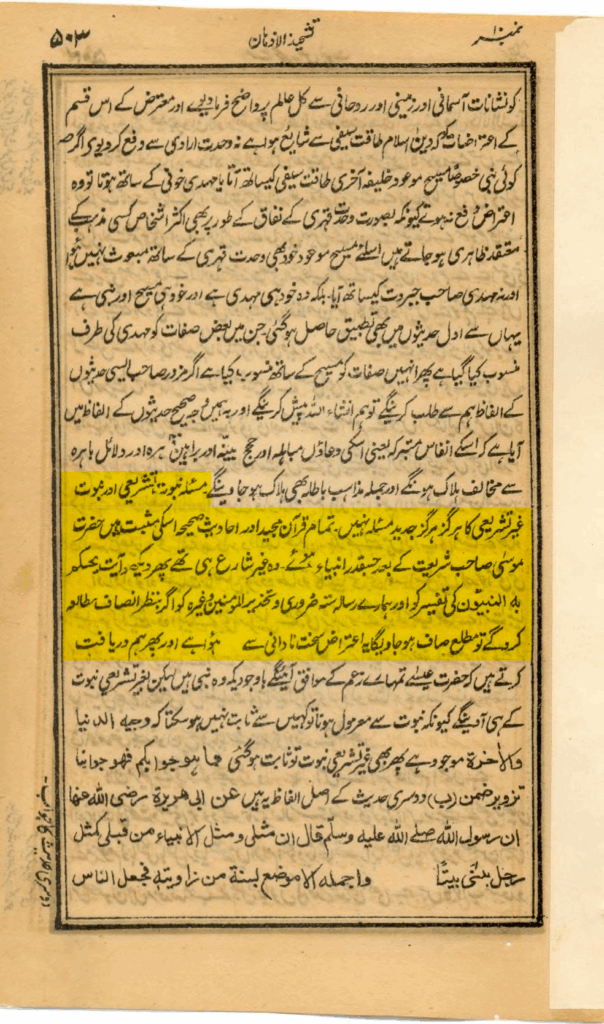
After Prophet Musa (Moses), whoever came were all non-legislative prophets. The issue of legislative prophethood and non-legislative prophethood is by no means a new issue. The entire Holy Quran and the Hadith affirm it. After Prophet Musa, who was a law-bearing prophet, whichever prophets came, they were all non-legislative. Then look at the verse “Yahkumu biha al-nabiyyun” (by which the prophets judged) and its commentary, and also refer to our treatise Sitta Zaruriyya etc., page 503.
Reference # 11 – Ummat-e-Muhamiyyah main Nabuwaat
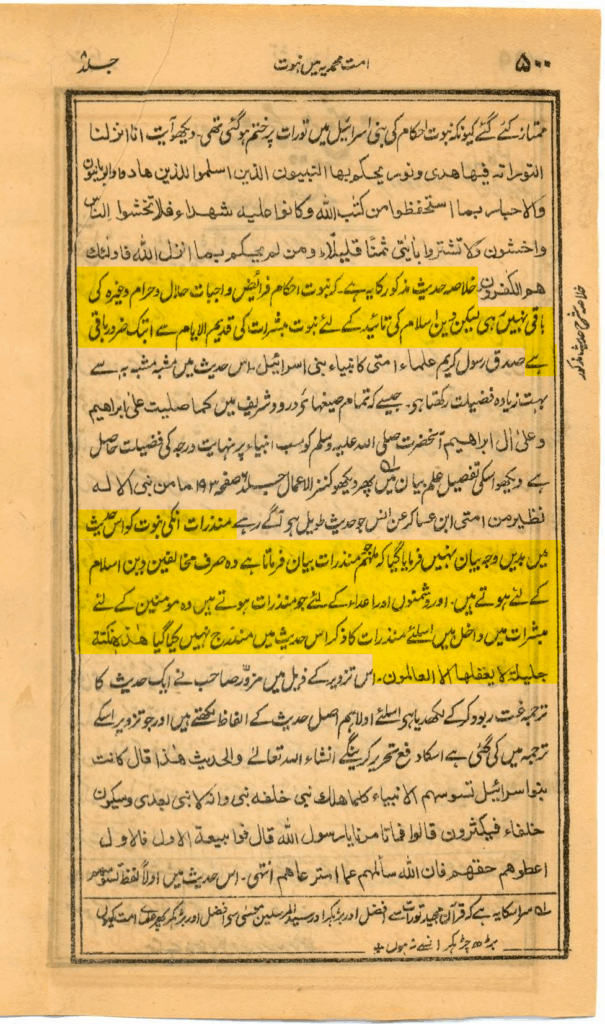
After the Holy Qur’an as well, the Prophethood of Glad Tidings (Nubuwwat al-Mubashshirat) remains.
The summary of the hadith (Lam yabqa min al-nubuwwati illa al-mubashshirat — “Nothing remains of prophethood except the glad tidings”) is that the prophethood of commandments (Nubuwwat al-Ahkam) — regarding obligations, duties, lawful, unlawful, etc. — does not remain. However, for the support of the religion of Islam, the need for the Prophethood of Glad Tidings has remained from ancient times until now.
As for the Warners (Munzirat), their prophethood is not mentioned in this hadith for this reason: that which the inspired one (Mulham) states as warnings is only for the opponents of the religion of Islam. And the warnings that occur for enemies and adversaries are, for the believers, included in the Glad Tidings. Therefore, the mention of Warners is not included in this hadith.
Last Testimony of Ahsan Amrohi RA vs Maulvi Muhammad Ali’s Aqaid
Qadhi Sb writes:
13 – A Tract by Maulvi Muhammad Ali Sahib – Titled “Maulana Maulvi Syed Ahsan Sahib’s Latest Testimony Regarding the Question of the Prophethood of the Promised Messiah is Published.” He states that the very existence of Maulana Syed Muhammad Ahsan Sahib is a great boon, who has been with the Promised Messiah from the beginning. Investigate from him… Behold, this venerable person has given testimony solely with the pleasure of Allah in mind. Yes, if you are not satisfied with this much, then arise, go meet him, correspond with him, and obtain clear testimony from him on the following few matters. This is Maulvi Sahib’s recommendation. So now we present to you that testimony of Syed Muhammad Ahsan Sahib which Maulvi Sahib has put forward.
- Syed Ahsan believes Hadhrat Sahib (the Promised Messiah) to be a partial prophet (Juzvi Nabi). Accordingly, he states: “I believe Mirza Sahib to be a perfect Mujaddid, and certainly consider him a partial prophet of the Buruzi (reflective) and Zilli (shadow) type.” Page 60
- Syed Ahsan Sahib also believes Hadhrat Isa (Jesus) and others to be partial prophets. Accordingly, he writes: “Denying those prophets who are mentioned with the word ‘Nubuwwat’ (prophethood) in the Quran, whether they are a legislative prophet (like Hadhrat Musa was) or a partial and subordinate prophet (like Hadhrat Isa and others), is Kufr (disbelief) which expels one from the fold of Islam. Because this denial leads to the denial of the Holy Quran. And regarding those prophets whose mention with the word prophethood is not in the Holy Quran, and who are included in ‘Wa minhum lam naqsus ‘alaik’ (And some We have not narrated to you), it is necessary to have faith in them collectively, just as one believes in Allah, but not by name without definitive proof.” Page 807
This is the final testimony of Maulvi Syed Ahsan Sahib which is acceptable to us. But my belief is that Muhammad Ali himself and his group do not accept it because:
- If, according to you, only a legislative prophet like Hadhrat Musa is a complete prophet, and the rest of the prophets of the Children of Israel, Hadhrat Isa and others, are partial and subordinate prophets, then on this very principle we also consider Hadhrat Mirza Ghulam Ahmad (the Promised Messiah) as partial and subordinate. Because he never claimed to be a legislative prophet like Hadhrat Musa. But are Maulvi Muhammad Ali and his companions prepared to accept the rest of the prophets of the Children of Israel, Hadhrat Isa and others, as partial prophets? Never.
- Furthermore, Syed Ahsan Sahib considers the denial of partial prophets like Hadhrat Isa and others as Kufr, and states that the denier is expelled from the fold of Islam. Regarding the denier of Hadhrat Mirza Ghulam Ahmad, this is also our belief about them. Because, according to Syed Ahsan, he is also a partial prophet. So, is this verdict acceptable to Maulvi Muhammad Ali and his companions? Never.
- If Maulvi Muhammad Ali Sahib has the excuse that Hadhrat Isa, although a partial prophet, is mentioned with the word ‘prophethood’ in the Holy Quran, but Hadhrat Mirza Ghulam Ahmad is not mentioned with the word ‘prophethood’ in the Holy Quran, then regarding this, we quote the saying of the Holy Prophet (on whom be peace). Hadhrat Mirza Ghulam Ahmad states:
- “To say that the Promised Messiah is not mentioned anywhere in the Holy Quran is entirely wrong.”
- “The prophecy concerning the Promised Messiah is clearly proven in the Holy Quran, because whoever reads the Holy Quran with reflection and honesty will see it manifest.”
- “From this, it is proven that the Promised Messiah is mentioned in the Holy Quran, and this is what needed to be proven.”
- “Therefore, the coming of the Promised Messiah is also proven from the Holy Quran.”
- “So one is amazed at this people who say that the Promised Messiah is not mentioned in the Holy Quran.” (Taken from Haqiqat al-Wahi)
Why, O Maulvi Muhammad Ali Sahib? Is this verdict now acceptable to you, or not? And in my view, it is never acceptable to you. So now ponder over your own situation. Who is worthy of blame?
Lo, the hunter has come into your own snare.
Conclusion
We can clearly see the Lahori Elders had the same Aqaid as the Qadian branch prior to the split and prior to the death of Mawlana Nuruddin RA!
Full text of Ummat-e-Muhamiyyah main Nabuwaat
Page 499:
Saying, Ahmadi lectures have created a new idea of Ghayr Tashri’i Nabuwaah (Non Legislative Nabuwaat1
Response: Respected,this is not a new issue while the issue has been ongoing since ancient times and has been in Islamic Sharia until now and will remain until the Day of Judgment. Its brief explanation is blessed in the hadith agreed upon in Sahih Bukhari and Sahih Muslim, which states: “Nothing remains of prophethood except the glad tidings (mubashshirat).” Now, please explain that in this hadith, along with the affirmation of prophethood, the prophethood of glad tidings has been proven, which provides definitive proof. Otherwise, “La ilaha illallah” (There is no god but Allah) would not have been definitively proven, and it would be false.
Firstly, in this matter, there is a connected exception (istithna muttasil) present, for which the true meaning of the word “illa” (except) is a connected exception (istisna Mutassil), not a disconnected one (Munqata). Secondly, the news of glad tidings (Al Mubashiraat) that is given, will it be given through necessity, magic, or soothsaying? God forbid! The prophecies of glad tidings are given through the medium of prophethood for the confirmation of Islam. And this is non-legislative prophethood. This is partial prophethood, or in other words, several verses of the Holy Quran definitively prove this partial prophethood of glad tidings. For example, see:
Indeed, those who say, ‘Our Lord is Allah,’ and then remain steadfast, the angels descend upon them, [saying], ‘Do not fear, nor grieve, but receive glad tidings of the Paradise which you were promised. We are your allies in the life of this world and in the Hereafter, and you will have therein whatever your souls desire, and you will have therein whatever you request, as a hospitality from the Forgiving, the Merciful.'”
And other verses like these.
Thirdly, all the prophets who came after Prophet Moses (peace be upon him) were with this prophethood of glad tidings(Mubashiraat).
page 500:
They were distinguished because the prophethood of commandments ended with the Torah among the Children of Israel. The verse: “
Indeed, We sent down the Torah, in which was guidance and light. The prophets who submitted [to Allah] judged by it for those who were Jews, as did the rabbis and scholars by that with which they were entrusted of the Scripture of Allah, and they were witnesses thereto. So do not fear the people but fear Me, and do not exchange My verses for a small price. And whoever does not judge by what Allah has revealed—then it is those who are the disbelievers.”
The mentioned hadith [Hadith about Al Mubashiraat ] is that the prophethood of commandments, duties, obligations, lawful and unlawful matters, and so on, no longer remains. However, for the confirmation of Islam, the prophethood of glad tidings has certainly remained from ancient times until now. The truthfulness of the Noble Messenger, the scholars of my nation are like the prophets of the Children of Israel. In this hadith, the one likened holds far greater excellence than the one to whom it is likened. Just as in all the noble and honorable [prayer],
“As You sent blessings upon Ibrahim and upon the family of Ibrahim,”
the Prophet (peace be upon him) has been granted the highest degree of excellence over all prophets. See its detail in the science of rhetoric.
Then see Kanz al-Ummal, volume 2, page 319:
«مَا مِنْ نَبِيٍّ إِلَّا لَهُ نَظِيرٌ فِي أُمَّتِهِ، وَأَبُو بَكْرٍ نَظِيرُ إِبْرَاهِيمَ، وَعُمَرُ نَظِيرُ مُوسَى، وَعُثْمَانُ نَظِيرُ هَارُونَ، وَعَلِيُّ بْنُ أَبِي طَالِبٍ نَظِيرِي، وَمَنْ سَرَّهُ أَنْ يَنْظُرَ إِلَى عِيسَى بْنِ مَرْيَمَ فَلْيَنْظُرْ إِلَى أَبِي ذَرٍّ الْغِفَارِيِّ رَضِيَ اللَّهُ عَنْهُمْ»
There is no prophet except that he has a counterpart from my nation,” narrated by Ibn Asakir from Anas, which is a lengthy hadith
The warnings were not mentioned in this hadith for the reason that when it speaks of warnings, they are only for the opponents of the religion of Islam. And the warnings that are for enemies and adversaries are included within the glad tidings for the believers. Therefore, the mention of warnings is not included in this hadith. This is a profound point that only the knowledgeable comprehend.
Under this pretext, the author has mistakenly translated a hadith and written it down. Therefore, we write the important original words of the hadith:
كَانَتْ بَنُو إِسْرَائِيلَ تَسُوسُهُمْ الْأَنْبِيَاءُ، كُلَّمَا هَلَكَ نَبِيٌّ خَلَفَهُ نَبِيٌّ، وَإِنَّهُ لَا نَبِيَّ بَعْدِي، وَسَتَكُونُ خُلَفَاءُ فَيَكْثُرُونَ، قَالُوا: فَمَا تَأْمُرُنَا يَا رَسُولَ اللَّهِ؟ قَالَ: فُوا بِبَيْعَةِ الْأَوَّلِ فَالْأَوَّلِ، أَعْطُوهُمْ حَقَّهُمْ، فَإِنَّ اللَّهَ سَائِلُهُمْ عَمَّا اسْتَرْعَاهُمْ
He said, “The Children of Israel were governed by prophets. Whenever a prophet passed away, another prophet succeeded him. And there will be no prophet after me, and there will be caliphs, and they will be many.” They said, “What do you command us, O Messenger of Allah?” He said, “Fulfill the pledge of allegiance to the first, then the first, and give them their rights, for Allah will hold them accountable for what they were entrusted with.”
In this hadith, firstly, the word “deficiency” refers to this: that the Holy Quran is superior and greater than the Torah, and the Leader of the Messengers is superior and greater. So why should one not surpass them in excellence?
Page 501:
It is proven that among the Children of Israel, there were also those who governed, meaning they held sovereignty in the form of a kingdom, and the righteous gave allegiance by the force of sovereignty, for which forceful unity is necessary. In the margin of Bukhari, it is written that the phrase “their affairs were managed” refers to the rulers and governors managing through mercy and governance, standing for the people with what benefits them. From the context and wording of this hadith, it is understood that in my nation, after me, no prophet will come to govern. Accordingly, in the deceased Islamic community, this is exactly what happened: no sultan in this nation passed as a prophet, nor did many claim to be so. Look at the era of the Rightly Guided Caliphate, the time of His Eminence Ali Murtaza (may Allah honor his face) and Amir Muawiya, the era of caliphate, and also cast a glance at the caliphates of the Abbasids and Umayyads, how numerous were the righteous who gave allegiance, and some among them were oppressive, forceful, and even tyrannical. This hadith points to that very caliphate, that despite being righteous, none of the caliphs were prophets. How truthful and perfectly fulfilled was this prophecy, in contrast to the Children of Israel, among whom there were kings who were also prophets, such as Prophet David and Prophet Solomon, among others.
Here, apart from these sultans and caliphs, there were many inspired saints and divinely guided friends of Allah in this nation in abundance. Even if they claimed prophethood for some expediency, they were not commanded by Allah Almighty to make such a claim. So how could they make such a claim? In contrast to the present Messiah, it is proven through the context and wording that the negation is of the prophet who comes as a sultan, not of the prophet who is honored with sainthood and comes into this nation. Accordingly, many saints with divine inspiration appeared in this nation, whose unity was voluntary, not forceful.
Secondly, the words of the hadith further state:
Arabic: قَالُوا: فَمَا تَأْمُرُنَا؟
Translation: They said, “What do you command us?”
This context indicates that since caliphs and sultans sometimes become oppressive and commit unjust acts—because their unity is forceful—if they ask us to do something strange, what should we do? The Noble Prophet (peace be upon him) responded:
Arabic: فُوا بِبَيْعَةِ الْأَوَّلِ فَالْأَوَّلِ Translation: “Fulfill the pledge of allegiance to the first, then the first.” Meaning, the allegiance to the first caliph is valid, and the allegiance to the second caliph after the first is invalid.
Page 502/503:
In the margin of Bukhari, it is written:
Arabic: قَالَ: فُوا بِبَيْعَةِ الْأَوَّلِ فَالْأَوَّلِ
Translation: He said, “Fulfill the pledge of allegiance to the first, then the first.”
And the meaning is that if a caliph is pledged allegiance after another caliph, the allegiance to the first is valid, and it is obligatory to fulfill it, while the allegiance to the second is invalid. This prophecy was fulfilled in this manner because, in this nation, no one with might and sovereignty was a prophet, Rather, the saints, possessors of divinely inspired sainthood, were effective, such that even the last caliph came as an exemplar of isa, As in the authentic hadith, he is referred to as a prophet, whose unity is voluntary, not forceful. It is also acknowledged by opponents that the friends of Allah (saints) are possessors of divine inspiration and revelation, and the one who receives abundant inspirations is indeed a partial prophet. Thus, in this hadith, the prophet whose prophethood is negated, based on the context and wording, is the prophet who comes as a sovereign, not the one honored with sainthood. So that the final phrase of the hadith: Arabic: فَإِنَّ اللَّهَ سَائِلُهُمْ عَمَّا اسْتَرْعَاهُمْ Translation: “For Allah will hold them accountable for what they were entrusted with,” is understood to mean that the caliphs and sultans, even due to the righteous of the nation, may commit some injustices, and therefore, they will be held accountable and answerable.
From these words, it is also proven that the Messiah’s coming to this nation will by no means be with such a Mahdi who possesses might and sovereignty or blood [lineage]. Here, we do not say that in another land, in opposition to the disbelievers and adversaries who are oppressors over Muslims in the capacity of Islam, a Muslim sultan, by fulfilling their rights and delivering them from their oppression and transgression, would be called a caliph of Islam. Such a caliph cannot be in opposition to the Promised Messiah. Rather, in the capacity of supporting Islam, he can also be called a Mahdi, but the complete Mahdi is only the Promised Messiah, none other. The phrase “There is no Mahdi except the Ali-like” refers to this, and the story of the Quran about the time of Prophet Samuel when Allah Almighty appointed Saul (Talut) as king also proves the possibility of this matter. That is, despite the presence of a prophet, there can also be a caliph in the Muhammadan nation whose unity is forceful. Thus, as the opponents claim, and the secret of this is that in the knowledge and wisdom of Allah Almighty, this matter had been decreed that the truth of this nation.
e clarified to the entire world through heavenly, earthly, and spiritual signs, and the objections of this kind from the objector—that Islam spread through the power of the sword, not through voluntary unity—have been refuted. Or if a prophet, especially the Promised Messiah, the last caliph, came with the power of the sword or as a Mahdi with force, those objections would not have been resolved. Because, in the case of such a Mahdi, most people, due to hypocrisy, outwardly become followers of a religion. Therefore, the Promised Messiah himself was not sent with forceful unity, nor did he come as a warrior possessing might. Rather, he himself is the Mahdi and he himself is the true prophet. From here, the application of the first hadiths has also been achieved, in which some attributes are attributed to the Mahdi, and then those attributes are associated with the Messiah. If the respected author demands the words of such hadiths from us, we will, God willing, present them. And this has come to us in the words of authentic hadiths that through his blessed breaths—meaning his prayers, supplications, and clear proofs, and through outward signs and manifest arguments—the opponents will be destroyed, and all false religions will also be annihilated.
The issue of legislative prophethood and non-legislative prophethood is by no means a new issue. The entire Holy Quran and authentic hadiths affirm it. After Prophet Moses, the possessor of a Sharia, all the prophets who came were non-legislative. Then, see the interpretation of “We gave the prophets clear authority” and our treatises The Six Essentials and The Writing of the Believers’ Victory. If you study them with fairness, the matter will become clear. This objection arises from extreme ignorance. And then we ask: Will he come according to your assumption, even though he is a prophet, but he will come only with legislative prophethood? Because it cannot be proven anywhere that being associated with prophethood means that “the best in this world and the Hereafter” exists, yet non-legislative prophethood has been proven. What is your response?
Then, the original words of the second hadith are these:
نَّ مَثَلِي وَمَثَلَ الأَنْبِيَاءِ مِنْ قَبْلِي كَمَثَلِ رَجُلٍ بَنَى بَيْتًا فَأَحْسَنَهُ وَأَجْمَلَهُ، إِلاَّ مَوْضِعَ لَبِنَةٍ مِنْ زَاوِيَةٍ، فَجَعَلَ النَّاسُ يَطُوفُونَ بِهِ وَيَعْجَبُونَ لَهُ، وَيَقُولُونَ هَلاَّ وُضِعَتْ هَذِهِ اللَّبِنَةُ قَالَ فَأَنَااللَّبِنَةُ، وَأَنَا خَاتِمُ النَّبِيِّي
Allah’s Messenger (ﷺ) said, “My similitude in comparison with the other prophets before me, is that of a man who has built a house nicely and beautifully, except for a place of one brick in a corner. The people go about it and wonder at its beauty, but say: ‘Would that this brick be put in its place!’ So I am that brick, and I am the Khatam an-Nabiyeen
Page 504:
In this hadith, the presence of the phrase “min qabli” (from before me) explicitly proves that with the advent of the Prophet (peace be upon him), the mission of every prophet from among the prophets before him has been completed. And now, none of them can come. And according to the implication of the opposite meaning, it is also understood that after the Prophet (peace be upon him), partial prophets will continue to come from his nation for the support of the religion of Islam. If someone says that in some narrations the phrase “min qabli” is not present, we say that the absolute is meant to be qualified, and its qualification has already been established elsewhere. And according to this hadith, the meaning of “Khatam an-Nabiyyin” (Seal of the Prophets), which is the final reading, is precisely this: that no prophet from among the prophets of the Children of Israel can come after the Prophet (peace be upon him) because I am their completer. Rather, prophets will come from among your obedient nation, as Allah Almighty says in the Holy Quran:
“And whoever obeys Allah and the Messenger—those will be with the ones upon whom Allah has bestowed favor, of the prophets, the truthful, the martyrs, and the righteous.”
Moreover, we say that the scholars and individuals of your nation have been granted such virtues that the scholars are likened to the prophets of the Children of Israel. And those who come as dependent prophets [Ummati Nabi Tufail] will be greater than the prophets of the Children of Israel. Because when the scholars of the nation are likened to the prophets, then the prophets of the deceased nation (the Muhammadan nation) should surpass the prophets of the Children of Israel in virtues. Furthermore, this verse also supports this superiority: “And if We willed, We could have made [some] among you angels succeeding [one another] on the earth.” As Hazrat Jari Allah has said in a poem…
Leave the mention of Ibn Maryam (Jesus, son of Mary); Ghulam Ahmad is better than him. And if you want to see the discussion on prophethood, look at our Six Essentials. This hadith has completely nullified the opponents’ claims. The poem accused them, but the fault turned out to be their own.
Page 505:
In Section (C): In this section, the respected author has also written the hadith of “thirty liars” (referring to the hadith about thirty false prophets or deceivers). Its response has already been given in several treatises. Here, we briefly state that yes, we also acknowledge that in opposition to the Leader of the Messengers (peace be upon him), there are many deceivers (dajjals), and this is not limited to thirty alone; many more have passed, as mentioned in other hadiths. For example, during the lifetime of the Prophet (peace be upon him), figures like Musaylima al-Kadhdhab and others emerged. However, the opponents of Islam, God forbid, consider the truthful and righteous one to be a liar and deceiver. Now, it should be pondered what has transpired in distinguishing between truth and falsehood.
Apart from thousands of other distinctions, it has also been distinguished by one prominent distinction: that his (the Prophet’s) established claim was rooted in a pure word (Kalima Tayyiba), which Allah Almighty has described as: Arabic: كَلِمَةٌ طَيِّبَةٌ كَشَجَرَةٍ طَيِّبَةٍ أَصْلُهَا ثَابِتٌ وَفَرْعُهَا فِي السَّمَاءِ تُؤْتِي أُكُلَهَا كُلَّ حِينٍ بِإِذْنِ رَبِّهَا Translation: “A good word is like a good tree, whose root is firmly fixed and whose branches reach to the sky, yielding its fruit at all times by the permission of its Lord.” (Surah Ibrahim 14:24-25)
It remained established and steadfast because, throughout the entire world, the testimony “I bear witness that there is no god but Allah, and I bear witness that Muhammad is the Messenger of Allah,” which is part of his claim, is firmly established in the world. It is proclaimed loudly five times a day in the calls to prayer (adhan) across the entire world. And then, its fruits—nearness to Allah and divine inspirations—continue to be received. And the name of the blessed and exalted Book (the Quran) is taken with reverence, while the poem states:
Bu Muslim laqab-e kadhdhab bashad, har Muhammad ra ulu al-albab mand”,
The title of liar is given to Musaylima, but every Muhammad remains the possessor of intellect
. Allah’s word endures, and their falsehood perishes, as Allah Almighty has said:
- Arabic: وَمَثَلُ كَلِمَةٍ خَبِيثَةٍ كَشَجَرَةٍ خَبِيثَةٍ اجْتُثَّتْ مِنْ فَوْقِ الْأَرْضِ مَا لَهَا مِنْ قَرَارٍ
- Translation: “And the example of an evil word is like an evil tree, uprooted from the surface of the earth, having no stability.” (Surah Ibrahim 14:26)
Even in the era of every prophet, these distinguishing signs have been observed in abundance, which cannot be contained in these few lines. See the book Haqiqat-ul-Wahi (The Reality of Revelation), where nearly two hundred deceivers and liars have been documented as destroyed. And many others were not written, who were the perfect embodiment of “uprooted from the surface of the earth, having no stability.” The remaining responses are available. If you do not accept them, they too will be included among those deceivers, or someone…
Page 506:
In my lifetime, they will be afflicted. There is no darkness here; rather, it becomes a means of guidance. Where is Asa of Musa [by Babu Elahi Baksh], the divine gift, and where is Chiragh Deen Jammuni and so on? And where are Lekhram, Atham, Dowie, and others, who, according to published divine inspirations, were destroyed and ruined? And the noble passing of Hazrat Jari Asad, clothed in the garments of the prophets, occurred in accordance with published inspirations and glad tidings. See the book Hayat al-Anbiya fi Wafat al-Anbiya (The Life of the Prophets in the Death of the Prophets), and so on. And your Ahmadiyya movement is progressing day by day, ever-increasing, as per the inspiration: “And whether We show you some of what We promise them, or We take you in death…”
The Headmaster, in the translation of the hadith about the deceivers, also writes that the rest of the hadith’s translation was omitted due to its length, and only the relevant portion was recorded. O observers, the Headmaster, who earlier objected to the abbreviation of the hadith in Izala-e-Auham (Removal of Misconceptions), has himself negated his own statement by doing so.
Arabic: يُخْرِبُونَ بُيُوتَهُمْ بِأَيْدِيهِمْ وَأَيْدِي الْمُؤْمِنِينَ
Translation: “They destroy their own houses with their own hands and the hands of the believers.” (Surah Al-Hashr 59:2)
And in the Gospels, it is written that the second coming of Jesus is based on his own verdict, which was fulfilled in the second coming of Prophet Elijah. Thus, the verses of the Gospel of Mark, chapter [likely a typo for Matthew or another Gospel, as Mark does not have 206 verses], what benefit can they bring you when we have already written the criterion of the truthful? And the signs of his coming, which Prophet Jesus foretold, are present in this era of the advent of the Promised Messiah.
Let it be clear that in this writing, brevity has been kept in mind to a great extent. Therefore, attention has been given to refuting those points that the opponent raised based on the three hadiths, which they considered their great asset in this matter. Attention has not been given to refuting other errors and mistakes. And there is no fault in the statement, and the refutation of falsehood is raised.
Tasdheedul Adhan p. 500
Notes on Translation:
- In this objection, the Headmaster has written three hadiths in the sixth section, which, according to his understanding, negate the view that the chain of prophethood has ended. These three hadiths prove the claim of Dawah Nabuwaah Juzwi. The complete response is evident. ↩︎