
Khala (خلا) & Khalat (خلت) in Arabic Lexicons & Dictionaries
Introduction
Khalā (خلا) means to pass away. In the context of a human passing away, it only means the following:
- Passing away from this worldly life (i.e death or martyrdom)
- Passing away from a specific location, IF that location is mentioned
It is never used to describe flying physically towards heaven.
Classical Arabic lexicographers are unanimous on the root Kh-L-W (خ-ل-و). When this verb is used in reference to past human generations, leaders, or messengers, it denotes their passing away from the realm of the living into death.
Whoever asserts that the Arabic verb Khalā (خلا) or its feminine form Khalat (خَلَتْ) signifies flying physically into heaven while remaining alive carries the entire burden of proof. There is zero entry in any classical or modern Arabic dictionary that supports such an interpretation.
📚 Khala & Khalat Series: All Messengers Have Passed Away
- Master Guide: What Does Khala (خلا) & Khalat (خلت) Mean in Islam?
- Classical Lexicons: Khala (خلا) & Khalat (خلت) in Arabic Lexicons & Dictionaries (Current Article)
- Quranic Analysis: Khalat (خَلَتْ) & Khala (خلا) in the Quran — 15+ Verses Explained
- Flagship Proof: Quran 3:144: All Messengers Have Passed Away & The First Ijma of the Sahaba
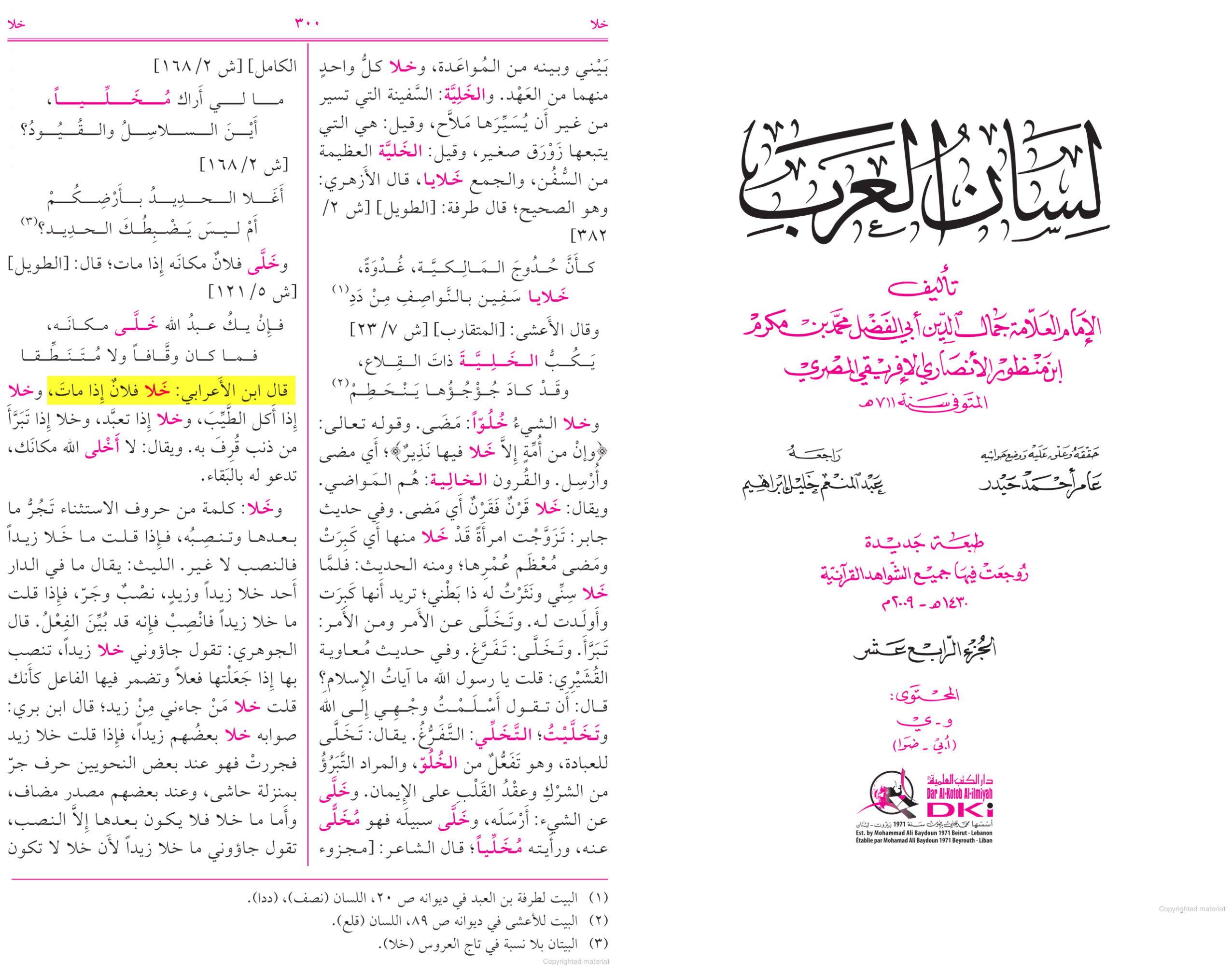
1. Lisān al-ʿArab (Ibn Manzūr, d. 711 AH)
Lisān al-ʿArab is widely recognized as the most comprehensive and authoritative lexicon of the Arabic language. In volume 14, under the root Kh-L-W, Ibn Manzur documents:
قَالَ ابْنُ الْأَعْرَابِيِّ: خَلَا فُلَانٌ إِذَا مَاتَ
“Ibn al-A’rabi stated: ‘So-and-so Khalā [خلا] when he died [مات].'”
[Lisān al-ʿArab, vol. 14, p. 240]
Ibn Manzur provides no secondary meaning implying physical bodily ascent into the sky. When Khalā is said of an individual human being, it means they have died.
2. Tāj al-ʿArūs (Al-Murtaḍā al-Zabīdī, d. 1205 AH)
In the monumental dictionary Tāj al-ʿArūs min Jawāhir al-Qāmūs, Allamah Murtada al-Zabidi confirms the established linguistic definition:
خَلَا فُلَانٌ: مَاتَ، عَنِ ابْنِ الْأَعْرَابِيِّ، وَخَلَتِ الْقُرُونُ: مَضَتْ
“Khalā so-and-so means: he died, as transmitted from Ibn al-A’rabi. And Khalat al-Qurūn means: the generations passed away.”
[Tāj al-ʿArūs, Root خ-ل-و]
![[Tāj al-ʿArūs, Root خ-ل-و]](https://whiteminaret.org/wp-content/uploads/2024/03/KhalaLexicons-Taajul-uroos.jpeg)
Al-Zabidi records that when applied to an individual person, Khalā means māta (he died); when applied to past generations or nations (al-qurūn), it means maḍat (they passed away through death).
3. Tahdhīb al-Lughah (Abū Manṣūr al-Azharī, d. 370 AH)
One of the earliest and most rigorous lexicographical authorities in Islamic history, Imam Abu Mansur al-Azhari, writes in Tahdhīb al-Lughah:
خَلَا فُلَانٌ، أَيْ: مَاتَ
“Khalā so-and-so, that is: he died.”
[Tahdhīb al-Lughah, Root خ-ل-و]
![[Tahdhīb al-Lughah, Root خ-ل-و]](https://whiteminaret.org/wp-content/uploads/2024/06/khalat-lexicons-tahdhiballugha.png)
This concise, uncompromising definition shows that from the earliest periods of Arabic scholarship, the verb carried the precise meaning of mortality.
4. Al-Muʿjam al-Wasīṭ (Academy of the Arabic Language, Cairo)
The standard contemporary academic lexicon compiled by leading Arab linguists at the Cairo Arabic Language Academy records:
خَلَا فُلَانٌ: مَاتَ
“Khalā so-and-so: he died.”
[Al-Muʿjam al-Wasīṭ, p. 248]
![[Al-Muʿjam al-Wasīṭ, p. 248]](https://whiteminaret.org/wp-content/uploads/2024/06/khalat-lexicons-muajamalwasit.png)
Modern Arabic lexicography completely preserves the classical consensus: when used for human beings, Khalā denotes death.
5. Asās al-Balāghah (Al-Zamakhsharī, d. 538 AH)
In his celebrated dictionary of Arabic rhetoric and figurative expression, Imam Jar Allah al-Zamakhshari records:
وَمِنَ الْمَجَازِ: خَلَا فُلَانٌ، إِذَا مَاتَ وَمَضَى
“And among its eloquent usages: Khalā so-and-so, when he died and passed away.”
[Asās al-Balāghah, p. 115]
![[Asās al-Balāghah, p. 115]](https://whiteminaret.org/wp-content/uploads/2024/03/KhalaLexicons-Asas-al-Balagha.jpeg)
6. Aqrāb al-Mawārid (Saʿīd al-Khūrī al-Shartūnī)
In the esteemed lexicon Aqrāb al-Mawārid fī Fuṣaḥ al-ʿArabiyyah, the definition is restated explicitly:
خَلَا فُلَانٌ: مَاتَ وَمَضَى دَهْرُهُ
“Khalā so-and-so: he died and his lifespan came to an end.”
[Aqrāb al-Mawārid, vol. 1, p. 297]
![[Aqrāb al-Mawārid, vol. 1, p. 297]](https://whiteminaret.org/wp-content/uploads/2024/03/KhalaLexicons-Aqrab-al-Mawarid.jpeg)
7. Lane’s Arabic-English Lexicon (Edward William Lane)
In the monumental Western reference work based on the greatest classical Arabic dictionaries (Lisān al-ʿArab, Tāj al-ʿArūs, and Al-Qāmūs al-Muḥīṭ), Edward William Lane writes:
“خَلَا فُلَانٌ: He died. … And خَلَتِ القُرُونُ: The generations passed away; came to an end; died.“
[Lane’s Arabic-English Lexicon, Book 1, p. 784]
![[Lane’s Arabic-English Lexicon, Book 1, p. 784]](https://whiteminaret.org/wp-content/uploads/2024/03/khalalexicons-steinglass.png)
Lane demonstrates that both classical Arab philologists and modern Orientalists reached the identical linguistic verdict: the verb describes the passing of life.
8. Pre-Islamic Arabic Poetry: The Linguistic Benchmark
Classical Arabic poetry is the ultimate linguistic arbiter (ḥujjah) for Quranic vocabulary. The famous pre-Islamic Jewish-Arab chieftain and poet As-Samaw’al ibn ‘Adiya composed:
إِذَا سَيِّدٌ مِنَّا خَلَا قَامَ سَيِّدٌ * قَؤُولٌ لِمَا قَالَ الْكِرَامُ فَعُولُ
“When a noble chieftain among us passes away [خلا – dies], another chieftain rises in his place, who speaks eloquent words and matches them with noble deeds.”
[Qisas al-Arab, vol. 4, p. 103]
![[Qisas al-Arab, vol. 4, p. 103]](https://whiteminaret.org/wp-content/uploads/2024/06/khalat-preislamicpoetry-qisasalarab-scaled.jpg)
This verse was recited across the Arabian Peninsula before the advent of Islam. Every native speaker recognized that Khalā meant the death of the chieftain and the accession of the next leader.
Comparative Lexical Summary
| Lexicon | Compiler / Era | Explicit Definition of Khalā (خلا) |
|---|---|---|
| Lisān al-ʿArab | Ibn Manzūr (d. 711 AH) | Māta (He died) |
| Tāj al-ʿArūs | Al-Murtaḍā al-Zabīdī (d. 1205 AH) | Māta (He died) / Maḍat (Passed away) |
| Tahdhīb al-Lughah | Abū Manṣūr al-Azharī (d. 370 AH) | Māta (He died) |
| Al-Muʿjam al-Wasīṭ | Arabic Language Academy, Cairo | Māta (He died) |
| Asās al-Balāghah | Al-Zamakhsharī (d. 538 AH) | Māta wa Maḍā (Died and passed away) |
| Aqrāb al-Mawārid | Al-Shartūnī | Māta wa Maḍā Dahruhu (Died and life ended) |
| Lane’s Lexicon | Edward William Lane | He died / The generations passed away |
| Pre-Islamic Poetry | As-Samaw’al ibn ‘Adiya | Chieftain died, successor took his place |
Frequently Asked Questions
What does Khala (خلا) mean in Arabic lexicons?
Classical Arabic dictionaries unanimously define Khala (خلا), when applied to a human being, as māta (he died) or maḍā dahruhu (his lifespan ended). Authorities such as Lisan al-Arab, Taj al-Urus, and Tahdhib al-Lughah confirm this exact meaning.
Does any Arabic dictionary state that Khala means bodily ascension?
No. There is zero Arabic dictionary in existence—classical or modern—stating that the verb Khala means being physically lifted alive into heaven.
How does Quran 3:144 align with Arabic lexicons?
Quran 3:144 states: “Verily, all Messengers have passed away [قَدْ خَلَتْ] before him.” Allah immediately defines this departure as natural death (māta) or martyrdom (qutila), precisely matching the definition documented across all classical Arabic dictionaries.