
What Does Khala (خلا) & Khalat (خلت) Mean in Islam? The Complete Theological Guide
Introduction
Khalā (خلا) means to pass away. In the context of a human passing away, it only means the following:
- Passing away from this worldly life (i.e death or martyrdom)
- Passing away from a specific location, IF that location is mentioned
It is never used to describe flying physically towards heaven. In this guide, we establish this fact from the Holy Quran, authentic Hadith, Arabic lexicons, and the unanimous consensus (Ijmāʿ) of the Sahaba.
Whoever claims that Khalā (خلا) or Khalat (خلت) means that a living human being was taken physically alive into heaven carries the entire burden of proof. There is zero Quranic verse, zero authentic Hadith, and zero classical Arabic dictionary in all of Islamic history that supports such an assertion.
📚 Khala & Khalat Series: All Messengers Have Passed Away
- Master Guide: What Does Khala (خلا) & Khalat (خلت) Mean in Islam? (Current Article)
- Classical Lexicons: Khala (خلا) & Khalat (خلت) in Arabic Lexicons & Dictionaries
- Quranic Analysis: Khalat (خَلَتْ) & Khala (خلا) in the Quran — 15+ Verses Explained
- Flagship Proof: Quran 3:144: All Messengers Have Passed Away & The First Ijma of the Sahaba
1. Pre-Islamic Arabic Poetry
Long before the revelation of the Holy Quran, the native Arabs used the verb Khalā (خلا) in their classical poetry to denote the passing away and death of human leaders.
The renowned pre-Islamic poet As-Samaw’al ibn ‘Adiya wrote:
إِذَا سَيِّدٌ مِنَّا خَلَا قَامَ سَيِّدٌ
“When a noble leader among us passes away [خلا – dies], another leader stands in his place.”
[Qisas al-Arab, vol. 4, p. 103]
![[Qisas al-Arab, vol. 4, p. 103]](https://whiteminaret.org/wp-content/uploads/2024/06/khalat-preislamicpoetry-qisasalarab-scaled.jpg)
No Arab in the pre-Islamic or early Islamic era ever interpreted this line to mean that their deceased chieftain had flown bodily into the clouds. It meant that the leader had died and passed away, making way for his successor.
2. Arabic Lexicons and Dictionaries
The most authoritative classical Arabic dictionaries unanimously define the verb Khalā (خلا), when applied to human beings, as death.
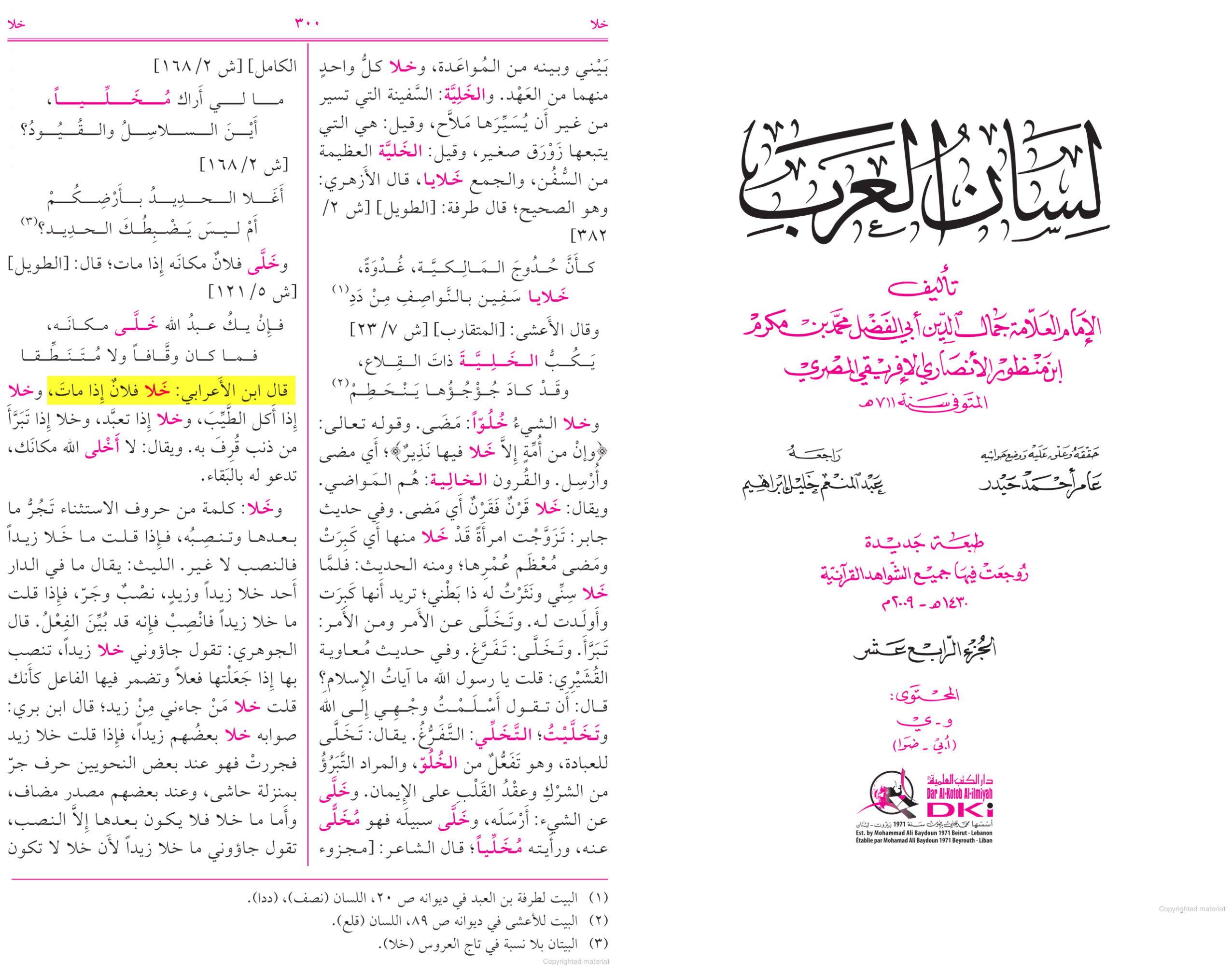
Lisān al-ʿArab (Ibn Manzūr)
The standard authority on Arabic lexicography documents:
قَالَ ابْنُ الْأَعْرَابِيِّ: خَلَا فُلَانٌ إِذَا مَاتَ
“Ibn al-A’rabi stated: ‘So-and-so Khalā [خلا] when he died [مات].'”
[Lisān al-ʿArab, Root خ-ل-و]
Tahdhīb al-Lughah (Al-Azharī) & Al-Muʿjam al-Wasīṭ
Imam Abu Mansur al-Azhari confirms this exact principle in Tahdhīb al-Lughah, as does the modern Academy of the Arabic Language in Al-Muʿjam al-Wasīṭ:
خَلَا فُلَانٌ: أَيْ مَاتَ
“Khalā so-and-so means: he died.”
[Tahdhīb al-Lughah] | [Al-Muʿjam al-Wasīṭ]
![[Tahdhīb al-Lughah]](https://whiteminaret.org/wp-content/uploads/2024/06/khalat-lexicons-tahdhiballugha.png)
![[Al-Muʿjam al-Wasīṭ]](https://whiteminaret.org/wp-content/uploads/2024/06/khalat-lexicons-muajamalwasit.png)
Classical lexicons including Tāj al-ʿArūs, Asās al-Balāghah, and Lane’s Arabic-English Lexicon all confirm that Khalā means to pass away or die. There is zero Arabic lexicon stating that Khalā means being lifted physically to the heavens while still living.
- For the complete dictionary entries and high-resolution manuscript scans, see: Khala (خلا) & Khalat (خلت) in Arabic Lexicons & Dictionaries.
3. Quranic Evidence: Quran 3:144 & Quran 5:75
The Holy Quran uses Khalat (خَلَتْ) with absolute theological clarity.
Quran 3:144 — All Messengers Have Passed Away
Following the false rumor of the Holy Prophet’s ﷺ martyrdom at the Battle of Uhud, Allah revealed:
وَمَا مُحَمَّدٌ إِلَّا رَسُولٌ قَدْ خَلَتْ مِنْ قَبْلِهِ الرُّسُلُ أَفَإِنْ مَاتَ أَوْ قُتِلَ انْقَلَبْتُمْ عَلَى أَعْقَابِكُمْ
“And Muhammad is only a Messenger. Verily, all Messengers have passed away [قَدْ خَلَتْ] before him. If then he die or be slain, will you turn back on your heels?”
[Quran 3:144]
Notice how Allah Himself immediately defines the scope of Khalat in the following sentence:
$$\text{قَدْ خَلَتْ} \implies \text{مَاتَ أَوْ قُتِلَ (Die a natural death OR be killed/martyred)}$$
Allah confines the departure of all previous messengers to two categories: 1. Natural death (māta – مَاتَ) 2. Martyrdom (qutila – قُتِلَ)
Allah does not say: “If he dies, or is killed, or is lifted physically to the sky.” To claim bodily ascension is a valid meaning of Khalat contradicts the Quran’s own internal definition.
Quran 5:75 — Isa (AS) and Maryam (AS)
In Surah Al-Ma’idah, Allah specifically applies this exact same phrase to Isa (AS):
مَا الْمَسِيحُ ابْنُ مَرْيَمَ إِلَّا رَسُولٌ قَدْ خَلَتْ مِنْ قَبْلِهِ الرُّسُلُ وَأُمُّهُ صِدِّيقَةٌ كَانَا يَأْكُلَانِ الطَّعَامَ
“The Messiah, son of Mary, was only a Messenger; surely, Messengers like unto him had indeed passed away [قَدْ خَلَتْ] before him. And his mother was a truthful woman. They both used to eat food.”
[Quran 5:75]
Allah presents two decisive proofs of Isa’s (AS) mortality: 1. All messengers before him had passed away (Khalat), establishing that Isa (AS) was bound by the identical prophetic law of human mortality. 2. Both Isa (AS) and Maryam (AS) used to eat food (kānā ya’kulānit-ta’ām). Since Maryam (AS) has died and no longer eats food, Isa (AS) likewise has died and no longer eats food.
- For the complete analysis of all 15+ occurrences in the Quran, read: Khalat (خَلَتْ) & Khala (خلا) in the Quran — 15+ Verses Explained.
4. Hadith Literature & The First Ijma of the Sahaba
The Companions of the Holy Prophet ﷺ understood Khalat in Quran 3:144 to mean the absolute death of every previous prophet without exception.
When the Prophet Muhammad ﷺ passed away, Hazrat Umar (RA) was overcome with profound grief. He drew his sword and declared that the Prophet ﷺ had not died, but had only gone to his Lord like Moses (AS) for forty days and would return.
Hazrat Abu Bakr (RA) addressed the grief-stricken Companions in the Prophet’s Mosque:
أَمَّا بَعْدُ، مَنْ كَانَ مِنْكُمْ يَعْبُدُ مُحَمَّدًا فَإِنَّ مُحَمَّدًا قَدْ مَاتَ، وَمَنْ كَانَ مِنْكُمْ يَعْبُدُ اللَّهَ فَإِنَّ اللَّهَ حَيٌّ لَا يَمُوتُ، قَالَ اللَّهُ: {وَمَا مُحَمَّدٌ إِلَّا رَسُولٌ قَدْ خَلَتْ مِنْ قَبْلِهِ الرُّسُلُ}
“To proceed: Whoever among you worshipped Muhammad, then Muhammad has indeed died. But whoever worshipped Allah, then Allah is Alive and shall never die. Allah has said: ‘And Muhammad is only a Messenger. Verily, all Messengers have passed away before him…’ [Quran 3:144]“
[Sahih al-Bukhari 4452, 4453]
Hazrat Ibn Abbas (RA) narrated:
“By Allah, it was as if the people never knew that Allah had revealed this verse until Abu Bakr recited it. Every single person received it from him, and I heard every human reciting it.”
Hazrat Umar (RA) declared:
“By Allah, the moment I heard Abu Bakr recite it, my legs gave way beneath me and I fell to the ground, knowing that the Prophet ﷺ had died.”
The Unbreakable Logic of the Sahaba’s Consensus (Ijmāʿ)
Had Hazrat Isa (AS)—or any other prophet—remained physically alive in the sky for over 600 years, Hazrat Umar (RA) or any Companion would have objected immediately:
“O Abu Bakr! You recite that all messengers have passed away, yet Isa (AS) has been sitting alive in the heavens with his physical body for centuries! If Isa can remain alive without dying, our beloved Master Muhammad ﷺ has far more right to remain alive!”
Yet zero Companions objected. The entire assembly of Sahaba in Madinah unanimously recognized that every single prophet before Muhammad ﷺ had tasted death. This stands as the first and most solemn Ijmāʿ (consensus) in the history of Islam.
5. The Definitive Argument of Mirza Ghulam Ahmad (AS)
Hazrat Mirza Ghulam Ahmad (AS), the Promised Messiah and Mahdi, articulated this decisive proof in Barāhīn-e-Aḥmadiyya:
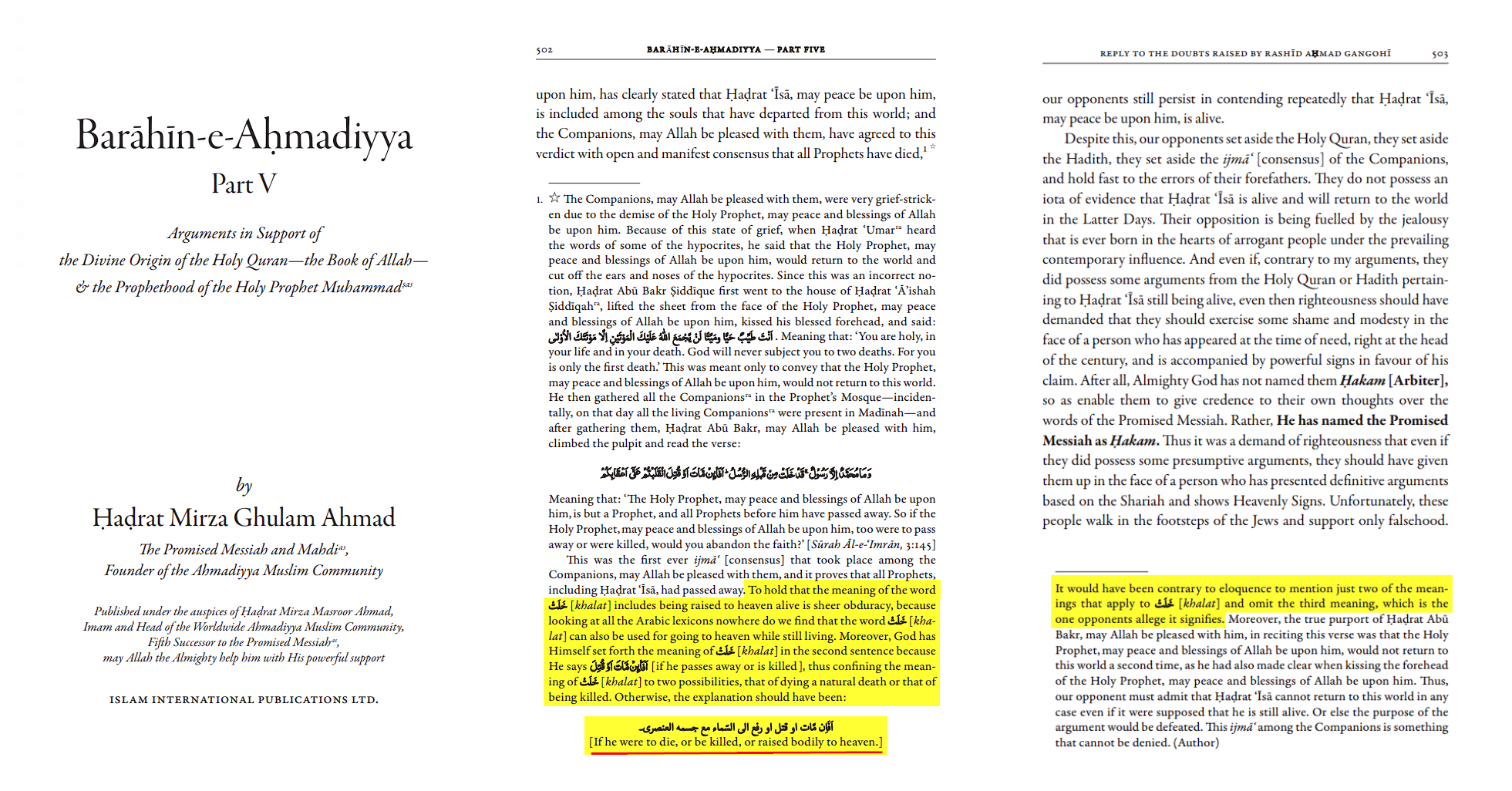
“This was the first ever Ijmāʿ [consensus] that took place among the Companions, may Allah be pleased with them, and it proves that all Prophets, including Hazrat ‘Isa (AS), had passed away.
To hold that the meaning of the word Khalat (خلت) includes being raised to heaven alive is sheer obduracy. Looking at all Arabic lexicons, nowhere do we find that the word Khalat can also be used for going to heaven while still living.
Moreover, God has Himself set forth the meaning of Khalat in the second sentence because He says: ‘If he passes away [māta] or is killed [qutila]’, thus confining the meaning of Khalat to two possibilities: dying a natural death or being killed. Otherwise, the verse would have read:
أَفَإِنْ مَاتَ أَوْ قُتِلَ أَوْ رُفِعَ إِلَى السَّمَاءِ مَعَ جِسْمِهِ الْعُنْصُرِيِّ
[If he were to die, or be killed, or raised bodily to heaven.]It would have been contrary to divine eloquence to mention just two meanings that apply to Khalat and omit the third meaning, which is the very one our opponents allege. This Ijmāʿ among the Companions is something that cannot be denied.”
[Barāhīn-e-Aḥmadiyya, vol. 5, p. 502, footnote]
6. Summary & Burden of Proof Checklist
| Foundational Rule | Evidence |
|---|---|
| Arabic Root Meaning | Khalā (خلا) means to pass away or die when applied to living beings. Zero lexicons allow bodily flight to heaven. |
| Pre-Islamic Poetry | Arabs used Khalā exclusively for death (Qisas al-Arab, vol. 4, p. 103). |
| Quran’s Internal Definition | Quran 3:144 explicitly confines Khalat to natural death (māta) or martyrdom (qutila). |
| Universal Prophetic Law | Quran 5:75 subjects Isa (AS) to the exact same law: all messengers before him died, and he ate food like his deceased mother Maryam (AS). |
| First Sahaba Consensus | Hazrat Abu Bakr (RA) recited Quran 3:144 to prove the Prophet’s ﷺ demise; all Sahaba accepted that every past prophet had died. |
| Opponent’s Burden | Zero Quran verses and zero Hadith state that Khalā means physical ascension to heaven. |
Frequently Asked Questions
What does Khala (خلا) mean in Arabic and Islam?
Khala is an Arabic verb that means to pass away or die. When used for humans or messengers in the Quran (such as Quran 3:144 and 5:75), it only means that they have all died and passed away. It never means remaining physically alive in the sky.
Does Khala (خلا) ever mean bodily ascension to heaven?
No. There is zero Arabic lexicon, zero Quranic verse, and zero Hadith in all of Islamic history where the verb Khala applied to a human means physical bodily flight into the heavens.
What is the meaning of Khalat (خلت) in Quran 3:144?
In Quran 3:144, Allah states: “Muhammad is only a Messenger. Verily, all Messengers have passed away before him [قَدْ خَلَتْ مِنْ قَبْلِهِ الرُّسُلُ].” Allah Himself defines Khalat in the very next clause as either natural death (māta) or martyrdom (qutila), proving that all prior prophets have tasted death.
How did the Sahaba understand Quran 3:144 at the death of Prophet Muhammad ﷺ?
When the Holy Prophet ﷺ passed away and Hazrat Umar (RA) believed he would return like Moses, Hazrat Abu Bakr (RA) recited Quran 3:144 to establish that every single messenger before Muhammad ﷺ had passed away. All Companions unanimously accepted this recitation, forming the first consensus (Ijmāʿ) of Islam that no prophet remained physically alive.