
True Jama’ah Is NOT the Majority: Example of Imam Ahmad Ibn Hanbal
Introduction
Imam Ahmad Ibn Hanbal (RH) (d. 241H) is one of the greatest scholars of Islamic history. He is the founder of the Hanbali school of thought and is widely known as 1 of the 4 most prominent Imams of Sunni Islam. More importantly though, Imam Ahmad (RH) is a shining example of steadfastness in faith during times of severe trials. He lived through the infamous Mihnat Khalaq al-Qur’an: a period when the ruling authorities (Abbasid Caliphate) tried to force the belief that the Qur’an was created, a clear deviation from the truth.
During this time, the majority of people, including judges, muftis, and even the caliph and his followers, sided with falsehood under pressure. Imam Ahmad (RH) stood alone, refusing to compromise on the truth, and his small group of followers remained steadfast with him.
This was the reality: Imam Ahmad Ibn Hanbal (RH) himself was the Jama’ah, together with his small band of loyal followers, while the so-called ‘majority’ had fallen into misguidance.
The Reality of Modern Sunni Islam
Sunni muslims today claim to be part of Ahlus Sunnah wal Jama’ah, often boasting of being a large, unified community. They proudly say that because they are the majority, they are upon the Haqq. However, these Non-Ahmadis choose to live in blissful ignorance as countless sects exist within Sunni Islam – all of whom constantly accuse one another of deviation and openly declare takfir.
Where is the unity in this? There is no single Imam guiding them with authority, no central leadership, and no consensus even on core issues of faith. The Qur’an itself makes clear that the majority is not a measure of truth [Quran 6:117], and Prophet (ﷺ) prophesied that in the latter days the majority would be misguided, not guided. So how can mere numbers be used as proof of being the Jama’ah? How can this be called Jama’ah?
Scholars Affirm: Imam Ahmad Ibn Hanbal Alone Was the Jama’ah
Both Imam Ad-Dhahabi (RH) and Ibn al-Qayyim (RH) explicitly affirm in the following statements that Imam Ahmad Ibn Hanbal (RH) and his small band of followers were the true Jama’ah. These statements by two of the most renowned scholars in Islamic history make it clear: the Jama’ah is not determined by the majority. Being part of the true Jama’ah does not mean being part of the largest group; it means following the truth, even if only a few remain steadfast.
Imam Ad-Dhahabi (RH) (d. 748H)
“All the people deviated during the time (Mihnat Khalaq al Qur’ãn) of Imam Ahmad Ibn Hanbal except for a small group, they were the Jammah, at that time the Judges, Muftis, the Caliph and his followers were all deviant and Imãm Ahmad alone was the Jamã’ah.”
![[إعلام الموقعين عن رب العالمين, p. 389]](https://whiteminaret.org/wp-content/uploads/2022/10/KhilafateMasih-AhmadHanbal-ImamDhahabi.png)
Ibn Al-Qayyim (RH) (d. 751H)
“All the people went astray during the time of Aḥmad b. Ḥanbal, except for a few individuals; thus, they were the Jamāʿah (the main body of the Muslims), while the judges, the Muftīs, the Khalīfah, and his followers were the ones who deviated and Imām Aḥmad alone was the Jamāʿah.”
![[ 4/399 معلومات للذين يكتبون نيابة عن رب العالمين]](https://whiteminaret.org/wp-content/uploads/2022/10/KhilafateMasih-AhmadibnHanbal-IbnAlQayyim.png)
True Jama’ah as Explained by the Sahaba
Abdullah Ibn Mas’ūd رضي الله عنهما (d. 32 AH), one of the closest and most knowledgeable companions of the Holy Prophet ﷺ, repeatedly emphasized in various accounts that true Jama’ah is not determined by the majority:
Abdullah Ibn Mas’ūd رضي الله عنهما said:
“The Jamā’ah is (whatever agrees with) the Book and the Sunnah, even if you are alone.”
In another narration:
“The Jamā’ah is the people of the truth, even if you are alone.”
[al-Faqīh wa’l-Mutafaqqih, Dār Ibn al-Jawzī edition, p. 303]
![[al-Faqīh wa’l-Mutafaqqih, Dār Ibn al-Jawzī edition, p. 303]](https://whiteminaret.org/wp-content/uploads/2025/08/TrueJamah-al-Faqih-wal-Mutafaqqih-IbnMasud.png)
ʿAbdullāh ibn Masʿūd said,
“The Jamāʿah is whoever obeys Allāh, even if they are a single person.”
![[Aitaqad Ahlus Sunnah Wal Jama’ah, p. 181]](https://whiteminaret.org/wp-content/uploads/2025/08/TrueJamaah-IbnMasud-Aitaqad-Ahlus-Sunnah-wal-Jamaah.png)
Ibn al-Qayyim reported: Abdullah Ibn Mas’ud, may Allah be pleased with him, said,
“The united community is that which adheres to the truth, even if you are alone.”
Nuaym ibn Hammad said,
“If the community becomes corrupted, you must adhere to its practice before it became corrupt. Even if you are alone, you by yourself would be the united community.”
‘Amr ibn Maymun reported: Abdullah ibn Mas’ud, may Allah be pleased with him, said,
“Verily, the majority of groups have left the united community. The united community is only the one that conforms to the obedience of Allah, even if you are by yourself.”
True Jama’ah in the Words of the Scholars
Ibn Al-Qayyim (RH) (d. 751H)
Ibn al-Qayyim (RH) is again on record saying that you can be upon the truth even if the entire ummah is against you or opposes you, therefore, you should not be fooled by the majority:
“Do not be deceived by the large number of this kind of people, for thousands upon thousands of them are not equal to one person of knowledge. And a single scholar is equal to the whole earth full of them. Know that consensus, proof, and the true majority is the scholar who possesses the truth—even if he is alone, even if the people of the whole world oppose him. […] Then I accompanied after him the most knowledgeable of people, ʿAbdullāh ibn Masʿūd, and I heard him say: “Hold fast to the community (al-jamāʿah), for indeed the Hand of Allah is with the community.” […] He said: “O ʿAmr ibn Maymūn, I used to think you were among the most knowledgeable people of this village. Do you know what the community (al-jamāʿah) is?” I said: “No.” He said: “The majority of people have in fact separated from the community. The community is whatever agrees with the truth—even if you are alone.” In another wording: He struck my thigh and said: “Woe to you! The majority of people have separated from the community, and the community is that which accords with obedience to Allah, the Mighty and Majestic.” And Nuʿaym ibn Ḥammād said: “If the community becomes corrupt, then hold to what the community was upon before they became corrupt—even if you are alone, for you are then the community.” Both al-Bayhaqī and others narrated this.“
![[ p.396-398, معلومات للذين يكتبون نيابة عن رب العالمين]](https://whiteminaret.org/wp-content/uploads/2025/08/TrueJamaah-IlamAlMuwaqeen-IbnQayyim.png)
Muhammad Ibn Abd Al-Wahhab (RH) (d. 1206H)
Muhammad Ibn Abd al-Wahhab (RH) also stated will return to being “strange,” upheld only by a few. He particularly warned against relying on the large number of people or their consensus as a proof of truth, noting that such reasoning was used by the disbelievers of the past to reject the messengers:
[…] the Messenger of Allah ﷺ and his Companions described it before it occurred, warned people against it, and informed that none would adhere to the religion except one after another, and that Islam would become strange as it began. You have known that when ‘Amr ibn ‘Abasah asked the Messenger of Allah ﷺ in the early days of Islam: “Who is with you in this?” He said: “A free man and a slave,” meaning Abu Bakr and Bilal. So if Islam returns as it began, how ignorant is one who argues based on the multitude of people and their consensus, and similar arguments, when faced with doubts that are great in the eyes of their adherents but insignificant before Allah and those of knowledge among His creation, as Allah says: “Rather, they say like what the former peoples said” [Al-Mu’minun: 81]. I know of no argument you use except that Allah has mentioned in His Book that the disbelievers used it to deny the messengers, such as the consensus of people, obedience to the elite, and other such things.
![[Al-Durar Al-Saniyyah, vol 1, pg. 41]](https://whiteminaret.org/wp-content/uploads/2025/08/download-11-scaled.png)
Sunni Claims of Majority ≠ True Jama’ah
The above statements of scholars and Sahaba completely dismantles the claim made by many Sunnis today that “we are the majority, therefore we are the Jama’ah.” If size and numbers truly defined truth, then the corrupt Khilāfah of Imam Ahmad’s (RH) time, backed by scholars, judges, and the masses of the time, would have been the true Jama’ah. Yet history tells us the exact opposite: a single Imam and a handful of followers held the truth, while the majority was astray. Unfortunately, this is the sad reality – most reject the Imam of the age, only to recognize him when it is too late.
True Ahlus Sunnah Wal Jama’ah: The Ahmadiyya Muslim Community
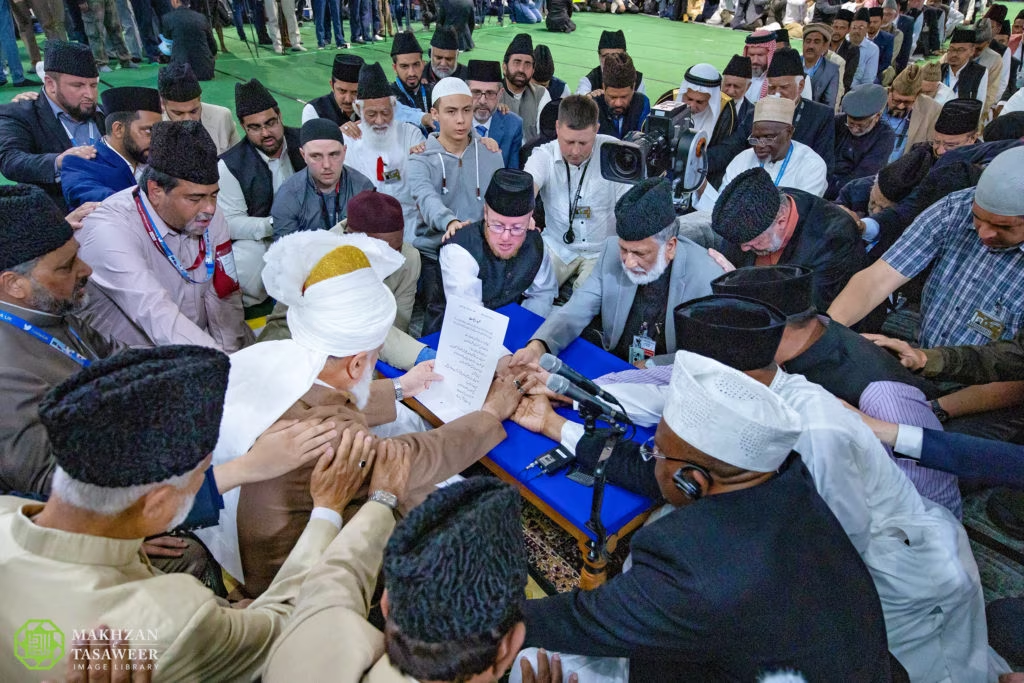
The example of Imam Ahmad Ibn Hanbal (RH) shows that true Jama’ah can be small, rejected by most, and steadfastly loyal to the truth. This is exactly the reality of the Ahmadiyya Muslim Community today, founded by the Promised Messiah and Imam Mahdi, Mirza Ghulam Ahmad (AS) in 1889.
A single Imam, Mirza Masroor Ahmad (ABA) – 5th successor of Messiah and Mahdi, leads the Jama’ah today. Followers remain loyal to him, despite widespread opposition around the world. Ahmadis around the world adhere to the Qur’an and Sunnah, just as Imam Ahmad (RH) and his small group exemplified centuries ago during the time of a monarchial caliphate.
Hazrat Khalīfatul Masīh I, Maulānā Ḥakīm Maulwi Nūrudīn (RA ) states:
“In this age, there is no Ahlus-Sunnah wa’l-Jama’ah on the face of the earth except [for] the Aḥmadīyyah. The Jama’ah will only be the one with an Imām. If we were to line up our opponent Muslims in one row, would they be able to have one Imām? Absolutely Not! [However], yes, it is the unique characteristic of the Aḥmadīyyah Jama’ah that it has an Imām. Thus, at this time, except for Ahmadis no one [else] is from Ahlus-Sunnah wa’l-Jama’ah.“
![[Al Hakam, Feb 21, 1910, pg. 3]](https://whiteminaret.org/wp-content/uploads/2022/10/KhilafateMasih-AlHakam-Nooruddin.png)
In a forthcoming article, we will take a deeper look at how renowned scholars have defined Ahl al-Sunnah wa’l-Jamā‘ah — and demonstrate, with references from scholars and Jama‘at literature, how Jama‘at Al-Ahmadiyya uniquely fulfills this title.
Conclusion
- Imam Ahmad Ibn Hanbal (RH) and his small group of followers were the real Jama’ah, while the majority were in deviation.
- True Jama’ah is NOT determined by the majority. Sunni belief that majority equals Jama’ah has been refuted by both the Sahaba and Scholars.
- Sahaba and Scholars taught that true Jama’ah is defined by steadfastness to the truth, not numbers.
- The Ahmadiyya Muslim Community exemplifies the real Jama’ah today: faithfulness, loyalty, and guidance from a true Imam are what define Jama’ah, not size, popularity, or majority opinion.