Who is Required to Fast in Fiqh ul Ahmadiyya?
Introduction
Fasting is one of the obligatory deeds of worship in Islam, it is kept from Fajr till Maghrib. Yet there are some people who are exempt from fasting, either temporarily or permanently.
Allah(ﷻ) states in the Qur’an:
The prescribed fasting is for a fixed number of days, but whoso among you is sick or is on a journey shall fast the same number of other days; and for those who are able to fast only with great difficulty is an expiation — the feeding of a poor man. And whoso performs a good work with willing obedience, it is better for him. And fasting is good for you, if you only knew.
Hazrat Muleh Mau’ood(ra) mentions upon whom fasting is obligatory during Ramadan and states:
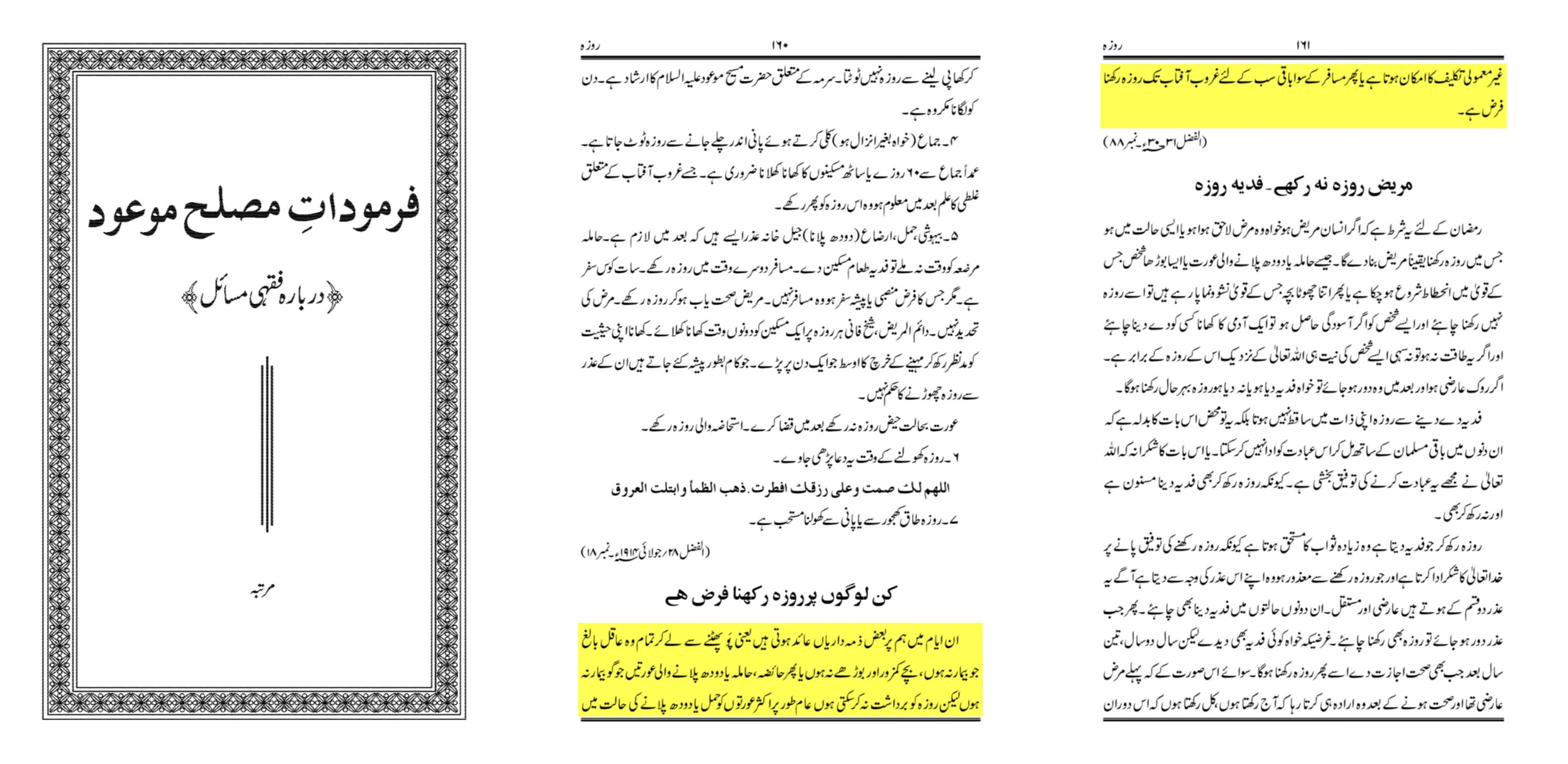
In these days, certain responsibilities are incumbent upon us; from the break of dawn, it is obligatory for all those who are sane and adult, who are not sick, and are not children, weak, or elderly, women who are menstruating or those who are pregnant or breastfeeding—provided they are not sick but usually for most women in a state of pregnancy or breastfeeding, there is a possibility of extraordinary hardship—aside from these and the traveler, fasting until sunset is obligatory for everyone else.
At what age does fasting become an obligation ?
Musleh Mau’ood(ra) while discussing at what age should fasting start states:
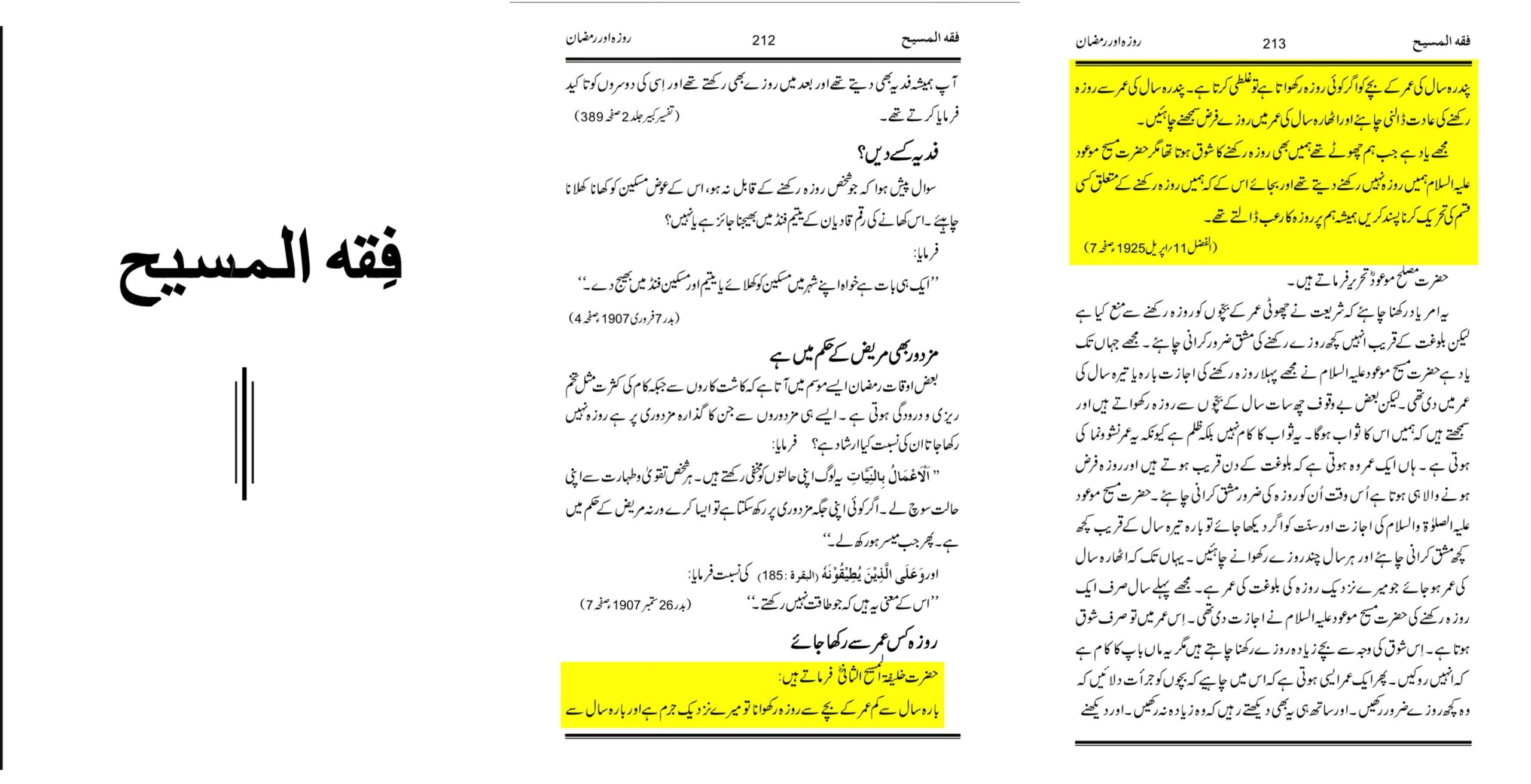
In my view, making a child younger than twelve years fast is a crime. And from twelve to fifteen years of age, if someone makes a child fast, they are making a mistake. From the age of fifteen, one should develop the habit of fasting, and by the age of eighteen, fasts should be considered obligatory (Farz).
I remember when we were young, we also had a keen desire to fast, but Hazrat Promised Messiah (as) would not allow us to fast. Instead of encouraging us in any way to fast, he would always instill in us a sense of the awe and gravity of fasting.
Fasting age depends on physical strength
Musleh Mau’ood(ra) on one occasion also stated:
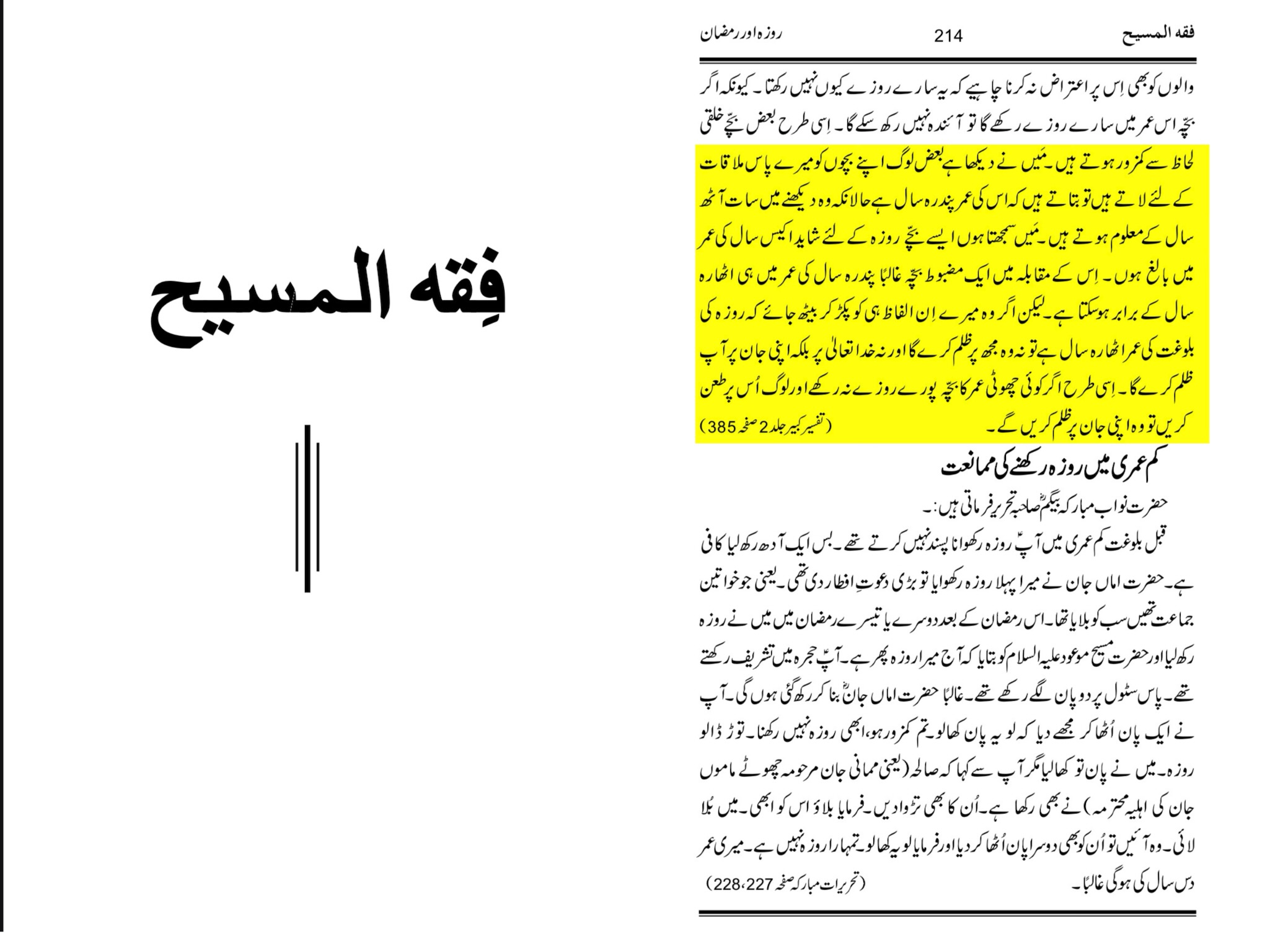
Some children are naturally weak in terms of their physical build. I have seen some people bring their children to meet me and state that the child is fifteen years old, even though they appear to be seven or eight years old. I believe that for such a child, the age of maturity for fasting might be twenty-one years. In contrast, a strong child may perhaps be equal to an eighteen-year-old at the age of fifteen. However, if someone strictly holds onto my words that the age of maturity for fasting is eighteen years, they will be committing an injustice not against me, nor against God, but against their own soul.
Ruling on fasting while on travel
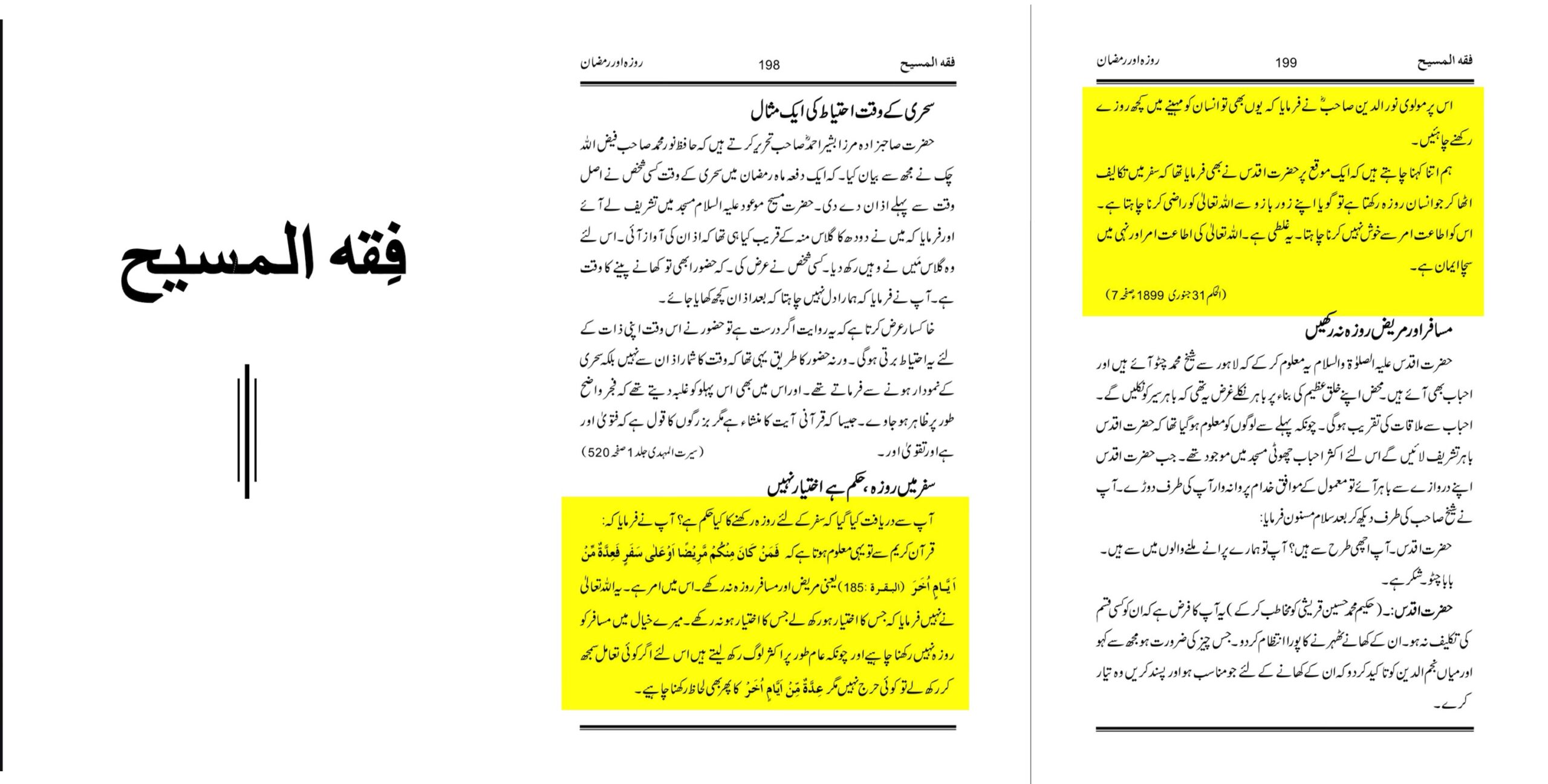
Hazrat Masih Mau’ood(as) once stated concerning fasting while on travel:
It was inquired of him: “What is the commandment regarding keeping a fast during travel?” He replied: “From the Holy Quran, it is understood that: ‘…but if any of you is ill, or on a journey, the prescribed number (should be made up) from days later.’ (Al-Baqarah: 185) This means that the sick and the traveler should not fast. This is a command. Allah the Almighty did not say that it is a matter of choice—that whoever wishes may keep it and whoever wishes may not. In my view, a traveler should not fast.
Since people generally do keep the fast [while traveling], if someone does so considering it a common practice, there is no harm; however, the instruction of ‘a number of other days’ must still be observed.
Who is considered a traveler?
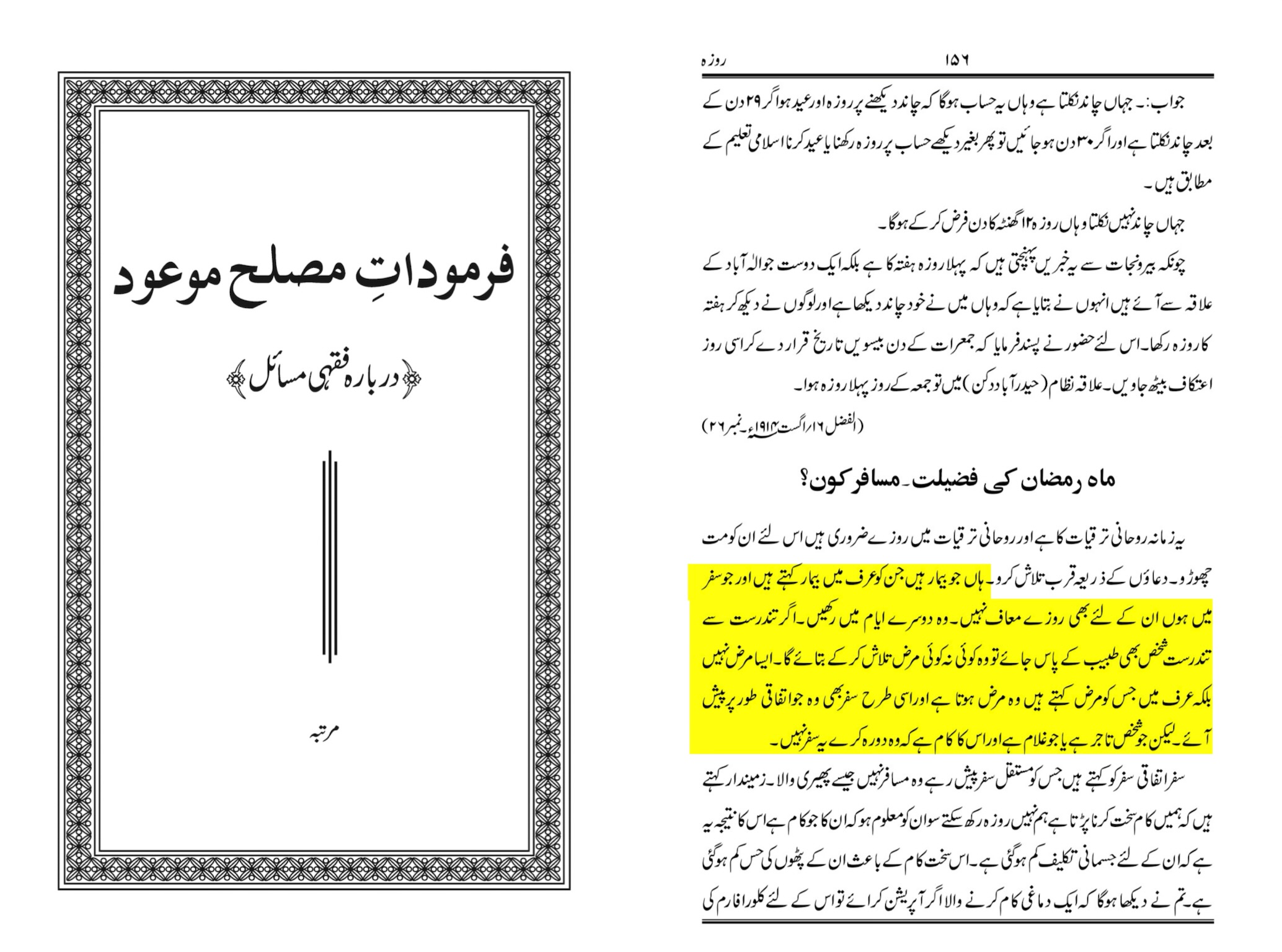
Musleh Mau’ood(ra) stated concerning what is considered a ‘travel’ that is exempt from fasting:
Similarly, a journey is one that occurs occasionally/incidentally. However, a person who is a merchant or a subordinate whose job requires him to be on tour—this does not constitute ‘travel’.
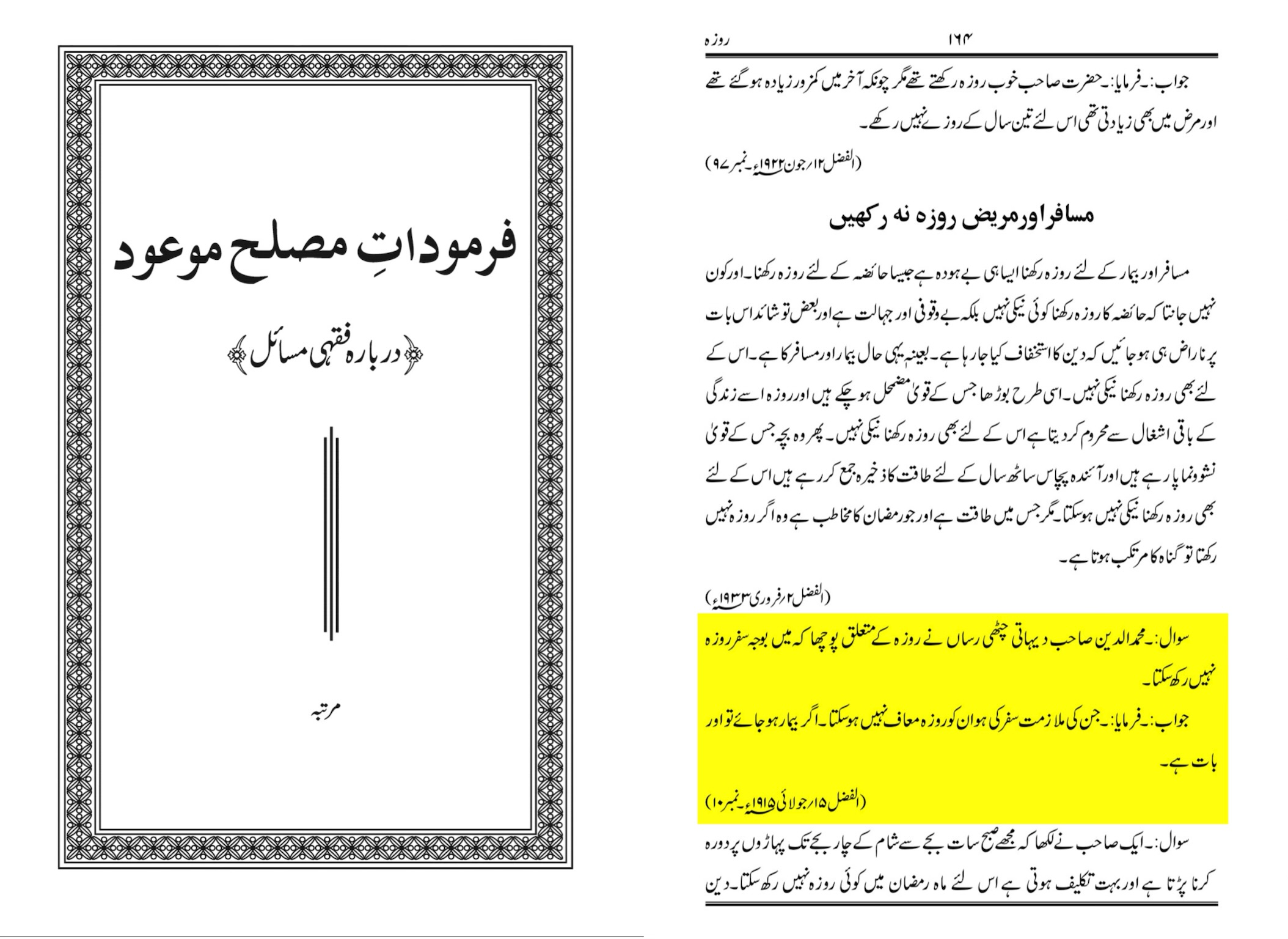
Similarly when a person asked whether he was exempt from fasting as his job requires him to travel often he stated:
Question: Mr. Muhammad Din, a rural postman, asked regarding fasting: “I am unable to fast due to the nature of my travels [for work].” Answer: “Those whose employment involves constant travel cannot be exempted from fasting. If one falls ill, that is a different matter.”
Fasting during illness?
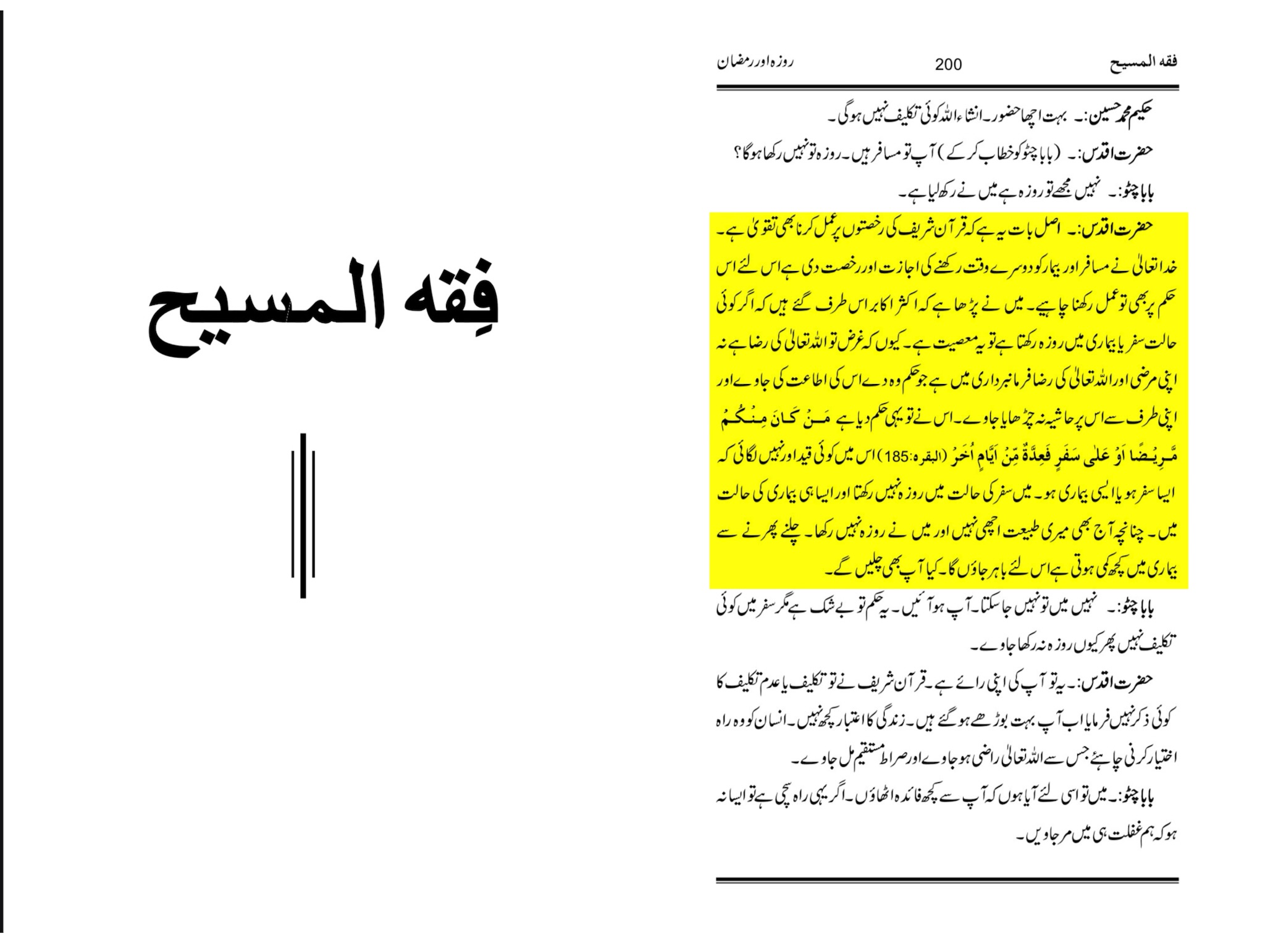
Hazrat Masih Mau’ood(as) stated:
The reality is that acting upon the concessions granted by the Holy Quran is also a form of righteousness (taqwa). Allah the Exalted has granted permission and a concession to the traveler and the sick to fast at another time; therefore, this command should also be acted upon. I have read that many of the great elders (akabir) held the view that if someone fasts while traveling or during illness, it is a sin. This is because the objective is to seek the pleasure of Allah, not one’s own will. Allah’s pleasure lies in obedience—that whatever command He gives should be followed, and one should not add their own ‘commentary’ to it. He has given this very command:
‘But whoso among you is sick or on a journey, shall fast the same number of other days’ (Al-Baqarah: 185).
In this, no further restriction has been placed as to what kind of journey or what kind of illness it must be. I do not fast while traveling, nor do I fast while ill.
What kind of illnesses make one exempt from fasting?
With regards to fasting while being sick, Musleh Mau’ood(ra) stated that not all kinds of illnesses make you exempt from fasting:
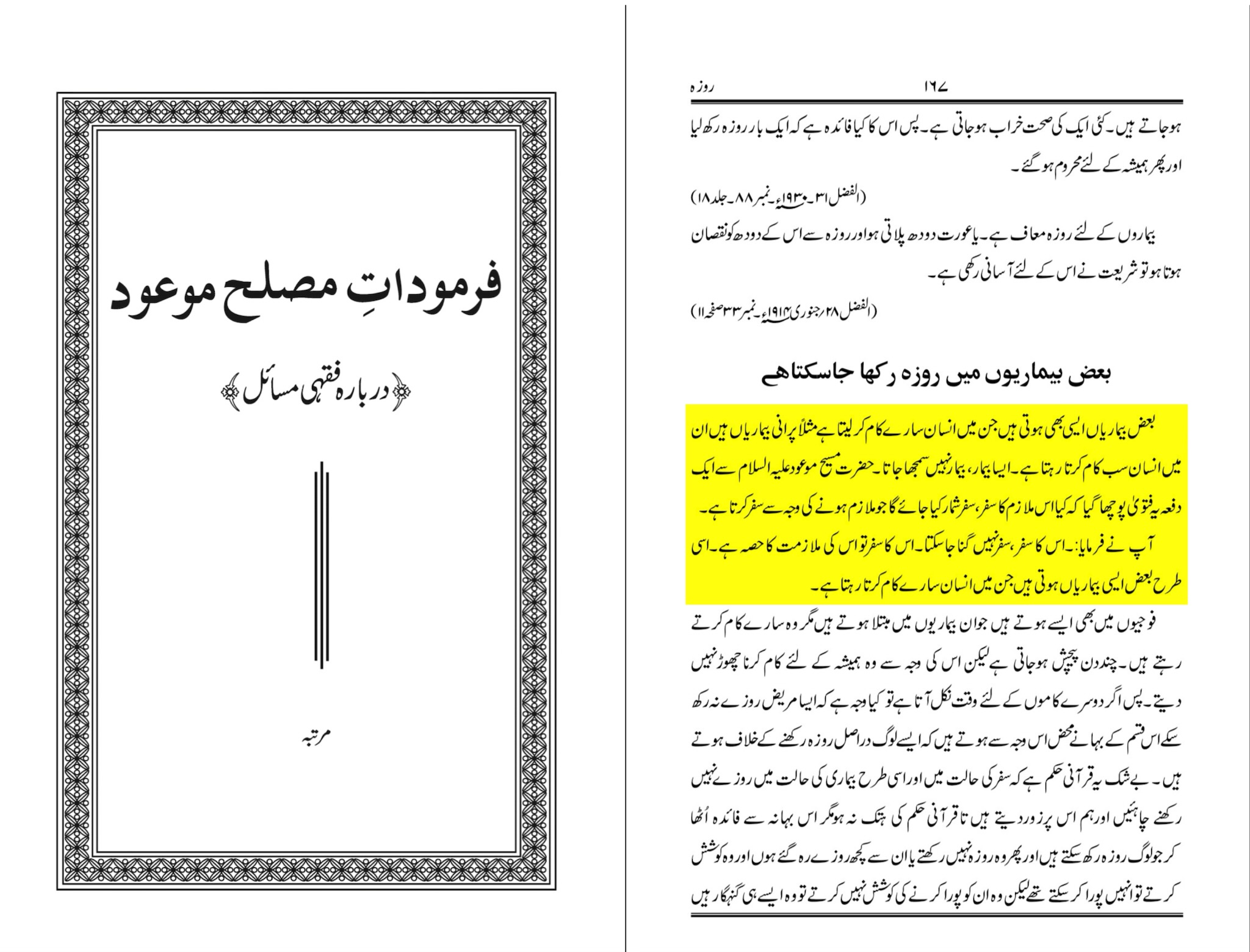
There are some illnesses in which a person can still carry out all their work; for example, there are chronic diseases where a person remains fully functional. Such a person is not considered “sick”. Once, a religious decree (fatwa) was sought from the Promised Messiah (peace be upon him) regarding whether the travel of an employee, who must travel due to his job, would be counted as “travel” (for the purpose of religious exemption). He replied: “His travel cannot be counted as travel; his journey is a part of his employment”. Similarly, there are certain illnesses in which a person continues to perform all their tasks.
He also stated on the other hand that certain mild illnesses can make one exempt from fasting and that if fasting worsens ones condition then he shouldn’t fast:
In my view, no matter how mild a cold may be, it is an illness that relates to fasting. For those who have a cold, fasting is very harmful and can cause significant damage.
As a result of a cold, a person feels more thirsty. If a person suppresses that thirst while fasting, the thirst will increase further, which is very detrimental to the cold. Therefore, some illnesses may appear ordinary, but their relationship with fasting can cause great harm. One should not fast during such an illness.