
Origins of Shirk in the Muslim Ummah – Detailed Ahmadi Analysis of Istigatha
Introduction
In our ongoing exploration of Islamic theology, our previous article established that Asharis and Maturidis have long represented the majority within the Ummah, overshadowing Salafi perspectives. This historical dominance raises a profound question: if Istigatha, seeking intercession from saints is deemed shirk (polytheism), why did it persist as a widespread practice for centuries? Drawing from Quranic warnings, prophetic traditions, and historical insights, this article examines how shirk subtly emerges through the reverence of holy figures, mirroring the deviations of Jews, Christians, and even pre-Islamic societies. We delve into the mechanisms of such innovations (biddah), the role of Mujaddids in reviving pure monotheism, and the irony of Muslims reciting verses of exclusive worship to Allah while turning to saints. Ultimately, we critique modern groups like Barelwis, Quburi Sufis, and even some Salafis for veering into associative beliefs, emphasizing the Quran’s unequivocal call to direct supplication to Allah alone.
How Does Shirk start among people? Reverence of Holy People
All the idols which were worshiped by the people of Noah were worshiped by the Arabs later on. As for the idol Wadd, it was worshiped by the tribe of Kalb at Daumat-al-Jandal; Suwa` was the idol of (the tribe of) Hudhail; Yaghouth was worshiped by (the tribe of) Murad and then by Bani Ghutaif at Al-Jurf near Saba; Ya`uq was the idol of Hamdan, and Nasr was the idol of Himyar, the branch of Dhi-al-Kala`. The names (of the idols) formerly belonged to some pious men of the people of Noah, and when they died Satan inspired their people to (prepare and place idols at the places where they used to sit, and to call those idols by their names. The people did so, but the idols were not worshiped till those people (who initiated them) had died and the origin of the idols had become obscure, whereupon people began worshiping them
In this Hadith, five holy people are mentioned, Wadd, Suwa, Yahouth, Ya;uq, and Nasr, who were holy persons among the Ummah of Nuh AS. These’s five people are actually mentioned in the Holy Qur’an as well.
{And they have said : You shall not forsake your gods, nor shall you forsake Wadd, nor Suwaa’, nor Yaghooth, nor Ya’ooq, nor Nasr.}
[Quran 71:23]
Today we can see the biggest shirk today is commited in the name of a prophet, Hadhrat Isa AS. As for Hinduism, it is speculated by Muslim Scholars that their gods might have been prophets who were idolized just like Jesus.
Muslims would become like Jews and Christians
And the Jews say, Ezra is the son of Allah, and the Christians say, the Messiah is the son of Allah; that is what they say with their mouths. They imitate the saying of those who disbelieved before them. Allah’s curse be on them! How are they turned away!
[Quran 9:30]
You would tread the same path as was trodden by those before you inch by inch and step by step so much so that if they had entered into the hole of the lizard, you would follow them in this also. We said: Allah’s Messenger, do you mean Jews and Christians (by your words)” those before you”? He said: Who else (than those two religious groups)?
The Barelwis and Other Quburi Sufis revere their saints so much that they believe that Allah has given certain divine qualities and powers such as being all-Hearing to them, in enssence creating Demi-gods. How is this not different from the Hindu Belief of splitting power between Gods. The Quraysh affirmed Allah but the issue is not that they denied Allah but rather they associated partners to him.
The Need for Mujaddideen contradicts seeking help from dead
If Islam is just about following the majority, why would Allah send Mujaddideen to revive the faith?
The Prophet (ﷺ) said: Allah will raise for this community at the end of every hundred years the one who will renovate its religion for it.
Regardless, following the Majority is not a Daleel, as the majority has been misguided in the past.
Promised Messiah AS states:
The Success of Followers Is Actually the Success of Their Master
All of these miracles and successes which took place after the demise of the Mes-senger of Allah, peace and blessings of Allah be upon him, through his follow-ers, and through Reformers, and which shall be attained until the Day of Resur-rection, are actually the success of the Messenger of Allah, peace and blessings of Allah be upon him. In short, the coming of a Reformer (Mujaddid) at the head of every century clearly demonstrates that seeking help from the dead is contrary to the will of God Almighty. If help was to be sought from the dead, what need would there have been for the advent of the living? What significance would there have been in the many thousands of saints that have been born? Why would the institution of Reformers have been instituted by God? If Islam was to be handed over to the dead, then know for certain that all traces of it would have vanished already. The religion of the Jews was entrusted to the dead. What was the result? Do tell me, what did the Christians gain by worshipping the dead? They went on worshipping the dead until they themselves became dead. Neither has the spirit of life remained in their religion, nor do the followers of their reli-gion possess any signs of life. From beginning to end, these people have become a horde of the dead.Malfuzat V. p.
Do scholars affirm Istigatha being allowed?
Barelawis claim that the common elders, saints and Sufis that are recognized by all branches and schools of ahl-us-Sunnah held the same doctrines of them, particularly concerning the issues of tawassul, istighathah, isti’anah and istimdad.
Muhammad Tahir al-Fattani al-Gujarati [d. 986 H]
Let us examine what the great Imam and Mujaddid, Muhammad Tahir al-Fattani al-Gujarati [d. 986 H] said about beseeching the Prophets and the pious for the fulfilment of needs:
كره مالك أن يقول زرنا قبره صلى الله عليه وسلم وعللوه بأن لفظ الزيارة صار مشتركا بين ما شرع وما لم يشرع فإن منهم من قصد بزيارة قبور الأنبياء والصلحاء أن يصلي عند قبورهم ويدعو عندها ويسألهم الحوائج وهذا لا يجوز عند أحد من علماء المسلمين فإن العبادة وطلب الحوائج والإستعانة حق لله وحده
“…among them is one who deliberately visits the graves of the Prophets and Pious to pray at their graves, to supplicate there and ask them for the fulfilment of needs, and this is not permissible according to any of the Ulama of the Muslims. It is only the right of Allah alone that worship, fulfilment of needs and aid be sought from.”
(Majma Bihar ul-Anwar; v.2, p.444)
Qadhi Thanaullah al-Panipati [d. 1225 H]
Likewise, Qadhi Thanaullah al-Panipati [d. 1225 H] says:
اور نہ خدا کے سوا کسی سے امداد چاہنا جائز ہے
“Neither is it allowed to seek aid [Imdad’ from anyone other than God”
فوت شدہ یا زندہ اولیا اور انبیا سے دعا مانگنا جائز نہیں
“Praying to deceased or living Saints and Prophets is not permissible”
(Irshad ut-Talibin; p.23)
He also stated:
انبیاء اور اولیاء کی قبروں کو سجدہ کرنا اور قبور کے ارد گرد طواف کرنا اور ان سے دعا مانگنا اور ان کے لۓ نذر قبول کرنا حرام ہے بلکہ یہ چیزیں کفر تک پہنچا دیتی ہیں
“Prostrating to the graves of the Prophets and Saints, circling graves, praying to them and accepting boons from them is forbidden, rather, these things lead to unbelief.”
(Mala Buddu Minhu; p.82)
Mahmud al-Alusi [d.1270 H]
Mahmud al-Alusi [d.1270 H], the well known mufassir, writes:
أن الناس قد أكثروا من دعاء غير الله تعالى من الأولياء الأحياء منهم والأموات وغيرهم، مثل يا سيدي فلان أغثني، وليس ذلك من التوسل المباح في شيء، واللائق بحال المؤمن عدم التفوه بذلك وأن لا يحوم حول حماه، وقد عدّه أناس من العلماء شركا
(Ruh al-Ma’ani; v.7, p.181)
‘Allāmah ‘Abd al-Ḥayy al-Laknawī (1848 – 1886)
‘Allāmah ‘Abd al-Ḥayy al-Laknawī (1848 – 1886), a renowned ‘ālim and muḥaddith of the 19th century whose works are accepted amongst Deobandīs and Barelwīs, Arabs and non-Arabs, clearly and strongly refuted some extreme Barelwī beliefs.
استفتاء: ما قولكم في رجل يظن أن الأولياء يعلمون ويسمعون نداء المنادي قريبا وبعيدا ويستمده بألفاظ يقولها الحاضر للحاضر، وينذر له بالأنعام يقول: نذرت له. بينوا توجروا
هو المصوب: هذا رجل فاسد العقيدة، بل يخشى عليه الكفر فإن سماع الأولياء النداء من بعيد ليس بثابت والعلم الكلي بجميع الجزئيات في جميع الأزمان مختص بالله جل جلاله، وقد قال فى الفتاوى البزازية: من قال إن أرواح المشايخ حاضرة تعلم يكفر، انتهى. وذكر فيه أىضا أن: من تزوج بشهادة الله ورسوله يكفر لأنه ظن أن الرسول يعلم الغيب، انتهى. والنذر لغير الله حرام، ويحرم المنذور لغير الله كما بسطه فى البحر الرائق والدر المختار وغيرهما، والله أعلم. حرره الراجي عفو ربه القوي أبو الحسنات محمد عبد الحي تجاوز الله عن ذنبه الجلي والخفي – مجموعة الفتاوى، ص٣٧٨-٣٧٩
“Question: What do you say about a man who assumes that the Awliyā’ know and hear the call of a caller from near and far, and seek his assistance using words that a person uses for someone in his presence, and makes vows of animals to him, declaring that he has made a vow to him. Explain, and be rewarded.
“Answer: [Allāh] grants rectitude. This is a man of corrupt belief. In fact, it is feared he has disbelieved because the Awliyā’ hearing the call from far is not proven, and complete knowledge of all particulars in all times is specific to Allāh (Glorious is His Grandeur). It states in al-Fatāwā al-Bazzāziyyah: ‘Whoever says the souls of Mashāyikh are present and knowing has committed disbelief.’ It also states in it: ‘Whoever marries taking as witness Allāh and His Messenger, he disbelieves because he assumes the Messenger knows the Ghayb.’ Taking a vow by other than Allāh is ḥarām, and whatever a vow was made upon is ḥarām, as explained in al-Baḥr al-Rā’iq, al-Durr al-Mukhtār and other books. This was written by one hopeful of the pardon of his Master, Abu l-Ḥasanāt Muḥammad ‘Abd al-Ḥayy, may Allāh pardon his manifest and hidden sins.”
(Majmū‘at al-Fatāwā, p. 378-9)
In another fatwa in Farsi, it states:
“Question: What do you say (may Allāh ۢMost High have mercy on you) regarding the issue that is prevalent in our lands amongst the common people that in times of calamity and dire need, they call out in asking for assistance from the prophets and saints from afar believing that they are ḥāḍir & nāẓir and that whenever they implore them they are aware, and in turn, supplicate for them in the fulfilment of these needs? Is this permissible or not? Explain, and be rewarded.
“Answer: He grants direction to what is correct: In reality, such belief in the prophets and saints being ḥāḍir and nāẓir, and at all times are aware of our calling out to them even from afar is shirk, since it entails belief in ‘ilm al-ghayb for other than Him Most High, and this belief is shirk. This is because this characteristic is from those exclusive to Allāh (Great is His Grandeur), which no other being can have partnership with Him in. It states in al-Fatāwā al-Bazzāziyyah: ‘One marries without witnesses, saying: I make Allāh, His Messenger and the Angels witness, he disbelieves, because he believes that the Messenger and Angel know the Ghayb.’ [1] Further, it states in Bazzāziyyah: ‘About this our scholars have said: Whoever says the souls of Mashāyikh are present and knowing have committed disbelief.’ And Allāh knows best. This was written by one hopeful of the pardon of his Powerful Master, Abu l-Ḥasanāt Muḥammad ‘Abd al-Ḥayy, may Allāh pardon his manifest and hidden sins.” (ibid. p. 344-5)
In al-Āthar al-Marfū‘ah, ‘Allāmah ‘Abd al-Ḥayy al-Laknawī states:
“From amongst these [fabrications] is what the sermonisers mention, that the Prophet (Allāh bless him and grant him peace) was given knowledge of the first and the last in full detail, and was granted knowledge of all that has transpired and all that will occur as a whole and in terms of its minutiae, and that there is no difference [in this respect] between his knowledge and the knowledge of his Creator in terms of encompassment and inclusiveness, and the only difference between them is that the knowledge of Allāh is pre-eternal and eternal by virtue of His own self without having been taught by another as distinguished from the knowledge of the Messenger as he acquired it by the teaching of his Maker. This is flowery speech and falsehood as stated by Ibn Ḥajar al-Makkī in al-Minaḥ al-Makkiyyah Sharḥ al-Qaṣīdah al-Hamziyyah and other spiritual masters. What is established from the verses of Qur’ān and the Prophetic ḥadīths is that [such] inclusiveness and encompassment and knowledge of all Ghayb is exclusive to the Revered Deity, and this characteristic has not been granted by the Revered Deity to any of creation. Yes, the knowledge of our Prophet (Allāh bless him and grant him peace) is more extensive and more numerous than the knowledge of all prophets and messengers; and the teaching of his Creator to him of unseen matters in relation to His teaching to others is more complete, thus he (Allāh bless him an grant him peace) is most complete in knowledge and practice and is the master of creatures in status and virtue.” (Al-Ᾱthār al-Marfū‘ah li l-Akhbār al-Mawḍū‘ah, p. 38)
Qur’an shouts worship Allah alone
Thee alone do we worship and Thee alone do we implore for help.
Muslims recite this every day, in every rakaat, after how can someone say I must pray to a Wali or a Saint?
Or, Who answers the distressed person when he calls upon Him, and removes the evil, and makes you successors in the earth? Is there a God besides Allah? Little is it that you reflect.
Qur’an 27:63 – Surah Naml
Here Allah is explicitly saying, who do you call out in distress and is there a God besides Allah
And when My servants ask thee about Me, say: ‘I am near. I answer the prayer of the supplicant when he prays to Me. So they should hearken to Me and believe in Me, that they may follow the right way.’
Qur’an 2:187
And your Lord says: ‘Pray unto Me; I will answer your prayer. But those who are too proud to worship Me will surely enter Hell, despised.’
Allah wants us to pray TO HIM.
And to Allah alone belong all perfect attributes. So call on Him by these. And leave alone those who deviate from the right way with respect to His attributes. They shall be repaid for what they do.
You can do Waseelah of Allah through his attributes however this doesn’t mean you directly ask Saints for help.
Clear Cut Hadith on this matter
Whenever drought threatened them, `Umar bin Al-Khattab, used to ask Al-Abbas bin `Abdul Muttalib to invoke Allah for rain. He used to say, “O Allah! We used to ask our Prophet to invoke You for rain, and You would bless us with rain, and now we ask his uncle to invoke You for rain. O Allah ! Bless us with rain.”(1) And so it would rain.
When they experienced drought ‘Umar bin al-Khattab (RA) used to seek rain by asking al-‘Abbas bin ‘Abdul Muttalib (RA) to supplicate Allah for rain. He (‘Umar) would say: ‘O Allah, we used to ask our Prophet (RA) to supplicate to You for rain, and You would give us rain. We are now asking our Prophet’s uncle to supplicate to You for rain, so give us rain.” They would then be given rain. [Reported by al-Bukhari].
If Rasulullah SAW is all hearing and all seeing in the grave, the Sahaba RA should have asked him to ask for rain, but they didn’t,
“The Messenger of Allah (ﷺ) said: ‘Allah provides respite until, when half or two thirds of the night had passed, He says: “My slave does not ask of anyone other than Me. Whoever calls upon Me, I will answer him; whoever asks of Me, I will give him; whoever asks My forgiveness, I will forgive him,” until dawn comes.’”
Mushrikeen of Quraysh had similar but slightly different beliefs from today’s Barelwis and Quburi Sufis
The way many Polytheists such as Hindus and Christianis try to claim their religions are actually monotheistic is because there is one supreme God or one original creator. The issue is you will quickly see how these Barelwis have basically the same Aqaid, as they believe Allah has given the saints powers of all seeing ,all hearing, but because Allah gave these powers ,somehow saying “Help me O Saint ” doesn’t become shirk even though they have become demi gods.
Here I am at Thy service, there is no associate with Thee. The Messenger of Allah (ﷺ) said: Woe be upon them, as they also said: But one associate with Thee, you possess mastery over him, but he does not possess mastery (over you). They used to say this and circumambulate the Ka’ba.
Ibn ‘Abbas said that the polytheists used to say, “Labbaik, Thou hast no partner,” whereupon God’s messenger would say, “Woe to you ! Enough, enough; [do not add] ‘except a partner who is Thine whom Thou possessest’, when He possesses none.” They used to say this when they were going round the House.
While this belief is similar to what the Barelwis believe and Barelwis do a type of shirk, but because they do not view their awliyah as gods its can not be classed as kufr Akbar
“Then why have you people started so much war and strife with your heretical brothers [Sufis] ? Those poor people also do not consider their saints to be gods, they only say that God Almighty has given them some divine powers with his permission and will, and because of the powers that they have obtained by the permission of God, they give someone a son and someone a daughter. And they are present and visible everywhere. They accept vows and offerings and grant wishes.”
[Ruhani Khazain, v. 3, p. 251-253]
Is Istigatha Kufr Akbar? Answer: No
Some Deobandis, Salafis, and Ahmadis concur that istighātha constitutes shirk; however, a significant point of divergence between Deobandis and Ahmadis on the one hand and Wahhabis on the other concerns whether istighātha amounts to kufr akbar. Wahhabis generally maintain that engaging in istighātha renders a person a disbeliever akin to Jews or Christians, thereby nullifying their nikāḥ and rendering their wealth licit. In contrast, the Ahmadi position holds that a Barelwi who practices istighātha remains a kalima-go mushrik, that is, a Muslim who has committed shirk, and thus continues to belong to the millah of Islam with full Muslim legal and social rights. This stance is grounded in several jurisprudential principles: first, Islamic law strongly cautions against takfīr unless disbelief is established with absolute certainty, as wrongful takfīr is itself a grave sin that rebounds upon the one who pronounces it; second, human beings cannot ascertain inner intentions, and the doctrine of excusable ignorance (ʿudhr bi’l-jahl) must be taken into account; and third, Barelwis and shrine-centered Sufis do not regard the awliyāʾ as divine, but rather as servants of God endowed with certain powers by Him. While Wahhabis argue that this mirrors the rationale of pre-Islamic idolaters regarding their idols, Salafis themselves acknowledge that figures such as Jesus (ʿĪsā) were granted extraordinary acts, such as creating birds from clay and reviving the dead, which are ordinarily considered exclusive to God, thereby complicating a strict equivalence between saint veneration and idolatry.
Shah Waliullah RH vs Modern Wahhabi Najdi Movement on Istigatha being Kufr Akbar/Shirk Akbar
Wahhabis would consider Deobandis, Ahmadis, and Shah Waliullah Delhvi RH as Shirk Apologists because they do not throw majority of the Ummah who does Istigatha out of the Milalh of Islam.
According to orthodox Islamic legal teachings, it is not permissible to accuse a person of being a kafir/mushrik unless one is certain (i.e., 100 % certain – it must be ma’lum min al-din bi-l-darura).If one is less than 100% certain, then it is not permissible to declare a person a kafir/mushrik. For example, it is not permissible to declare a person a kafir/mushrik if one is only 50% certain, or 70% certain or even 99% certain.In order to be 100% certain about any fiqh matter one needs a clear verse from the Quran or a clear mutawatir hadith.
Shah Wali Allah strongly condemns istighatha. He says that he thinks istighatha is haram. He also thinks it is probably kufr/shirk, but he is not 100% certain due to the absence of a clear Quranic verse or mutawatir hadith.
تفهيم – كل من ذهب إلى بلدة أجمير أو إلى قبر سالار مسعود أو ما ضاهاها لأجل حاجة يطلبها فإنه أثم إثما أكبر من القتل والزنا. ليس مثله إلا مثل من كان يعبد المصنوعات أو مثل من كان يدعو اللات والعزى إلا أنا لا نصرح بالتكفير لعدم النص من الشارع في هذا الأمر المخصوص. كل من عين حيوان الميت وطلب منه الحوائج فإنه آثم قلبه داخل في قوله تعالى ذلكم فسق
He says: “Instruction: Anyone who goes to the town of Ajmer [to the grave of Khawaja Mu’in al-Din Chishti] or to the grave of Salar Mas’ud, or to any such place, for a need he requests of them, indeed he has committed a sin more grievous than murder and adultery. His likeness is not but like those who worship the creation or like those who call on Lat and ‘Uzza [for help]. However, we do not state explicitly that he has disbelieved due to the absence of a text from the Lawgiver in this specific matter. Anyone who assigns life to the dead and requests his needs from them, ‘his heart is surely sinful’ (Qur’an, 2:283), and [this act] is included in His statement (Exalted is He), ‘that is iniquity’ (Qur’an, 5:3).”
(al-Tafhimat al-Ilahiyyah, 2:45)
Promised Messiah AS: Salafis commit shirk too
Promised Messiah AS questions why Salafis harass Quburi Sufis when they hold similar beliefs
Some people from the Muwahhideen sect, based on a verse of the Quran, believe that Jesus, the son of Mary, used to create birds of various kinds and give them life by blowing into them. Therefore, they have objected to this humble one, saying that if he claims to be a Messiah, then he should also create a bird out of clay and then bring it to life and show it to us. Because if the billions of birds that Jesus created are seen flying all over the place, then the Messiah should also have some birds that he created that still exist today.
The answer to all these false and baseless objections is that the verses in which this is written are in the category of mutashabihat (verses with ambiguous meanings). To interpret them as meaning that God Almighty had, with His will and permission, made Jesus a partner in His attributes of creation is clear blasphemy and gross infidelity. Because if God Almighty can also give His special attributes of divinity to others, then there is no difference between Him and His creation, and the whole concept of monotheism collapses. So this proves that his claim to divinity is false.
And the Muwahhideen’s excuse that they do not believe that Jesus was the creator of birds by his own power, but that their belief is that God Almighty had given him this power with His permission and will, and that He had made him a part of His creation by His will, and that it is His prerogative to make whomever He wills His Messiah, the Almighty, the One who does whatever He wills. This is pure paganism and worse than kufr (disbelief). This Muwahhideen was also asked if he could now identify which of these birds were created by God Almighty and which were the offspring of the birds that Jesus created? So he answered by his silence that he could not identify them.
It should now be clear that the belief of some Muwahhideen of this time that some of the species of birds are the creation of God Almighty and some are the creation of Jesus is a completely corrupt and pagan idea. And one who holds such a belief is undoubtedly outside the circle of Islam.
And the excuse that we do not consider Jesus to be God, but rather believe that God Almighty has given him some of His divine attributes is a very hateful and false excuse. Because if God Almighty can give His divine attributes to His servants with His permission and will, then He can undoubtedly give all His divine attributes to one servant and make him a complete God. In this case, all the religions of the idolaters will be proved true. Because if God Almighty can give the attribute of creation to a human being with His permission and will, then He can similarly make someone omniscient with His permission and will and give him such power that God Almighty like God Almighty, he is present and visible everywhere. And it is clear that if divine attributes can also be divided among the servants, then the oneness of God Almighty is false.
As many idolaters there are in the world, they do not even say that our gods are God, but in reality, like these Muwahhideen, their saying is also this that our gods have been given divine powers by God Almighty. The Lord Most High and Exalted is He, and these are only small gods. It is surprising that these people consider calling someone the Messenger of Allah a word of shirk and forbid it, but they are making a humble son of Mary a partner in divinity.
Brothers! Your religion is actually this that divinity can also be divided among the creatures, and God Almighty makes whomever He wills a partner in His attributes of creation, knowledge, omniscience, power, etc., forever. Then why have you people started so much war and strife with your heretical brothers? Those poor people also do not consider their saints to be gods, they only say that God Almighty has given them some divine powers with His permission and will, and because of the powers that they have obtained by the permission of God, they give someone a son and someone a daughter. And they are present and visible everywhere. They accept vows and offerings and grant wishes.
Now, if any seeker of truth asks this question that if such beliefs are completely false and pagan ideas, then what are the correct meanings of those verses of the Quran in which it is written that Jesus, the son of Mary, made a bird out of clay and breathed into it and it became a living bird by the command of God?
![[Izala-e-Auham, pg. 251-253]](https://whiteminaret.org/wp-content/uploads/2025/08/SalafiShirkGhulamAhmadIzalaAuham-scaled.png)
Hazrat Mirza Ghulām Aḥmad (عليه السلام) again explains that the Salafīs hypocritically accept that ʿĪsā (عليه السلام) performs divine actions by Allāh’s permission. At the same time, they harshly condemn Ṣūfīs for holding the same belief regarding the Prophet (صلى الله عليه وسلم) or the saints, even though Ṣūfīs also maintain that such divine miracles occur solely through Allāh’s will and permission.
It is astonishing to consider the understanding of those people who call themselves Ahl-e-Hadith and non-conformists (ghair muqallid) and claim that they prefer the paths of Tawhid. They are the same people who accuse the Hanafis of associating some saints with divine attributes and seeking their help. Yet, we have already proven that these people attribute many divine qualities to Prophet Jesus (peace be upon him), declaring him as the Creator, the Reviver of the Dead, and the Knower of the Unseen. They ascribe to him attributes that they do not regard permissible for any other human, even though the foundation of divine monotheism (Tauhid) is that God is One, without partners in His essence, His attributes, or His actions, and no other creation is like Him in being One without partners.
These are the same people who objected to the miracles that manifested through Hazrat Syed Sheikh Abdul Qadir Jilani (may Allah be pleased with him) and other revered saints. These self-proclaimed Monotheists (Muwahhideen) used to laugh at the notion that a ship could emerge from the river after twelve years with all the people who had drowned still alive in it. Yet now, these same people attribute miraculous qualities to the Dajjal (Antichrist) that they never deemed permissible for any saint. They used to say that invoking ‘Ya Sheikh Abdul Qadir, something for the sake of Allah,’ is disbelief (kufr), yet now they consider it permissible to attribute to the Messiah (Jesus) a form of disbelief that is even greater. They regard him as having extraordinary attributes, akin to God’s uniqueness without partners[Tohfa-e- Golarhviyyah, pg. 207-208]
![[Tohfa-e- Golarhviyyah, pg. 207-208]](https://whiteminaret.org/wp-content/uploads/2025/08/SalafiShirkGhulamAmadTohfaGolarhviyyah-scaled.png)
Full article on this topic at this link.
Promised Messiah’s message: Do not throw Muslims out of the Millah of Islam
“Fear Allah… Muslims are already in a small number. Do not further decrease their number and thus increase that of the unbelievers”
The warning, “Fear Allah… Muslims are already in a small number. Do not further decrease their number and thus increase that of the unbelievers” (Rūḥānī Khazā’in, vol. 3, p. 422), sets the moral framework for the entire discussion. This statement alone dismantles the Najdi mindset, whose defining feature has been the aggressive chain takfir.
Promised Messiah AS: Takfirism is a curse
Promised Messiah AS also states:
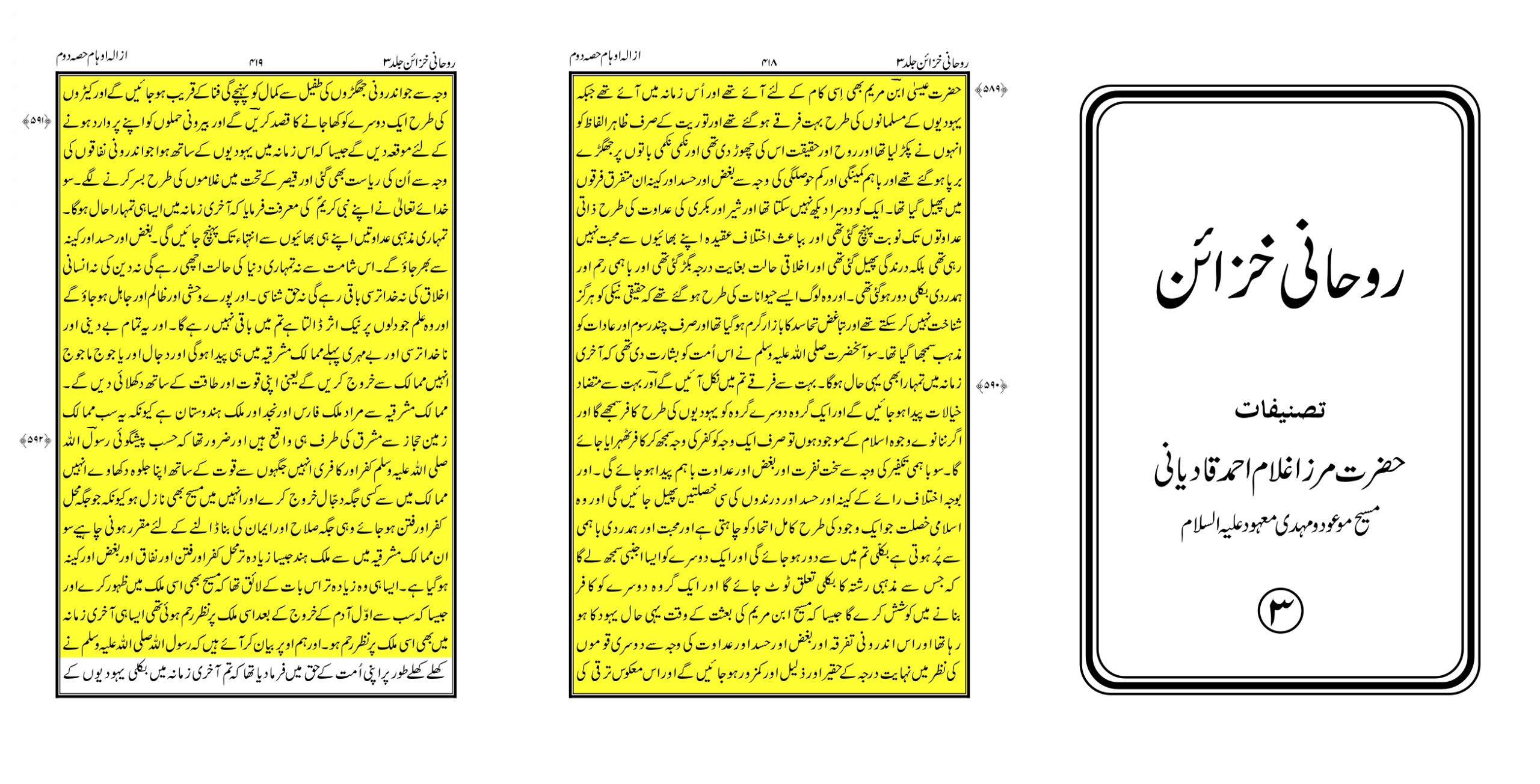
Hazrat Isa ibn Maryam (Jesus, son of Mary) also came for this very purpose, and he came at a time when the Jews, like Muslims, had divided into many sects. They had clung only to the literal words of the Torah and had abandoned its spirit and essence. Disputes had arisen over trivial matters, and due to mutual baseness and cowardice, hatred, envy, and malice had spread among these divided sects. One could not bear the sight of another, and matters reached the point of personal enmities like that between a lion and a goat. Due to differences in belief, love for one’s brothers had vanished; instead, savagery had spread, the moral condition had deteriorated to the extreme, and mutual compassion and sympathy had completely disappeared. They had become like such animals that they could no longer recognize true goodness, and the market of mutual hatred and envy had heated up. Only a few rituals and customs were considered religion.
Therefore, the Holy Prophet (peace be upon him) gave this Ummah the glad tidings that in the latter days, your condition will be the same. Many sects will emerge among you, and many contradictory ideas will arise. One group will consider another group infidels, just like the Jews. Even if ninety-nine reasons for Islam are present, just one reason will be considered a reason for disbelief, and they will be declared infidels. Thus, due to mutual excommunication, intense hatred, malice, and enmity will arise among you. And because of differences of opinion, malice, envy, and beastly traits will spread. That Islamic character, which desires perfect unity like a single body and is full of mutual love and sympathy, will completely disappear from among you. You will consider each other such strangers that the religious bond will be completely severed, and one group will strive to declare another infidel, just as was the condition of the Jews at the time of the advent of the Messiah, son of Mary.
And due to this internal division, hatred, envy, and enmity, you will become extremely contemptible, degraded, and weak in the eyes of other nations. And because of this inverted progress, which will reach its peak due to internal strife, you will near destruction and will intend to devour each other like worms, and you will provide opportunities for external attacks to befall you, just as happened with the Jews in that era, whose state was lost due to internal discord, and they began to live like slaves under Caesar.
Therefore, Almighty God informed through His Noble Prophet that in the latter days, your condition will be exactly the same. Your religious enmities with your own brothers will reach the extreme. You will be filled with hatred, envy, and malice. Due to this calamity, neither your worldly condition will remain good, nor your religion, nor human morals, nor God-consciousness, nor recognition of truth will remain. And you will become complete savages, oppressors, and ignorant, and that knowledge which has a good effect on hearts will not remain among you. And all this irreligiosity, godlessness, and heartlessness will first emerge in the Eastern lands, and the Dajjal (Antichrist) and Ya’juj Ma’juj (Gog and Magog) will emerge from these very lands, meaning they will manifest their power and might.
By Eastern lands is meant the land of Persia, Najd, and the land of India, because all these lands are located to the east of the land of Hijaz. And it was inevitable that, according to the prophecy of the Messenger of Allah (peace be upon him), disbelief and its manifestations would forcefully show their face from these very places. The Dajjal would emerge from some place among these lands, and among them the Messiah would also descend, because the place that becomes the seat of disbelief and strife should be the very place appointed for establishing reform and faith. Therefore, among these Eastern lands, since the land of India has largely become the seat of disbelief, strife, hypocrisy, hatred, and malice, it is all the more deserving that the Messiah should also appear in this very country. And just as, after the emergence of Adam, the gaze of mercy first fell upon this very country, so too in the latter days, the gaze of mercy should fall upon this same country.
Ruhani Khazain Vol 3. p. 419 Izālah Auhām, Interactive Book Link
Maulānā Ḥakīm Nūrudīn RA’s argument with a Najdi Wahhabi of whether Quburi Sufis are Non-Muslim
Mawlana Nuruddin RA states:
“Once there was a Najdi acquaintance named ʿAbd al-Raḥmān. Regarding the people of Makkah, he said: ‘The people of Makkah are all polytheists.’
I said to him: ‘Say: except whom Allah wills.’
He replied: ‘By Allah, all of them without exception, entirely, are polytheists.’
Then I again said: ‘Say: except whom Allah wills.’
He replied: ‘They may be killed and their wealth may be plundered.’”
This passage records an argument by Maulana Nuruddin (ra), the first Khalifa of the Ahmadiyya Movement, against a Najdi Wahhabi who adopts an extreme takfīrī position. The Najdi asserts that all inhabitants of Makkah are mushrik, leaving no room for exception. This is significant because Makkah is historically and theologically central to Islam, and its population includes Muslims who profess the kalimah and perform Islamic rituals.
Maulana Nuruddin’s repeated response, “Say: except whom Allah wills,” is deliberate and rooted in Islamic legal and theological principles. It reflects the Qur’anic and juristic caution against issuing blanket judgments of disbelief and emphasizes that ultimate judgment belongs to Allah alone. His insistence highlights the classical Sunni principle that takfīr must be restricted, precise, and based on certainty, not sweeping generalizations.
The Najdi’s escalation from declaring universal shirk to legitimizing violence, “they may be killed and their wealth may be plundered,” exposes the practical consequences of indiscriminate takfīr. In Islamic jurisprudence, declaring a Muslim a disbeliever carries severe legal implications, including the permissibility of bloodshed and confiscation of property. By documenting this exchange, Maulana Nuruddin illustrates how doctrinal extremism can directly translate into moral and legal transgression.
The episode thus serves as a critique of Najdi-Wahhabi absolutism and a defense of the Ahmadi position that even when shirk is alleged, the individuals involved may still remain within the fold of Islam unless disbelief is established with absolute certainty. It reinforces the Ahmadi emphasis on restraint in takfīr, recognition of human fallibility in judging intentions, and rejection of vigilante violence justified through theological excess.
Mujaddideen, who did Istigatha, can not be labelled as non-Muslim
Amr ibn al-‘As reported: The Messenger of Allah, peace and blessings be upon him, said, “If a judge makes a ruling, striving to apply his reasoning and he is correct, he will have two rewards. If a judge makes a ruling, striving to apply his reasoning and he is mistaken, he will have one reward.”
Source: Ṣaḥīḥ al-Bukhārī 7352, Ṣaḥīḥ Muslim 1716
The Ahmadi Position is consistent with the position of the great Ulama like Imam Dhahabi RH,
Imam Dhahabi RH (d.1348) on the mistakes of past Ulama
Imam Dhahabi, who was the student of Ibn Taymiyyah RH, wrote:
ثُمَّ إِنَّ الكَبِيرَ مِنْ أَئِمَّةِ العِلْمِ إِذَا كَثُرَ صَوَابُه، وَعُلِمَ تَحَرِّيهِ لِلْحَقِّ، وَاتَّسَعَ عِلْمُهُ، وَظَهَرَ ذَكَاؤُهُ، وَعُرِفَ صَلاحُه وَوَرَعُه وَاتَّبَاعُه، يُغْفَرُ لَهُ زَللَّهُ، وَلا نُضِلَّلهُ وَنَطْرُحُهُ وَنَنسَى مَحَاسِنَه
نعم، وَلا نَقتَدِي بِهِ فِي بِدعتِه وَخَطَئِه، وَنَرْجُو لَهُ التَّوبَةَ مِنْ ذَلِكَ“Then, if a great scholar among the imams of knowledge has many correct opinions, is known for his diligence in seeking the truth, has vast knowledge, demonstrates intelligence, and is recognized for his piety, righteousness, and adherence to the faith, his mistakes should be forgiven. We do not declare him misguided, abandon him, or forget his virtues. Yes, we do not follow him in his innovations and errors, and we hope for his
This is exactly the Ahmadiyya position!
Promised Messiah As gives the example of belief of Jesus being alive, a wrong belief, among the muslims but it was okay for them to have this beleif as 1. The messiah had not come yet 2. Hadith says that if a Mujathid makes a wrong judgment he will still get a reward
Promised Messiah AS: Past Scholar’s Mistakes and wrong rulings are forgiven
Promised Messiah as stated
I do not say that the people of this age are at fault alone for believing in the life of the Messiah. Nay, some among the people of past too were mistaken, but even in their error they remained worthy of divine reward. For it is written قَدْ يُخْطِئُ وَيُصِيبُ that is, on certain occasions a Mujtahid (A scholar of Islam who strives to come to a conclusion on religious matters on the basis of his own analytical reasoning, in light of the fundamental sources of Islam, namely, the Holy Quran, Sunnah and Hadith) ‘ errs and on other occasions he is in the right. But in both cases he receives divine reward. The fact is that this matter remained hidden from them because this is what divine will had so desired. Thus, they re-mained in ignorance and, like the People of the Cave, 2 this truth was not disclosed to them. In this context, I also received the revelation:
أمْ حَسِبْتَ أَنَّ أَصْحَبَ الْكَهْفِ وَالرَّقِيمِ كَانُوا مِنْ أَيْتِنَا عَجَبًاDo you think that the People of the Cave and the Inscription wer a wonder among Our Signs?
Similarly, the issue relating to the life of the Messiah is a remarkable secret. The Holy Quran clearly and lucidly establishes the death of the Messiah and the Hadith also substantiate this fact. Further, the verse that was recited to deduce the same, on the day that the Holy Prophet, peace and blessings of Allah be upon him, passed away also confirms this. However, despite this matter being so manifest, God Almighty concealed it, and kept it hidden for the Promised One. And so when he ap-peared, he disclosed this secret.
In His wisdom, whenever Allah Almighty so wills, He conceals a secret or unveils it. Thus, He kept this matter hidden until its appointed time, but now when the Promised One has appeared, in his hand was the key to this secret, and so he revealed it. Now, anyone who does not accept this and remains obstinate, wars with Allah Almighty.
Promised Messiah AS also states:
If the elders who have passed away did not understand the issue of Christ’s death and made a mistake, they are not to be blamed for this, because this matter was not openly explained to them, and they did not face these issues. They tried as best they could to attain taqwa [righteousness] and purity. The example of these people is like that of the Jewish jurists among the children of Israel who had passed away before the time of the Holy Prophet, may peace and blessings of Allah be upon him, who firmly held on to the belief that the last Prophet who was to come would be from the descendants of the Prophet Isaac and would be an Israelite. They died and went to Paradise, but when the Holy Prophet, may peace and blessings of Allah be upon him, appeared, the issue became clear that the last Prophet to come was from the Ishmaelites and that was how it should have been, then those of the Israelites who did not believe were declared disbelievers and accursed, and they are still walking around humiliated and afflicted going door to door.
Malfuzat English Volume 8. p.448, 449
List of Mujaddidin:
| Islamic Era Century | Name of Mujaddids (Reformers) |
|---|---|
| First century A.H. | Hazrat Umar ibn Abdul Aziz |
| Second century A.H. | Hazrat Imam Shafi‘i and Hazrat Imam Ahmad ibn Hanbal |
| Third century A.H. | Hazrat Abul Hassan Ashari and Hazrat Abu Sharh |
| Fourth century A.H. | Hazrat Abu Ubaid Naishapuri and Hazrat Qazi Abu Bakr Baqlani |
| Fifth century A.H. | Hazrat Imam Ghazali |
| Sixth century A.H. | Hazrat Sayyid Abdul Qadir Gilani |
| Seventh century A.H. | Hazrat Mueen-ud-Din Chishti and Hazrat Imam ibn Taimiyya |
| Eighth century A.H. | Hazrat Hafiz ibn Hajar Asqalani and Hazrat Saleh ibn Umar |
| Ninth century A.H. | Hazrat Sayyid Muhammad Jaunpuri. |
| Tenth century A.H. | Hazrat Imam Jalal-ud-Din Sayuti |
| Eleventh century A.H. | Hazrat Mujaddid Alif Sani |
| Twelfth century A.H. | Hazrat Shah Waliullah Muhaddith Dehlavi |
| Thirteenth century A.H. | Hazrat Sayyid Ahmad Brelvi |
| Fourteenth century A.H. | Hazrat Mirza Ghulam Ahmad Sahib |
Of these Mujadideen, scholars liek Abu Hassan Ashari, Imam Ghazali, Syed Abdul Qadir Jilani, Ibn Hajr Aqslani, Imam Jalaluddin Suyuti all believed Isigatha to be halal. It would be foolish for any Muslim to takfir these great Ulama when they were not in the presence of a Hakam wa Adl’.
Mawlana Ahsan Amrohi RA blesses both Subki RH and Ibn Taymiyyah RA
Mawlana Sayyid Muhammad Ahsan Amrohi RA wrote RH for Subki and RA for Ibn Taymiyyah despite the fact that these two scholars were fierce opponents of each other. Subki considered Ibn Taymiyyah to be an anthromorphist [ Mujasim] and Ibn Taymiyyah considered Subki to be a Mushrik.
The key difference: Ahmadiyya vs Najdi methodology
Najdi–Salafi approach
- Treats Ibn Taymiyyah and Ibn Abdul Wahhab and Ibn Baz and Ibn Uthaymeen as normative and decisive
- Absolutizes his harshest formulations
- Retroactively declares centuries of Muslims guilty of shirk and kufr
- Turns theological disagreement into takfīr
- Erases intent, context, and historical consensus
Ahmadiyya (and broader Sunni) approach
- Sees Ibn Taymiyyah as a great but fallible scholar who made mistakes and has many positions which salafis would Takfir for such as believing hell is not eternal, that Quburi Sufis and Shias have Udhr bil Jahl, etc
- Ahmadis recognize Ibn Taymiyyah’s ijtihād, but understand he was a fallible scholar who did make mistakes
- Acknowledges that Subkī was a scholar also grounded in Qurʾān, Sunnah, and usūl
- Refuses to declare the past mujaddideen mushrikeen udhama’ (great mushrikeen) and out of millah of Islam over a crime that both Salafis and Sufis are guilty of.
- Maintains adab, balance, and restraint
Conclusion
The arguments of Quburi Sufis and similar groups—often rooted in appeals to historical majorities, Ottoman or Mughal practices, and scholarly consensus crumble under scrutiny, as they overlook the clear scriptural prohibitions against Istigatha and the insidious origins of shirk. As evidenced by Quranic verses like Al-Fatiha 1:5, Surah An-Naml 27:62, and Al-Baqarah 2:186, alongside authentic Hadiths such as Sahih al-Bukhari 4920 and Sahih Muslim 2669a, Islam demands unwavering tawhid: worship and supplication directed solely to Allah. The proliferation of such biddah stemmed from emulating earlier nations, the absence of true Khilafah, limited Quranic accessibility, and unchecked reverence for pious figures, but Allah promises Mujaddids to renew the faith every century (Sunan Abi Dawud 4291). Muslims today must heed this revival, rejecting demi-god-like attributions to saints or prophets, and return to the pristine monotheism that defines our deen. In doing so, we avoid the pitfalls that ensnared communities before us, ensuring our pleas for help reach the One who truly answers