
Ahmadi vs Non-Ahmadi: Is the Finality of Prophethood Debate Just Semantics?
Introduction
Dear brothers and sisters in Islam, I invite you to reflect on a misunderstanding that has divided us, a disagreement not of faith but of words. As Ahmadi Muslims, we believe the dispute over prophethood is purely semantic, rooted in how we use the term “prophethood” (نبوت). Our founder, Hazrat Mirza Ghulam Ahmad (AS), the Promised Messiah, explains this beautifully in Chashma-e-Marifat:
“The dispute between us and our opposing Muslims is merely semantics , and it is this: we designate the words of God that consist of prophecies as ‘prophethood’ (نبوت). A person who receives such prophecies in abundance through divine revelation, to the extent that they have no equal in their era, we call a ‘prophet’ (نبی). This is because a prophet is someone who, through divine revelation (Ilham) , frequently foretells future events. However, our opposing Muslims believe in divine discourse (مکالمہ الٰہیہ) but, due to their ignorance, do not designate such discourses that are replete with prophecies as ‘prophethood,’ even though prophethood specifically refers to foretelling the future through divine revelation and inspiration. We all agree that the Sharia of the Holy Quran has been completed, and only glad tidings (Mubashiraat مبشرات), i.e., prophecies, remain.
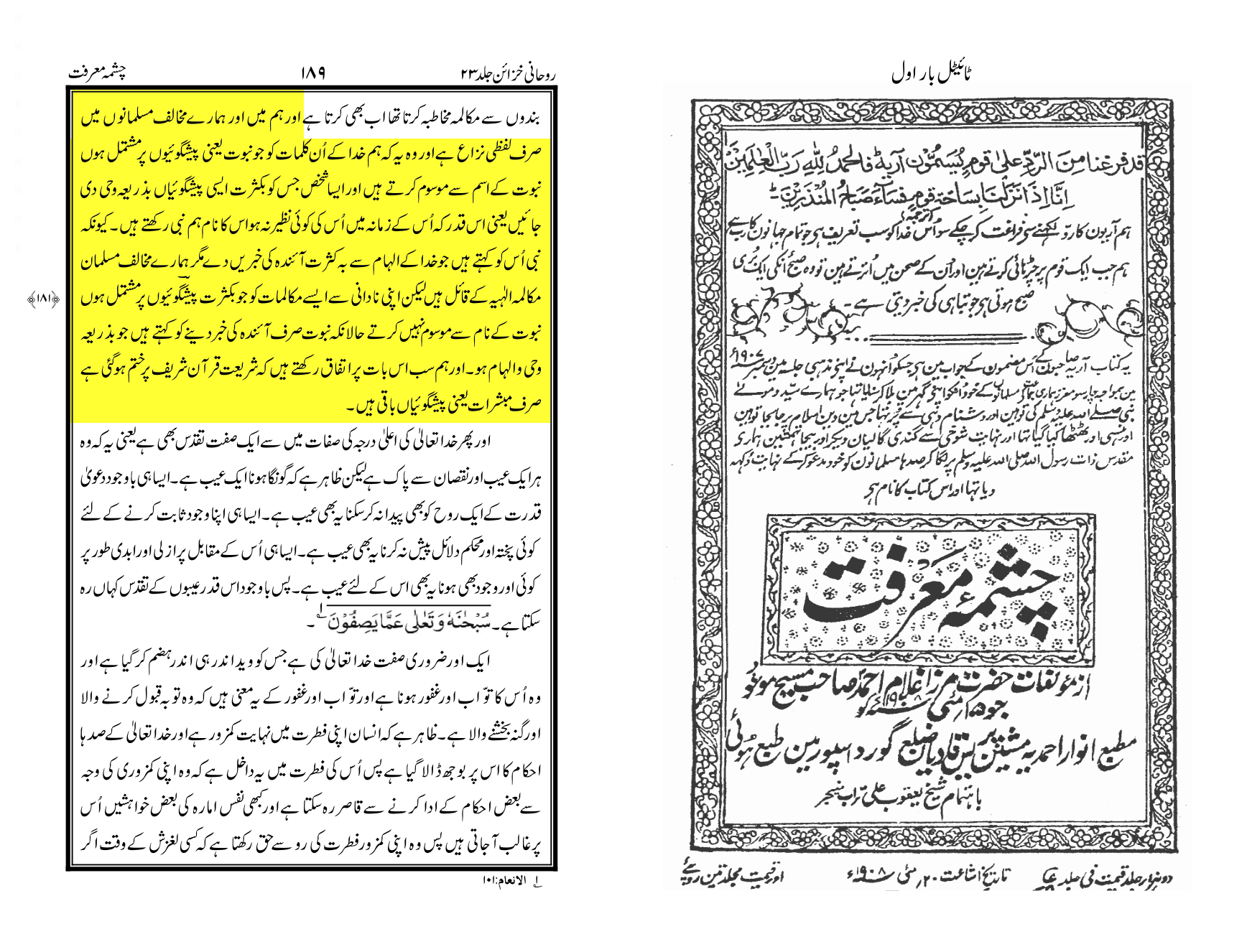
Let me ask you: don’t we all believe that Allah continues to speak to His servants? Scholars like Ibn Hibban and Ibn Taymiyyah have long affirmed that divine revelation persists in the Ummah. Only a recent trend among some groups denies this. So, if someone receives abundant revelations from Allah, foretelling the unseen with unmatched accuracy, what should we call them? We Ahmadis say such a person is a Nabi—not a law-bearing prophet, but one who reflects the light of the Holy Prophet (peace be upon him). This is no challenge to the finality of prophethood; it’s simply a matter of terminology.
Consider the hadith that supports our view:
إِنَّ الرِّسَالَةَ وَالنُّبُوَّةَ قَدِ انْقَطَعَتْ فَلاَ رَسُولَ بَعْدِي وَلاَ نَبِيَّ ” . قَالَ فَشَقَّ ذَلِكَ عَلَى النَّاسِ فَقَالَ ” لَكِنِ الْمُبَشِّرَاتُ ” . قَالُوا يَا رَسُولَ اللَّهِ وَمَا الْمُبَشِّرَاتُ قَالَ ” رُؤْيَا الْمُسْلِمِ وَهِيَ جُزْءٌ مِنْ أَجْزَاءِ النُّبُوَّةِ
Anas bin Malik narrated:
“The Messenger of Allah (s.a.w) said: ‘Indeed Messenger-ship and Prophethood have been terminated, so there shall be no Messenger after me, nor a Prophet.‘” He(Anas) said:”The people were concerned about that, so he (s.a.w) said: ‘But there will be Mubash-shirat.’ So they said: ‘O Messenger of Allah! What is Mubash-shirat?’ He said: ‘The Muslim’s dreams, for it is a portion of the portions of Prophethood.’”
[Jami` at-Tirmidhi 2272]
The Prophethood claimed by Mirza Ghulam Ahmad AS was that of al-Mubashiraat!
This hadith shows that while legislative prophethood ended with our beloved Prophet (peace be upon him), divine communication continues through Mubashiraat—glad tidings and prophetic visions. We Ahmadis believe that Hazrat Mirza Ghulam Ahmad’s (AS) prophethood is exactly this: a continuation of Mubashiraat, fully subordinate to the Holy Prophet (peace be upon him). Why should we hesitate to call such a blessed recipient a Nabi when their revelations revive Islam’s glory?
We have answered all the allegations on the Ahmadi Understanding of this hadith at this link.
Non-Ahmadi Belief in Continuity of Revelation
Imam Suyuti asked: Will Isa (as) have wahi at the end times? He responds: YES He then quotes Hadith Ahmadis quote [ie about Nuzul] to how that Isa (as) will have Wahi. He goes on stating it is explicit, certain, and undisputed.
هَلْ ثَبَتَ أَنَّ عِيسَى عَلَيْهِ السَّلَامُ بَعْدَ نُزُولِهِ يَأْتِيهِ وَحْيٌ؟
Question: Will revelation (wahi) be granted to Jesus, son of Mary, at the end of times?
وَالْجَوَابُ: نَعَمْ
Answer: Yes.
It has been narrated by Muslim, Ahmad, Abu Dawud, Tirmidhi, Nasa’i, and others, from the hadith of Nawwas bin Sam‘an, who said:
“While it is so, Allah will send the Messiah, son of Mary, who will descend at the white minaret east of Damascus, between two dyed garments, placing his hands on the wings of two angels. He will follow him [the Dajjal] and overtake him at the gate of Ludd, where he will kill him. Then, while they are in that state, Allah will reveal to Jesus, son of Mary (peace be upon him), ‘I have brought forth servants of Mine against whom no one has the power to fight. So, take My servants to safety at Mount Tur.’ And Allah will send forth Gog and Magog…” (Sahih Muslim, Musnad Ahmad, Sunan Abu Dawud, Jami‘ Tirmidhi, Sunan Nasa’i, and others).
Sahih Muslim 2793a
فَهَذَا صَرِيحٌ فِي أَنَّهُ يُوحَى إِلَيْهِ بَعْدَ النُّزُولِ، وَالظَّاهِرُ أَنَّ الْجَائِيَ إِلَيْهِ بِالْوَحْيِ جِبْرِيلُ عَلَيْهِ السَّلَامُ، بَلْ هُوَ الَّذِي يُقْطَعُ بِهِ وَلَا يُتَرَدَّدُ فِيهِ؛ لِأَنَّ ذَلِكَ وَظِيفَتُهُ، وَهُوَ السَّفِيرُ بَيْنَ اللَّهِ وَبَيْنَ أَنْبِيَائِهِ، لَا يُعْرَفُ ذَلِكَ لِغَيْرِهِ مِنَ الْمَلَائِكَةِ
This is explicit (Sareeh) in stating that revelation (wahi) will be granted to him after his descent. It appears that the one who delivers this revelation is Gabriel (peace be upon him), as this is certain and undisputed (wa laa traadud) , given that this is his role. He is the messenger between Allah and the prophets, and no other angel is known to perform this function
This hadith confirms that Jesus (peace be upon him) will receive wahi—divine revelation—during his second coming. If you accept that Allah will speak to a figure after the Holy Prophet (peace be upon him), why should it be controversial for us to say that Hazrat Mirza Ghulam Ahmad (AS), who received abundant revelations, is a Nabi in a subordinate sense? Our belief in his prophethood as Zilli (reflective) aligns with this concept of ongoing divine communication, fully respecting the Holy Prophet’s finality as Khatamul Anbiya.
Sahaba Receiving Revelation
Your tradition also acknowledges that the Sahaba received divine inspiration. Consider the incident of Hazrat Umar (may Allah be pleased with him) during a sermon:
“While `Umar was delivering a Khutbah from the Minbar (pulpit), he began to abruptly shout, ‘O, Sariyah! Move to the mountain! O, Sariyah! Move to the mountain!’ (يا سارية بن زنيم الجبل). In some cases, he had trouble remembering what he said when asked about it. Umar (ra) said he did not say these words, rather they came out.”
This event, widely accepted among you, shows Hazrat Umar (may Allah be pleased with him) receiving divine guidance to warn Sariyah, far away, of danger. He attributed these words to divine inspiration, not his own volition. If such inspiration—akin to wahi—was possible for a companion, why should we deny the possibility of Allah bestowing similar or greater revelation on a later servant like the Promised Messiah? We call him a Nabi because his revelations were abundant and prophetic, yet always derived from the Holy Prophet’s (peace be upon him) spiritual light.
The Ummah Receiving Revelation
Your scholars, like Ibn Taymiyyah, further affirm that the Ummah continues to receive divine communication. In Aqeedah al-Wasitiyyah, he writes:
“From among the Usool of Ahlus Sunnah is to: (Tasdeeq bi Karaamaat al Awliyah) To Attest, to Testify, To believe in the Miracle of the Saints (Wal Mukhashaafat) To Attest, to Testify, To believe in the Kashf (Visions) of the Saints… From the principle of the Ahle Sunnah is the affirmation of the miracles of the awliya (tasdeeq bi Karaamaat al Awliyah), and that which Allah performs at their hands of supernatural events from the types of science, visions (wal Mukhashaafat), types of qadr (destiny), and influences/effects.”
(Aqeedah al-Wasitiyyah, p. 123)
Ibn Taymiyyah’s words are clear: the Ahlus Sunnah believe in the mukashafat (visions) and miracles of the saints, which include divine revelations about the unseen. This is exactly what we Ahmadis mean by prophethood! When Allah grants someone like Hazrat Mirza Ghulam Ahmad (AS) countless revelations, fulfilling prophecies that revive Islam, we call him a Nabi in the sense of one wh
Ahmadi Definition of a prophet
The Ahmadi View is that there are three types of Prophethood, Law Bearing, Independent (Mustaqil), and Zilli Buruzi Ummati Nabuwwah… With the coming of Rasululllah SAW’s both Law-bearing and Mustaqil prophethood has ended. Zilli Buruzi Nabuwaah is only given like how a sun illuminates a moon, the moon has no light of its own but it is reflected light
“The word Nabi (prophet) is derived from Naba, which means ‘to inform’ or ‘to give news.’ A Nabi is one who informs, meaning someone who receives divine revelation from God Almighty, containing powerful prophecies about the unseen, and conveys it to people. According to Islamic terminology such a person is called a Nabi.”
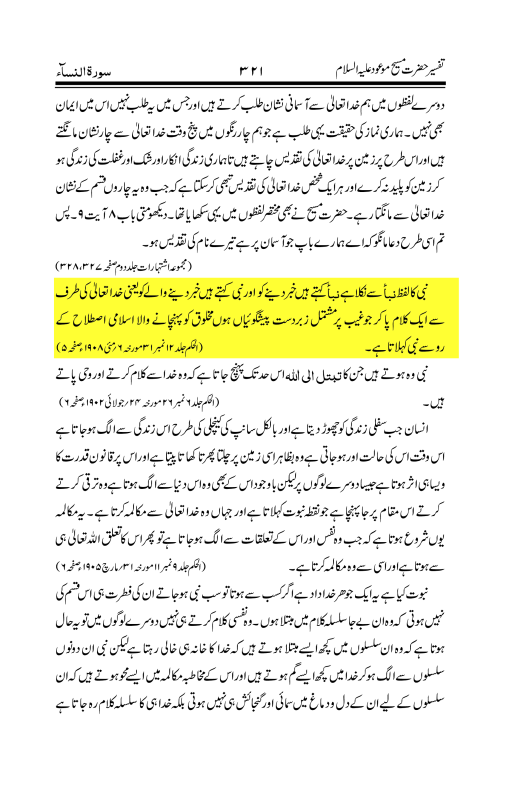
Promised Messiah AS: The difference in definitions is purely semantic
The content, which you call `mokalma mokhataba’ (precise, definitive communion) amplitude and abundance of the same, under mandate from the Lord God, I designate as Nabuwwat. Wa likullin an yastaliha.”
“They say, ‘This is a claim of prophethood (nubuwwat).’ I say: This is merely a matter of semantics. A ‘prophet’ (nabi) is simply one who conveys divine news. Now, what should one call a person with whom Allah the Almighty holds conversations and dialogues? This (so-called) prophethood is, in fact, a result of the grace and following of the Holy Prophet (peace be upon him). I would consider it disbelief (kufr) and a curse if someone were to claim that a person can partake in the fountain of prophethood without deriving from the Holy Prophet (peace be upon him) and instead claims independent prophethood.“
We Ahmadis firmly believe that the Holy Prophet (peace be upon him) is Khatamul Anbiya, the Seal of the Prophets. Our prophethood—called Zilli (reflective) or Buruzi (manifestational)—is like the moon reflecting the sun’s light. It’s not independent; it’s a gift from following the Holy Prophet (peace be upon him). Why should this cause division when we’re all devoted to the same Prophet and Quran?
My claim is only this: that due to the present corruptions, God has sent me. And I cannot conceal this matter, that I have been honored with divine converse. And God speaks to me, and speaks abundantly. And this is prophethood, but not real prophethood. ‘Naba’ is an Arabic word, which means news. Now, whoever receives news from God and makes it manifest to the people, in Arabic, he will be called a ‘Nabi’ (Prophet). I do not make any claim separate from the Holy Prophet Muhammad (peace and blessings of Allah be upon him). This is merely a matter of semantics. Abundant divine converse, in other words, is called prophethood.
Look at this saying of Hazrat Aisha (may Allah be pleased with her): “Say that he is the Seal of the Prophets, but do not say that there will be no prophet after him.” This clarifies the matter. If prophethood has ceased in Islam, then know for certain that Islam has also died, and then there is no distinguishing sign left.
Hazrat Aisha’s words show that the finality of prophethood doesn’t close the door to subordinate prophets. If Allah stopped speaking to His Ummah, wouldn’t that dim Islam’s light? We Ahmadis believe that Allah’s dialogue with His servants, like the Promised Messiah, keeps Islam alive and vibrant. His mission was to revive faith in an era of corruption, and his revelations prove his divine appointment.
God does not remain without speaking to the one He loves. When a person, through following the Holy Prophet (peace and blessings of Allah be upon him), becomes beloved to God, then He speaks to him and reveals to him news of the unseen. This is what prophethood is.
(Al Badr, Volume 2, Number 15, dated May 1, 1903, page 113)
The word “prophethood” in our revelations has two conditions: firstly, it does not carry a new law; and secondly, it is through the Holy Prophet Muhammad (peace and blessings of Allah be upon him).(Al Hakam, Volume 7, Number 14, dated April 17, 1903, page 12)
If we use the word “prophet” for ourselves, we always take that meaning which does not contradict the finality of prophethood. And when we negate it, we mean that meaning which does contradict the finality of prophethood.
Maulana Nuruddin RA: No Major Difference in Nabuwaah
Khalifatul Masih I RA:
“We have no disagreement with other Muslims in the principles of religion. Where they accept the death of more than one hundred thousand prophets, if we have accepted the death of one Jesus Christ, what sin is there in that? Similarly, in the Ummah of Muhammad, divine dialogue and communication continues with the saints of Allah, so what harm is there in accepting God Almighty’s dialogue with Mirza Sahib?
Conclusion
Our belief in the Promised Messiah’s prophethood is not a rejection of the finality of prophethood but an affirmation of Allah’s ongoing guidance through Mubashiraat. We call him a Nabi because he received divine revelations abundantly, fulfilling prophecies that revive Islam’s glory. This is no new religion—it’s Islam in its purest form. I urge you to look beyond the semantics and see that our belief strengthens the Ummah, uniting us under the banner of the Holy Prophet (peace be upon him). Join us in embracing this truth, and let’s rebuild Islam’s unity together.