
Who was John Alexander Dowie?
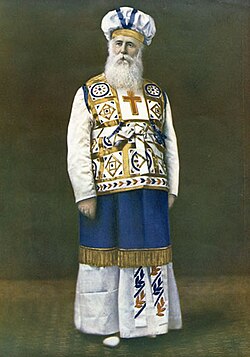
Who was John Alexander Dowie?
A Brief Life Sketch
John Alexander Dowie was born in Edinburgh, Scotland, in 1847. His family moved to Australia in 1860, where he began working at his uncle’s shop as a shoe salesman and worked a few odd clerk jobs here and there as a young man.
In 1867 he moved back to Scotland for further studies. He studied theology and some other subjects for two to three years. As his father could not afford to continue funding him, he was asked to return to Australia, which he did in 1872. He sought employment in the Church and was accepted in a Congregational church in Alma, a small, dusty in-land settlement fifty miles north of coastal Adelaide.
After stops in the Sydney suburbs of Manly and Newton, Dowie moved to Melbourne, where he assumed the pastorate at Collingwood Tabernacle. In 1878, following successful encounters in divine healing, he organized the International Healing Association.
He was arrested many times during his tenure owing to his aggressive protests against the wickedness that he felt was overtaking the area.
In July 1888, he embarked on a journey to San Francisco, California, where he would continue his healing-based ministry. He initially received a warm welcome, which gradually dwindled as he accused his helpers of being apostates. He traveled extensively up and down the West Coast, and, passing through Utah, he arrived in Evanston, Illinois. In 1895, he set up a “small wooden hut” as the press described it, near the World’s Fair entrance in Chicago, quickly gaining fame and repute for his grand public healings of the infirm.
In 1896, he formed his own congregation, naming it the Christian Catholic Church. He had an enrollment of five hundred followers. In 1897, he claimed that he had been arrested over a hundred times for protesting against alcohol use and practicing medicine (faith healing) without a license.
Gradually, he bought large parcels of land some forty-two miles north of Chicago while, at the same time, keeping the attention of the media on his controversial pursuits in Chicago. On New Year’s Eve, he gathered his followers for an all-night service at the Central Zion Tabernacle. As the clock struck midnight, Dowie drew back a large curtain, twenty-five feet high and twenty-five feet wide, to uncover the blueprint of a new city he would establish in 1901 along the banks of Lake Michigan. It was a 6,600-acre vision of the future City of Zion. From this point on, his success and progress grew in leaps and bounds. He was at the height of his career.
During the next several years, however, Dowie’s life became a roller coaster ride of peaks and valleys, the likes of which are seldom seen. Dowie enjoyed the media limelight for a twelve-year period, yet the eventual outcome of it all was encapsulated in the following report by the Princeton Telegraph, dated March 20, 1907, several days after Dowie died:
“When John Alexander Dowie passed away, his death ended the most spectacular and remarkable career that modern times have known. Gigantic success and tragic failures punctuate his life. Here are some of the remarkable works and reversals that marked Dowie’s career:
- He built a creed; he was excommunicated.
- He built a city: he was expelled from it.
- He amassed a fortune of millions; he was reduced to virtual poverty.
- He elevated Voliva to a great power; Voliva ruined him.
- He drew about him thousands who worshiped him; he died deserted by all save a handful of the faithful.”
A cursory look at Dowie’s downfall indicates a turn for the worse in 1902, right around the time that he was challenged to a mubahalah, or a prayer duel, by His Holiness Mirza Ghulam Ahmad as. Also of significance is that Dowie had just claimed to be Elijah III, paving the road for the long and eagerly awaited second coming of Christ, and had grown far too flagrant and liberal in his criticisms of those who differed with his theological beliefs. Particularly disturbing to Ahmad as was Dowie’s overt antagonism towards Islam; its Holy Founder, Muhammad sas; and the Muslim population in general. Dowie openly expressed views that sought the annihilation of the entire Muslim nation. Thus, it was only natural that Ahmad as—being the representative of Islam—would respond to Dowie’s comments with an offer no prophet could refuse. And no, there was no need to extirpate millions of Muslims across the globe.
Ahmad as offered an easy solution. Since both men claimed to be prophets divinely sanctioned by the One True God, yet their teachings were diametrically opposed to each other, one of them—by definition—had to be a liar. Therefore, Ahmad as proposed that he and Dowie should both pray to their respective Gods to cause the liar to die in the lifetime of the truthful claimant. He further warned Dowie to refrain from abusing the Holy Founder of Islam lest God’s wrath be kindled all the more.
Dowie paid no heed and tried to dismiss the challenge altogether, but Ahmad picked his words carefully, leaving Dowie no means of escape. God’s wrath would befall Dowie whether he accepted the challenge explicitly and openly in public, or implicitly and covertly by failing to repent and refrain from his slanderous rhetoric against Islam. Silence would only delay his inevitable fate. It mattered not that Dowie had every material advantage in his favor; for, Ahmad as stood on solid spiritual ground.
Dowie faced a real dilemma and was forced to pick his poison: either (i) stay silent and accept the defeat of a cowardly retreat, or (ii) speak up and run the risk of losing on the battlefield. Although he did not explicitly accept Ahmad’s challenge, he did so implicitly through his actions. This was acknowledged by the American newspapers. Consequently, the events that would shortly unfold in Dowie’s life bore the marks of God’s wrath. On top of the unrelenting reports of his exposed hypocrisies and indiscretions, he suffered a two-year bout with paralysis after which he died on March 9, 1907, abandoned by his wife, disowned by his son, and forsaken by his followers.
Ahmad’s bold prophecy that Dowie “shall leave the world before my eyes with great sorrow and torment” was gloriously fulfilled as if a modern-day resurrection of an incredulous Old Testament tale, and stands as a stark reminder of God’s low tolerance for imposture and pretense.
Dowie’s Claims
A brief reflection on the life of John Alexander Dowie reveals that he made claims to four independent offices in the last decade of his life, beginning in 1896. These claims expose an ambitious drive for personal status, each boasting a lofty degree of spirituality. In 1896, he founded his own congregation, the Christian Catholic Church, and assumed the office of its General Overseer.
January 22, 1896: Authoritative Teacher
Mr. Rolvix Harlan in his dissertation entitled John Alexander Dowie and the Christian Catholic Apostolic Church writes:
In his address of Jan. 22, 1896, he [Dr. Dowie] sets forth an organization of the church.
1 Cor.12:28 reads: “And God hath set some in the church, first apostles, secondarily prophets, thirdly teachers, after that miracles, then gifts of healing, helps, governments, diversities of tongues.” He says, “Now then, what is the way of perfect wisdom as to the order of the church? What is the first office God has established?” answer, “Apostles,” “The second?” “Prophets.” “The third?” “Teachers.” “Now then, did God form a church with these offices?” “He did.” “Is that the order of the Church of God?” “It is.” “Does the Church of God ever alter?” “No.” “Can the Church of God be acceptable to Christ if it is organized after His own order?” “No” …
Mr. Dowie: “I am not claiming any office; no man has heard me claim any office. I am a teacher and have taken no other place. I have not stood here claiming to be recognized as a prophet. I have not stood here claiming to be recognized as an Apostle. I have stood here as an authoritative teacher.” Mr. Dowie in 1896 may have doubted whereunto this thing would grow, but to whatever extent it did grow he was clearly determined to be the head. Every element introduced into the reports is calculated to strengthen his hold upon people already inclined to have him for a leader. Added to great patience in bidding his time is a shrewdness bordering upon hypocrisy, which led an unwary following, step by step, to the place where they must accept the alternative of renouncing him entirely or giving him more authority, until he came to be strong enough to assume absolute authority, and then point back to the beginning of his movement and show that such had been the drift of events from the first.” (p. 47–50)
March 5, 1899: Claims to be the Messenger of the Covenant
In the wake of his tremendous success at the World’s Fair, during which time his church grew rapidly, Dowie undertook a secret plan to found a theocratic city, which he already referred to by the Biblical appellation of “Zion.” This holy city would pave the way for the Second Advent of Jesus Christ. Accordingly, in March of 1899, Dowie announced that he had been appointed the Messenger of God’s Covenant according to the Book of Malachi, which reads: “Behold, I will send My Messenger, and He shall prepare the way before Me: and the Lord, whom ye seek, shall suddenly come to His Temple; even the Messenger of the Covenant, whom ye delight in: behold, he shall come, saith the Lord of Hosts” (Malachi 3:1-6). Dowie reiterated this claim in January of 1900, and his followers readily accepted his divine authority.
Dowie announced:
The time has come for a great onward step in Zion, for which God has gradually prepared us. It has been my privilege to be simply in all this matter His Messenger. Whether you use the definite or indefinite article will not offend me. You may call me a Messenger or the Messenger; but you cannot make me either the one or the other. No man can make or unmake a Divine Messenger. He is God’s making, as well as God’s sending. (Leaves of Healing, Jan. 13, 1900, p. 361)
June 2, 1901: Claims to be Elijah
“As the teacher of the Christian Catholic Church in Zion … I continued to develop practically these principles in my ministry, and God used me to prepare the church for the declaration of June 2, 1901. I there stood forth before an immense audience in the Chicago Auditorium and declared that God had sent me as John the Baptist had been sent, in the Spirit and Power of Elijah.”
He further said:
“The name is not a title, it is a reality. I firmly believe in common with tens of thousands of my followers that I have been sent by God in the ‘Spirit and Power of Elijah’ as the third and last manifestation of that prophet. ‘The first manifestation was in Elijah (which means Jehovah is my God) 28 centuries ago, when the worship of Baal was triumphant in Israel. This was Elijah the Destroyer.’ ‘The second manifestation was in the person of John the Baptist. Mathew 13:14. He was Elijah the Preparer. The third manifestation of Elijah is in my person, of whom Christ spoke, after John the Baptist’s death, when he admitted the correctness of rabbinical contention, ‘Elijah must first come,’ saying ‘Elijah indeed cometh and shall restore all things.’ I am Elijah, the Restorer.’ “ (p. 53–57)
September 18, 1904: Claims to be the First Apostle
“I stand hereby today as the High Priest on earth and the First Apostle of the Christian Catholic and Apostolic Church in Zion of that High Priest in Heaven.”
Dowie’s Attitude towards other Christian Denominations
John Alexander Dowie stated:
Let me put it simply and plainly. The purpose of the Christian Catholic Church in Zion is to smash every other church in existence.
The Methodist Churches
“The Methodist Church, which was the greatest and most spiritual Church in America at one time, is today almost wholly controlled by the Freemasons. Nine-tenths of the bishops, and nearly all the ministers are Freemasons. Freemasonry is heathenism; because they cannot get away from the statement that they do not believe in Jesus, the Christ, and dare not mention His name.”
Mormon Church
“Zion has no affinity with the false Zion that has sent forth a false Gospel, false prophets and a false religion under the guise of truth to curse the world.”
“I never had any understanding with the Mormon authorities at any time, and I think that it is a base insult; because all of good that Joseph Smith or Brigham Young ever knew, I knew apart from them or any of their followers. I will not be likened unto them for a moment! I am their superior mentally, morally, spiritually intellectually, and every other way, and I will not be likened to these wicked men.” (Leaves of Healing, vol. XIII, p. 662)
Dowie’s Hatred for the Holy Founder of Islam
John Alexander Dowie was amongst the foremost enemies of Islam, its Founder and its adherents. His vituperations were explicitly expressed both in his oration and his publications. The following are examples of headlines published in his Leaves of Healing:
“Zion will have to destroy Mohammedanism”
One of the greatest systems in the Orient is Mohammedanism … the Mohammedan is taught to look forward to heaven as one vast brothel and harem, where he can find satisfaction in women that are prepared for him as the creatures of lust. Zion will have to wipe out that shocking blot upon humanity. That accursed flag will have to come down from the high towers of Jerusalem. May God help me to knock at the gate of the Moslem before long! The Moslem will fight. There are hundreds of millions of them. One of the great wars imminent is that between the Cross and the Crescent. But, beloved, there is something stronger than steel. It is the Sword of the Spirit. There is something greater than anger, it is Love. Love subdues the man; it subdues the nation, and will reach the heart…(vol. XIII, p. 474)
“The Unspeakable Turk”
“How can anyone who knows exactly what Mohammedanism is, for one single moment imagine that God or man can forever stand that abomination? ‘Where the Moslem hoof comes no grass grows’ is the Eastern proverb. Wherever the accursed teaching of Mahomet has come there has been an end of all real progress … I pray for the day to come when the Crescent shall disappear, and when the flags – I would like to see them united there and everywhere of Great Britain and America shall float over Zion at Jerusalem, as they often do at the city of Zion near Chicago. May God Grant it! It is the time that the Moslem abomination was gone, bag and baggage as Mr. Gladstone used to say. Let it slink away back into the deserts of Arabia whence the filthy thing emerged … May God destroy it.” (vol. XII, p. 526)
“Indulgence in Damning Lust the Prize Offered in Mohammedanism and Mormonism”
“But with it all came the damning lust; that which enticed, under Mohammed, the tribes of Koresh to forsake their God and enlist under his banner, namely, that they would have women galore while they lived, and that when they died there would be a host of houris with whom they should dwell in a paradise of damning lust, eating and drinking, and be forever happy, with the happiness of a filthy brute whose highest aspirations never rise higher than its belly. This was the prize that Mohammed offered, and this is the prize that Mohammedanism still offers … This is the prize, despite all they say, that still underlies Mohammedanism and Mormonism, and which by the grace of God, we hope to do something in smashing.” (vol. XIII, p. 662)
“The Terrible Danger to Christianity from Mohammedanism”
“I warn the Christian nations of America and Europe. Islam is not dead. Islam is full of power. Although Islam must go, although Mohammedanism must be destroyed, remember it will not be wiped out by the effete Latin Christianity; the powerless Greek Christianity; the worn-out Christianity of those who nominally acknowledge Christ and live as gluttons and drunkards and harlots and whoremongers and oppressors.” (vol. VII, August 25, 1900)
Related Historical Documentation
- The Dowie Prophecy: 156 Historical Newspaper Compendium (1899–1907) — Read the complete global press coverage of the prayer duel and Dowie’s downfall.