
Deobandis Reject Finality of Prophethood
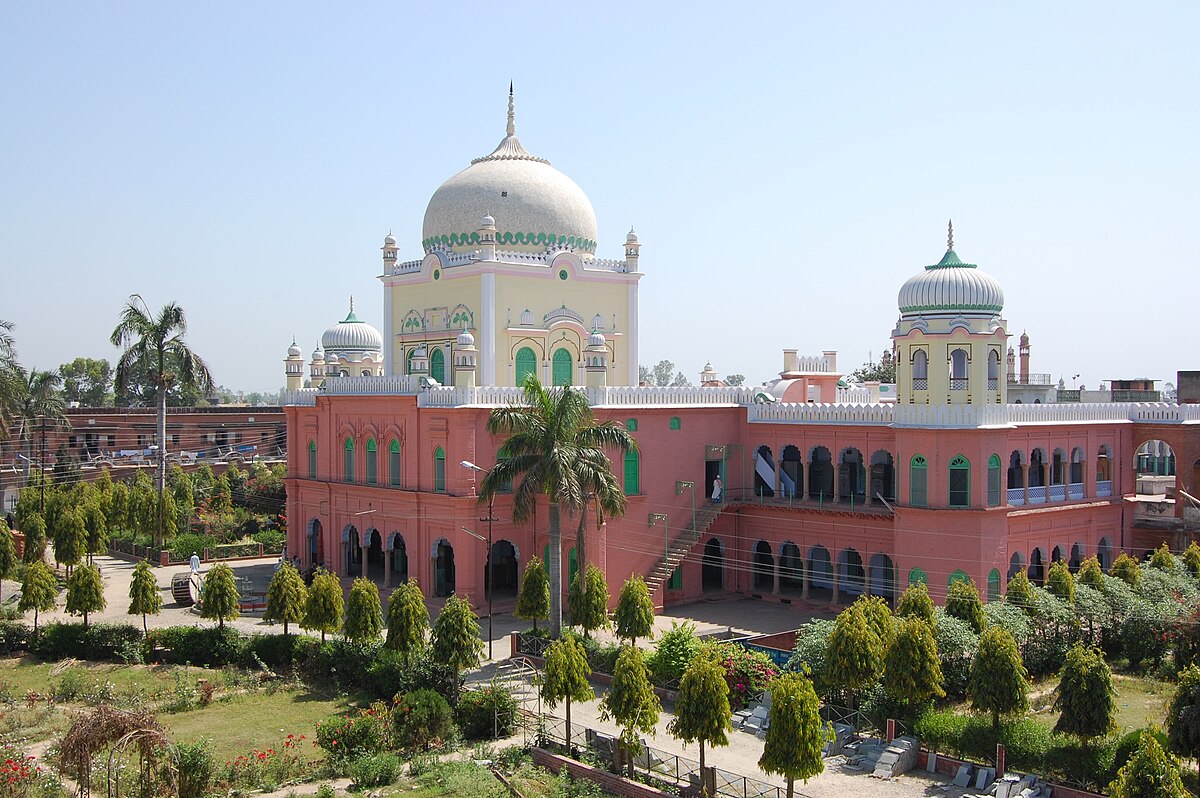
Introduction
Most Sunni organizations defending Khatam un-Nabiyyin belong to the Deobandi sect. Ironically, the founder, Qasim Nanotwi, held a position on the Seal of Prophethood similar to Mirza Ghulam Ahmad (AS), the Ahmadi or Qadiani view. Furthermore, Deobandis elevate their own scholars to prophethood, which proves they reject the Finality of Prophethood.
Muhammad Qasim Nanotwi and His Position on Khatam an-Nabiyeen
Qasim Nanotwi did not believe Seal of Prophethood refers to the Finality of Prophethood, he held that the Seal of Prophethood means Prophet Muhammad’s ﷺ reached the highest level of perfection in all the qualities and ranks of prophethood. He explained that greatness is not about coming first or last, but about reaching the most complete and perfect status. For this reason, even if another prophet were to appear after him ﷺ or at the same time elsewhere, it would not affect the Prophet Muhammad’s ﷺ unique and superior position, because all others would still remain below him ﷺ.
Statement 1
The public imagine that Rasulullah (SAW) being Khaatam literally means that his time is after the time of all the previous prophets, and he is the Last Prophet of all. However, the people of understanding will be enlightened as to the fact that there is no excellence or virtue, in essence, of being either the ‘first’ or ‘last’. Then in what form is it correct to attribute a praiseworthy station of excellence in the verse “but he is the Messenger of Allah and the Seal of the Prophets” (33:40)?
[Tahzir An-Nas, pg. 14]
![[Tahzir An-Nas, pg. 14]](https://whiteminaret.org/wp-content/uploads/2025/08/DeobandiRejectKhatamNabuwatQasimNanotwiTahzeerUnNaas-scaled.png)
Statement 2
Rather, if, hypothetically, after the time of the Prophet (SAW) another Prophet is born, even then it will make no difference to the Khaatamiyyat-e-Muhammadi (Seal of Prophethood of Muhammad) – similarly if another Prophet is his contemporary in another Earth, or even on this Earth another Prophet is made.
[Tahzir An-Nas, pg. 63]
![[Tahzir An-Nas, pg. 63]](https://whiteminaret.org/wp-content/uploads/2025/08/DeobandiRejectKhatamNabuwatQasimNanotwiTahzeerUnNaas2.png)
Statement 3
Therefore, the person who possesses this attribute, which is Khaatam as-Siffaat (Seal of Attributes), to a greater degree of manifestation, that is, there is no attribute above it or which has the possibility of being manifested and granted into the creation – Such a person, among the creation, is the Khaatam al-Maraatib (Seal of Stations), and that person is the master of all and the most superior of all.
[Intisar-ul-Islam, pg. 48]
![[Intisar-ul-Islam, pg. 48]](https://whiteminaret.org/wp-content/uploads/2025/08/DeobandiRejectKhatamNabuwatQasimNanotwiIntisarUlIslam-scaled.jpg)
Statement 4
There is no status above that of the Khaatam (Seal) of the stations of Prophethood. Whoever becomes (a Prophet) is subordinate to it.
[Mubahasa Shahjahanpur, pg. 25]
![[Mubahasa Shahjahanpur, pg. 25]](https://whiteminaret.org/wp-content/uploads/2025/08/DeobandiRejectKhatamNabuwatQasimNanotwiMubahasaShahjahanpur-scaled.png)
Deobandi Scholars on the Seal of Prophethood
Maulana Qari Muhammad Tayaib Qasmi
Maulana Qari Muhammad Tayaib who is called ‘Hakeem al-Islam’ by the Deobandis which means ‘The Wise scholar of Islam’ is the grandson of Qasim Nanotwi and he explains Seal of Prophethood in the same way.
Statement 1
The meaning of Khatme Nabuwat is not the termination of prophethood but rather consummation of prophethood i.e such a complete prophethood has been sent that there requires no need for anymore prophethood after that. This is like when you see numerous stars at night, you can also see the moon but its still night. The day has not come even with all their light. Everyone is shining and spreading light but it is still dark. But even a slightest ray of Sun hides the stars away. Now if the Sun says “I am Khatimun Noor. I seal the noor. I end all the noor”. It means that I have brought the most complete noor thus there is no need for the stars. Their noor will be incorporated within me.
[Youtube Video: Deobandis REJECT Finality of Prophethood!?!; Time Stamp: 0:00-1:59]
So when Muhammad (S.A.W) claimed that “I am Khatimun Nabiyyin” so the Khatme Nabuwat does not mean “Ending of the prophethood” but the “Perfection of Prophethood”. That the Sun of the prophets brought a light so bright that the light of any star was not needed anymore. It will become dim. Light of all the stars will be incorporated with it. When the sun rises, it is not that the light of all the stars end. But rather it gets incorporated within the light of that sun. When Islam came, all the excellencies of the past religions got integrated within it. Islam is the compilation of all religions. This is why Quran describes its glory by saying that I have not come to deny all previous religions but to protect them. Whichever truth was in there, I took while discarded the teachings that nations have changed. So, all the virtues got compiled in Islam. So prophethood is the compilation of all the prophethoods while Islam is the compilation of all the laws (shariah) of the past.
There are two key points being made from this passage. The first is that Prophet Muhammad ﷺ was the last of the Prophets, but only in this sense that all the qualities and attributes of prophethood found their most perfect and complete cultivation and expression in him ﷺ. That is to say that no prophet after him ﷺ could ever add anything new or higher to the status of prophethood, because its perfection was already fully manifested in him ﷺ. So, being the “last” is less about being last in time, but about completion and perfection.
The second point being made is that Prophet Muhammad ﷺ was the last of the Law bearing Prophets. This point is in harmony with the first point that is being that since the Prophet Muhammad ﷺ brought together the best qualities and teachings of all previous prophets and Islam and his ﷺ religion, integrates the truth from earlier religions while correcting the parts that were changed or corrupted by people. It means that Prophet Muhammad’s ﷺ prophethood is the compilation of all earlier prophethoods while Islam is the compilation of all previous laws (shariah). Therefore, no Prophet can come after the Holy Prophet ﷺ who should abrogate his religion and not be in his Ummah.
His other statements will be presented on this matter which further reflect these same ideas:
Statement 2
And this is the status of the description of Khaatam, this attribute comes from it and returns to it. He is the Faateh (meaning first) and the Khaatam, the first one (having this attribute) and the last one. This is why we will not say that the sun is only luminous, rather it is Nur Bakshi (meaning it provides light)…we will not only say it is possessor of light but Khatam ul Anwar, as the light of all stars come from it, and in this movement of light, it goes back to it. So being Khatam ul Anwar will be the most distinguished of its qualities, and this can properly describe its particularity
[Aftab-i-Nabuwwat, pg. 80]
![[Aftab-i-Nabuwwat, pg. 80]](https://whiteminaret.org/wp-content/uploads/2025/08/DeobandiRejectKhatamNabuwatqarimuhammadtayyabaftaabenabuwwat-1.png)
Statement 3
In the same way, the status of the sun of Prophethood (the Noble Messenger of Allah SAW) is not only being a Prophet, this quality is common among all Prophet. So his real particular quality is that in matters of prophetic light, he is the Murabbi of all Prophets, and the Masdar of Faydh (centre of emanation) for them, and the origin of their excellent lights. This is why he is a Prophet in real, and the other Prophets (peace be upon them) are not (Prophets) in real but became Prophets from his Faydh (emanation).
![[Aftab-i-Nabuwwat, pg. 81]](https://whiteminaret.org/wp-content/uploads/2025/08/DeobandiRejectKhatamNabuwatqarimuhammadtayyabaftaabenabuwwat2.png)
Statement 4
The status of Huzur is not only being a Prophet, but also Nubuwat Bakhshi (meaning he provides Prophethood), every person who is ready for Prophethood and comes in front of him will become a Prophet. In the same manner, the light of Prophethood started from him and will return to him, and this is the description of Khatam…” For this reason, we do not simply call him (Prophet Muhammad SAW) as a Prophet but he is called Khaatam an-Nabiyyeen that all of the lights of Prophethood find their ultimate manifestation in him, making him the pinnacle of Prophethood.
[Aftab-i-Nabuwwat, pg. 82]
![[Aftab-i-Nabuwwat, pg. 82]](https://whiteminaret.org/wp-content/uploads/2025/08/DeobandiRejectKhatamNabuwatqarimuhammadtayyabaftaabenabuwwat3.png)
Shaykh Muhammad Abu Bakr Ghazipuri al-Ansari
Shaykh Muhammad Abu Bakr Ghazipuri al-Ansari defends Qasim Nanotvi statements and essentially affirms that seal of prophethood does not mean being the last in time, because being last in history has no special value on its own rather, it means he ﷺ is the one in whom prophethood reached perfection and through whom all other prophets are validated. Therefore, this perfection would not be negated if another prophet were to come after him ﷺ; rather, that prophet too would only be a prophet by bearing his stamp of approval and deriving authenticity through him.
He strove to incite people against the Imam in regards his statement that the Prophethood of Muhammad is original and the Prophethood of the other Ambiyaa stems from the effulgence of his Nubuwah. That also means that he is the Seal of the Ambiyaa, from the first of them to the last, in aspects of personality, time and place. Even if in theory there should have been a prophet after him, that would have no effect on his Finality, because his Nubüwah is vested in himself originally whilst the others stem from his effulgence. There is no doubt that that statement is correct. It is the belief of the Ahlus Sunnah wal Jama’ah. It is from Rasulullaah that the chain of Nubüwah originated. He was the Nabi from primordial times and was already then the Seal of Ambiyaa by the decree of Allaah, before even the presence of the creation, before there was time and place, before any Nabi came to the world. Sadly, the author of the booklet did not understand this subtle meaning due to his ignorance and enmity against the Deobandis. He thus spewed against ash-Shaykh an-Nänotwi what he spewed and his tongue spoke like a devil. The statement of ash-Shaykh an-Nänotwi is in fact in the same style as that Ibn Taymiyah. He presented his argument based on the Quraan and Hadith, in a style and division modern intelligence can understand. If the author of the booklet has any intelligence then he should listen very carefully to what Hujjatul Islaam wrote.
[Was Ibn Taymiah From the Ahlus Sunnah wal Jama’ah?, pg. 44]
![[Was Ibn Taymiah From the Ahlus Sunnah wal Jama’ah?, pg. 44]](https://whiteminaret.org/wp-content/uploads/2025/09/DeobandiRejectKhatamNabuwatAbuBakrWasIbnTaymiyyahFromAhlusSunnah.jpg)
Deobandi Prophets
Deobandi apologists such as Shaykh Usman Iqbal argue that that merely attributing exclusive prophetic qualities to an individual constitutes a violation of Khatam al-Nubuwwah:
The same thing is said by the famous Deobandi scholar Khalid Mahmud:
The belief in the finality of prophethood is not a play of words, where one merely accepts the word ‘prophet’ while continuing the reality and significance of prophethood in the name of Imamate.
[Abaqat, vol 1, pg. 239]
Hujjat al-Hind, Hazrat Imam Shah Waliullah Muhaddith Dehlvi, in Sharh Muwatta, writes:
“Allah’s Messenger (SAW) is the Seal of Prophethood, but the meaning of this statement is that it is not permissible for anyone to be a prophet after him. As for the meaning of prophethood—being someone sent by Allah to creation, whose obedience is obligatory, protected from sins, and free from error in what is required—this exists in the Imams after him. That person, however, would be a heretic. The majority of later scholars among the Hanafis and Shafi‘is agreed to punish anyone who follows this path.”
The conclusion of Hazrat Shah Sahib’s ruling is that anyone who holds the belief that after the Holy Prophet (SAW) there could arise in this Ummah individuals who are divinely inspired and infallible is by no means a true believer in the doctrine of the finality of prophethood, even if verbally they call the Prophet (SAW) Khatam an-Nabiyyin a thousand times.
![[Abaqat, vol 1, pg. 239]](https://whiteminaret.org/wp-content/uploads/2025/12/DeobandiRejectKhatamNabuwatKhalidMahmoodAbaqat-scaled.png)
However, this is ironic, because they follow scholars who elevated themselves to such extreme levels that, by their own logic, they themselves end up defying the Finality of Prophethood.
Rashid Ahmad Gangohi: I Am Infallible
Rashid Ahmad Gangohi claimed that he was free from error:
Khan Sahib said that Hazrat Gangohi (may Allah have mercy on him) once said to Maulvi Muhammad Baiti Sahib Kandhlawi: “Look up such-and-such issue in Shami.”
The Maulvi replied, “Hazrat, that issue is not found in Shami.”Hazrat said, “How can that be? Bring Shami.”
[Arwah-e-Salasa, pg. 230]
Shami was brought. At that time, Hazrat had already lost his eyesight. He placed two-thirds of the pages to the right and one-third to the left, and by estimation opened the book in one motion. He then said, “Look on the lower part of the page on the left.” When they looked, the issue was found exactly in that spot. Everyone was astonished.
Hazrat then said, “Allah Almighty has promised me that He will not allow anything incorrect to come out of my tongue.”
![[Arwah-e-Salasa, pg. 230]](https://whiteminaret.org/wp-content/uploads/2025/12/DeobandiRejectKhatamNabuwatAshrafThanwiArwahESalasah.jpg)
Rashid Ahmad Gangohi’s Promise of Salvation to His Followers
In this passage, it is recorded that Rashid Ahmad Gangohi reassured his followers, telling them that it had been promised to him that they would be saved and would not enter Hellfire.
A person in Gangoh used to cry a lot in the assemblies of Hazrat Gangohi (may Allah sanctify his secret), and even by nature, he was very emotional. On one occasion, Hazrat Maulana Rashid Ahmad Gangohi asked him:
“Why do you cry so much? Why are you distressed?”
He replied:“Hazrat! I fear Hell—how will the fire be bearable?”
Hazrat said:“No, no! There is nothing to worry about. It has been promised to me that your people will not be sent to Hell.”
[Maslak Ulama-e-Deoband aur Hubb-e-Rasul, pg. 37]
![[Maslak Ulama-e-Deoband aur Hubb-e-Rasul, pg. 37]](https://whiteminaret.org/wp-content/uploads/2025/12/DeobandiRejectKhatamNabuwatGangohiMaslakDeoband.png)
He entered the highest echelon as a principal member, whose words, actions, and the state of his heart and limbs have been protected by Allah in every era. In matters of speech and bodily action, divine support and guidance were granted so that creation could be safeguarded from error and misguidance.
He repeatedly stated in his capacity as a preacher, through a skilled translator:“Whatever comes from the tongue of Rashid Ahmad is indeed true. I swear, I am nothing, yet in this era, guidance and salvation depend upon following me.”
[Tazkira-tur-Rasheed, vol 2, pg. 17]
In matters where people, bound by reasoning and evidence, fell into disputes and could not fully distinguish between truth and falsehood, wandering in the deserts of doubt and confusion, Hazrat Imam Rabbani (may Allah sanctify his secret), through the light of his heart, kindled by the lamp of prophethood, clearly spoke the truth, clarified the correct path, and rendered decisions without requiring external corroboration.
![[Tazkira-tur-Rasheed, vol 2, pg. 17]](https://whiteminaret.org/wp-content/uploads/2025/12/DeobandiRejectKhatamNabuwatAshiqMerathitazkiraerasheed.png)
The Second Founder of Islam: Rashid Ahmad Gangohi
After Gangohi died, his student , Mawlana Mahmud Hasan, who is also called Shaykh al-Hind by the Deobandis wrote a poem in praise of Gangohi. He writes:
A second founder of Islam has emerged in the world
[Marsiya Gangohi, pg. 5]
![[Marsiya Gangohi, pg. 5]](https://whiteminaret.org/wp-content/uploads/2025/12/DeobandiRejectKhatamNabuwatMahmudHasanMarsiyah.jpg)
The Disciple of Gangohi: His Pen Moves Beyond the Arsh
Aashiq Ilahi Mirathi wrote this about Gangohi:
At the time when your opponents raised an uproar over the issue of imkān-e-kidhb and published a verdict of excommunication, in the gathering of Sāʾīn Tawakkul Shāh Sahib of Anbalā, a certain cleric mentioned Imām Rabbānī (may his sanctity be exalted) and said that he held the view of the possibility of falsehood being attributed to God.
Upon hearing this, Sāʾīn Tawakkul Shāh Sahib lowered his head, and after remaining in silent meditation for a short while, he raised his head and, in his Punjabi language, uttered these words:[Tazkira-tur-Rasheed, vol 2, pg. 322]
‘People, what are you saying? I am seeing the pen of Mawlānā Rashīd Aḥmad Sahib moving beyond the ʿArsh (the Throne).
![[Tazkira-tur-Rasheed, vol 2, pg. 322]](https://whiteminaret.org/wp-content/uploads/2025/12/DeobandiRejectKhatamNabuwatGangohiTazkiraeRasheed.png)
Again, Deobandis must ask themselves: when an individual claims that Allah has promised him infallibility, that his followers will be spared from Hell and his followers shamelessly describe that same individual as the second founder of Islam and say his pen moves beyond the Arsh, does such a personality resemble a mere scholar, or does he bear the attributes of a prophet?
For the confused Deobandis, they should refer to the statement of Khalid Mahmud again.
Gangohi Invoked ‘Mercy of the Worlds’ Upon a Saint
In the Quran “Mercy to all mankind” (Rahmatullil ‘Alamin) is a title uniquely attributed to Prophet Muhammad ﷺ however, Gangohi permits the titles for scholars or saints:
The title Rahmatullil ‘Alamin is not exclusively a characteristic of the Prophet Muhammad ﷺ. Other saints, prophets, and pious scholars (ulama rabbaniyyin) can also be a source of mercy for the world. Although the Prophet ﷺ is the highest among them, it is permissible to attribute this phrase to others in a figurative sense.
[Fatawa-e-Rashidiya, pg. 242]
![[Fatawa-e-Rashidiya, pg. 242]](https://whiteminaret.org/wp-content/uploads/2025/12/DeobandiRejectKhatamNabuwatGangohiFatawaRashidiya-scaled.png)
According to the Deobandis, Imdadullah Muhajir Makki is also Mercy to all Worlds (Rahmatan Lil Aalamin):
When Hazrat Gangohi (may Allah have mercy on him) received the news of Hazrat Haji Sahib’s passing, he remained profoundly distressed for several days. The shock and sorrow were so great that it was evident even outwardly that he had such deep love for him. Hazrat Gangohi (may Allah have mercy on him) repeatedly invoked rahmatullil ‘alamin (mercy of the worlds) upon him.
![[Malfoozat-e-Hakeem-ul-Ummat, vol 1, pg. 138]](https://whiteminaret.org/wp-content/uploads/2025/12/DeobandiRejectKhatamNabuwatAshrafThanwiMalfoozat.png)
Rank of Prophethood Present in Gangohi
Deobandi scholar Manazir Ahsan Gilani writes:
In Maulana Muhammad Qasim Sahib, the aspect of the rank of sainthood (wilayat) was dominant, while in Maulana Gangohi, the aspect of the rank of prophethood was (dominant).
[Sawanih Qasimi, vol 1, pg. 477]
![[Sawanih Qasimi, vol 1, pg. 477]](https://whiteminaret.org/wp-content/uploads/2025/12/DeobandiRejectKhatamNabuwatAhsanGilaniSwanehQasmi.png)
The Prophetic Revelation of Qasim Nanotwi
Qasim Nanotwi felt as though the weight of a hundred tons of stones was weighing down upon his heart as a consequence of offering Tasbih. His pir, Haji Imdadullah Muhajir Makki reassured him by saying:
[Sawanih Qasimi; vol 1, pg. 259]
These are the emanations [faidan] of Prophesy on your heart. And this is that heaviness which the Prophet ﷺ used to feel at the time of Revelation. God shall take from you that service/tasks which is taken from Prophets
![[Sawanih Qasimi; vol 1, pg. 259]](https://whiteminaret.org/wp-content/uploads/2025/12/DeobandiRejectKhatamNabuwatAhsanGilaniSwanehQasmi2-1.png)
Ashraf Ali Thanwi: The Road to Salvation
Muhammad Aashiq Ilahi Meerthi elevates Ashraf Ali Thanwi to such a high status that he claims washing Thanwi’s feet and drinking the same water is a means of attaining salvation in the Hereafter. Deobandis again should ask themselves who are the real deniers of Khatam al-Nubuwwah?
His (Ashraf Ali Thanwi) excellence reached such a level that, by Allah the Most Great, washing the feet of Maulana Thanawi and drinking that water became a means of salvation in the Hereafter.
[Tazkira-tur-Rasheed, vol 1, pg. 113]
![[Tazkira-tur-Rasheed, vol 1, pg. 113]](https://whiteminaret.org/wp-content/uploads/2025/12/DeobandiRejectKhatamNabuwatMuhammadIlahiTazkiraTurRasheed.png)
Ashraf Ali Thanwi’s Approval of a Kalima Recited in His Name
A disciple reportedly recited “La ilaha illa Allah, Ashraf Ali Rasul Allah” and a Durud invoking blessings on Ashraf Ali Thanwi, when Thanwi heard about this, he reassured the disciple and said:
There was assurance in this incident that the one to whom you return back to [Ashraf Thanwi], with the help of Allah the Exalted, is a follower of the Sunnah.
[Risala al Imdad, pg. 35]
![[Risala al Imdad, pg. 35]](https://whiteminaret.org/wp-content/uploads/2025/12/DeobandiRejectKhatamNabuwatAshrafThanwirisalaalamdad-scaled.jpg)
In this case, a disciple openly recited words attributing prophethood to Thanwi, and Thanwi approved it. While condemning others for overstepping the bounds of finality of prophethood, their own scholars venerated themselves in such ways that effectively violates the finality of prophethood.
A Refutation of Deobandi Counter Arguments
Qasim Nanotwi Affirmed Chronological Finality?
Some Deobandi apologetic articles quote statements of Qasim Nanotwi to suggest he affirmed the finality of prophethood. Their main argument is that Nanotwi distinguished two main aspects of Seal of prophethood:
- Martabah (rank) – the primary meaning, referring to the superiority and exalted status of Prophet Muhammad ﷺ.
- Zamānī (temporal/chronological) – the secondary, incidental meaning, referring to the Prophet ﷺ being the last in time.
Deobandi writers argue that while Nanotwi primarily argued about the rank aspect, he also affirmed the temporal finality, which differentiates him from Mirza Ghulam Ahmad (AS), whom they claim did not accept the Zamānī aspect.
Firstly, if such was true then Nanotwi’s earlier statements would be contradicted. He explicitly said it is possible for another prophet to come without violating the Seal, and he also stated that there is no inherent virtue in Muhammad ﷺ being called the “last in time” as cited earlier.
Therefore, it would be inaccurate to claim that Nanotwi believed Allah conferred this title as a special honour especially when the verse 33:40 itself addresses the disbelievers mocking the Prophet ﷺ for having no physical progeny, affirming instead that he will have a spiritual progeny until the end of time. Thus contextually “being last in time” is not inherently meritorious just as the last caliph of the Rashidun Caliphate was not greater than the first.
Secondly, Qasim Nanotwi did not define khatamiyyat zamani as chronological finality. Rather, he defined khatamiyyat zamani to mean that Muhammad ﷺ is the last sharīʿah-bearing Prophet. In other words, Islam will not be abrogated, no new religion will be revealed, and therefore no prophet after Muhammad ﷺ can appear with a new sharīʿah or religion.
Two explicit statements from him will be presented below:
And the scholars of the People of the Sunnah (Ahle Sunnat) also explicitly state this matter, that in the era (or during the time) of the Holy Prophet (peace and blessings of Allah be upon him), no Prophet possessing a new law (Sharī’ah Jadīd) can appear/exist and any prophet who is contemporaneous with him saw will be follower of Mohammedan Shariah
[Tahzir An-Nas, pg. 91]
![[Tahzir An-Nas, pg. 91]](https://whiteminaret.org/wp-content/uploads/2025/12/DeobandiRejectKhatamNabuwatQasimNanotwiTahzeerunNaas3.jpg)
The meaning of Khatamiyyat-e-Zamaani is that after the advent of Deen-e-Muhammadiؐ , it won’t be abrogated. The knowledge of Nubuwwat has reached its apex. No other Prophet’s Religion or Knowledge is now needed for Bani Adam
[Munazarah Ajeeba, pg. 58]
![[Munazarah Ajeeba, pg. 58]](https://whiteminaret.org/wp-content/uploads/2025/12/DeobandiRejectKhatamNabuwatQasimNanotwiMunazraEAjeebah.jpg)
Therefore, any statement in which Deobandis allege or give the impression that Qasim Nanotwi affirmed khatamiyyat zamani as chronological finality is either based on misunderstanding or deception. All such statements, when read in light of his own explicit definitions, refer to finality in the sense that Muhammad ﷺ is the last sharīʿah-bearing Prophet.
Just like Qasim Nanotwi, Hazrat Mirza Ghulam Ahmad (AS) explained there are two main aspects of Khatm al-Nubuwwah:
- Martabah (rank) – All perfections of prophethood were completed in him ﷺ.
- Zamānī (temporal/chronological) – After him ﷺ, no messenger will bring a new shariah, and there is no prophet outside his community. Rather, anyone who receives divine communication now receives it through his ﷺ grace and mediation, and such a person is considered a follower of his Ummah, not an independent prophet.
Hazrat Mirza Ghulam Ahmad (AS) states:
But the Holy Prophet ﷺ was given a special honor as the Seal of the Prophets: All perfections of prophethood were completed in him. After him, no messenger will bring a new shariah, and there is no prophet outside his community. Rather, anyone who receives divine communication now receives it through his grace and mediation, and such a person is considered a follower of his Ummah, not an independent prophet.
[Roohani Khazain, vol 23, Chashma Ma’rafat, pg. 380]
![[Roohani Khazain, vol 23, Chashma Ma’rafat, pg. 380]](https://whiteminaret.org/wp-content/uploads/2025/12/DeobandiRejectKhatamNabuwatMirzGhulamAhmadChashmaMarafat.png)
If both Qasim Nanotwi and Hazrat Mirza Ghulam Ahmad (AS) affirmed Khatm al-Nubuwwah in terms of both Martabah (rank/superiority) and Zamānī (temporal/chronological finality), and both defined Zamānī in identical ways, then there is effectively no difference in the core meaning of finality of prophethood between them.
Qari Muhammad Tayyab al-Deobandi: Muhammad (SAW) is NOT the Last Prophet
Misquoting Qasim Nanotwi to suggest he believed in the chronological finality of prophethood contradicts how major Deobandi scholars explained it. For example, Qari Muhammad Tayyab explicitly stated that prophethood has not ended. A transcription of his recording was cited earlier in this article, and he has also written extensively on this topic. Full details of his statements can be found in this article.
Qari Muhammad Tayyab al-Deobandi on the Seal of the Prophets and the Return of ‘Isa ﷺ
Secondly, claiming that Qasim Nanotwi defined khatamiyyat zamani as purely chronological finality contradicts how Qari Muhammad Tayyab rationalised the return of Prophet Isa (AS). He recognized that if khatamiyyat zamani meant being last in time, a contradiction would arise: Prophet Isa (AS) returning after Muhammad ﷺ would appear to challenge Muhammad ﷺ’s status as the Seal of the Prophets. Qari Muhammad Tayyab resolves this by explaining that Isa (AS) will follow the law of Muhammad ﷺ thus there is no contradiction, since the Qur’an contains all previous knowledge and the Prophet ﷺ’s character embodies the qualities of all prior prophets. This shows that Muhammad ﷺ is the ultimate perfection in prophethood, with all other prophets, including Isa (AS), subordinate to his law. Consequently, this entails that Muhammad ﷺ is the last sharīʿah-bearing prophet: no new religion will be revealed, and Islam will not be abrogated, fully aligning with Qasim Nanotwi’s and Mirza Ghulam Ahmad’s (AS) definition of khatamiyyat zamani.
The comprehensiveness of perfection in character that exists in the Messenger of Allah ﷺ is clearly understood from the incident wherein Siddiqah ‘A’ishah (may Allah be pleased with her) was asked about the prophetic character. She responded, “His character was the Qur’an” (Ahmad). In other words, all of that which exists in the Qur’an in the form of knowledge exists in the form of character and aptitude in the Prophet ﷺ … Since the Qur’an encompasses [the knowledge of] all the previous books and is a collection of the Prophet ﷺ’s character, this establishes that his character encompasses all the characteristics of the previous prophets. This is a clear proof for the Prophet ﷺ being the finality of the perfection in character and being at the highest degree of perfection in creation. Hence, it is self-evident from this that the Blessed One ﷺ in whom all the foundations of prophethood are contained and who is superior to all, only he can then be the primary one (asl) of these foundations (prophets).
A covenant was taken from the prophets to believe, follow and aid the Prophet [Muhammad] ﷺ on the basis of him being the primary prophet as is clear from the verse of the Qur’an, “When Allah took the covenant of the prophets” )3:81). The Prophet ﷺ elucidated, in light of this verse, that the previous prophets are all under the Seal of the Prophets by saying, “If Musa (peace be upon him) was alive, he would have had no option except to follow me” (Musannaf Ibn Abi Shaybah). The upshot of this is that Musa (peace be upon him) – the resolute messenger who was given a shari’ah – had to be obeyed [by mankind] in the absence of the Seal of the Prophets, but in the presence of the Seal of the Prophets, rather than being the one who is to be obeyed, he becomes the one who obeys [the Seal of the Prophets]. This is only possible when his rank is deemed below the Seal of the Prophets’ rank, because in reality all the control and authority of the one who is subordinate (ma taht) comes from the one above (ma fawq), i.e., it is given to him by the one who is higher in authority.
[The principle is that] in the presence of the primary authority, the authority of the secondary is nonexistent. This is exactly like the prime minister saying to his [subordinate] ministers, “In my presence, none of you has full authority. Your ability to command comes into effect only in my absence.” It can be understood from this that the authority of the one below is nonexistent in the presence of the one above him, even if the rank of the one below customarily remains intact. This principle is not just restricted to this case, but rather this is the case of every primary and secondary entity in any sphere, i.e., in the presence of the primary, the secondary has no control. In the presence of the father, for example, his own son (who has his own children) would feel shy in calling himself “father” in front of him, let alone pointing to or using his right of fatherhood. This is because his fatherhood is secondary to his father’s fatherhood, and in the presence of the primary, the status of the secondary does not remain. Furthermore, for example, one would feel shy in referring to a stream as a “river” if the ocean is right in front of him, because [the reality is that] wherever a body of water exists it is directly or indirectly fed by the ocean. This is why once all these mighty rivers reach the ocean, they flow into the ocean’s flow. Their own rate of flow does not remain intact. Also, for example, stars would feel shy to refer to themselves as radiant when the sun is shining, because their primary star is in front of them. In the presence of the primary, the secondary feels shy of its own existence, let alone becoming a claimant to its [independent] existence.
In the same manner, upon the rising of the Sun of all Guidance ﷺ, it is natural and innate for all the prophets to conform to this Seal of the Prophets rather than implement their own law, i.e., rather than ruling according to their own prophethood or commanding [others] to rule by them. This is the same reality which has been made clear in the above-mentioned hadith that if a previous prophet finds himself in the period of the Seal of the Prophets, the laws of the finality of prophethood (khatm al-nubuwwah) shall apply upon him and his nation rather than his own laws … which in reality is a clear proof for the Seal of the Prophets ﷺ being primary in perfection, and all non-final prophets being secondary in [this] perfection.
Even though the above-mentioned hadith in regards to Musa (peace be upon him) portrays a hypothetical scenario but when in the period of the Prophet ﷺ, ‘Isa (or Jesus) (peace be upon him) will be made to descend from the heavens, he will [in actuality] follow the religion of the Seal of the Prophets ﷺ. In fact, it is possible that ‘Isa (peace be upon him) was raised to the heavens alive, so that he be made to descend from the heavens to the earth in the last period to make this very reality apparent, such that in the age of strife he perform renewal (tajdid) of the Shar‘iah of the Prophet ﷺ, while obeying it, with all the powers of his prophethood. Therefore, through this, the obedience of a previous prophet to the Shari’ah of the Prophet ﷺ no longer remains a matter of creed (aqidah) only, but rather a practical example will [now] be in front of all.
This practical example also establishes that this is not just in reference to a single Israelite messenger, but rather the adherence of all the Israelite prophets is established through this because ‘Isa (peace be upon him) is the final prophet of the Banu Isra’il and the last link in the chain of the Israelite prophethood (nubuwwah). If the last link of a continuous chain is pulled in one direction, the entire chain will naturally be pulled in the same direction. The ruling of the last link in the chain will be considered the ruling of the entire chain. Therefore, there is no reason to not accept this as proof for the entire chain of [Israelite] prophets to be followers of the way of the Seal of the Prophets ﷺ, after the descent of ‘Isa (peace be upon him) as a follower of the way of the Seal of the Prophets ﷺ, as he is the last link in the chain of Banu Isra’il prophets.
Especially when this is [also] in accordance with the Torah’s clarification, as has been mentioned in hadiths, that Musa (peace be upon him) supplicated, “If the likes of the ummah of Muhammad cannot be given to me then include me in it”. Therefore, the final prophet of Musa (peace be upon him)’s chain [i.e. ‘Isa, peace be upon him] will be sent as a reviver of Islam and as a follower of the Shari’ah of the Prophet ﷺ. ‘Isa (peace be upon him) will be included in the ummah of the Prophet ﷺ to fulfill the desire of Musa (peace upon him). As ‘Isa (peace be upon him) is a prophet who is the end point of the Israelites, when he becomes a member of the ummah of the Prophet ﷺ, the entirety of Israelite prophethood from Musa to ‘Isa (peace be upon them both) becomes included in the ummah of the Prophet ﷺ as followers.
Through the connection between the first and last, i.e., through making apparent the obedience to the way of the Prophet ﷺ by the very first Israelite messenger (Musa) and the very last (‘Isa), all of the Israelite messengers – who were the most superior in the world in their respective times – are as a result proven to be followers of the Prophet ﷺ. In addition to this, all the earlier prophethoods which culminated in the station of Isra’iliyyah, due to them being the predecessors to Isra’iliyyah, are included in this following of the Prophet ﷺ [as well]. Consequently, the same ruling is derived for all the prophets (peace be upon them), i.e., their prophethoods are considered secondary to the Seal of the Prophets. Through this, it becomes evident that the Prophet ﷺ is the prophet of the prophets (nabi al-anbiya’).
From this, another issue is clarified in regards to the period of the Prophet ﷺ, which is the last period, if the prophets have no option but to practice obedience to the Prophet ﷺ, then it is an open declaration that their nations also have no option but to be obedient to the Seal of the Prophets ﷺ. In fact, salvation in the Hereafter is restricted to the religion of the Seal of the Prophets ﷺ [as the Qur’an declares]:
“If anyone seeks a religion other than Islam, it will not be accepted from him: he will be one of the losers in the Hereafter.” (3:85)[Aftab-e-Nubuwwat, pg. 86-89]
Thus, the title of Khatam al-Nabiyyin (Seal of the Prophets) has made apparent the primary nature of the prophethood of the Seal of the Prophets ﷺ and that he is the one who is followed in the universal sense.
![[Aftab-e-Nubuwwat, pg. 86-89]](https://whiteminaret.org/wp-content/uploads/2025/12/DeobandiRejectKhatamNabuwatQariMuhammadTayyabAftabeNabuwat-scaled.png)
Qasim Nanotwi Made an Error, and No One Is Obliged to Follow Him?
When unable to reconcile Qasim Nanotwi’s position on the Seal of Prophethood, Deobandis may claim that he simply made an error and that no one is obliged to follow him. However, according to Deobandi sources themselves, he received divine insight when explaining Khatam an-Nabiyeen. In Al-Muhannad ‘ala al-Mufannad it is written that Maulana Muhammad Qasim Nanotwi received kashf (revelation from Allah) when explaining Khatam an-Nabiyeen in his book titled Tahzīr An-Nās.
This puts the Deobandis and the admirers of the Deobandi sect in a predicament: either say they lied and Allah never gave them such revelation to write such statements, or say they are right and consequently agree that the Ahmadi position, which is identical, is not only right but their aqeedah is also informed by divine insight.
Nor will you attain the honor of his comprehensive excellence and complete merit; this subtle point is Maulana’s revelation (kashf) regarding the majesty, exalted rank, and greatness of the Prophet ﷺ.
[Al-Muhannad ‘ala al-Mufannad, pg. 42]
![[Al-Muhannad ‘ala al-Mufannad, pg. 42]](https://whiteminaret.org/wp-content/uploads/2025/08/DeobandiRejectKhatamNabuwatKhalilSaharanpuriAlMuhannad.png)
On top of that, Khalil Ahmad Saharanpuri (the author of Al-Muhannad), a leading figure in the Deobandi school, explicitly defends the Nanotwi’s position in Al-Muhannad. When someone defends a position, they do not reject it; they affirm it. This defense, along with the attestation and certification of Al-Muhannad ala al-Mufannad by 24 leading Deobandi scholars including Ashraf Ali Thanwi, Mahmud ul Hassan, and others shows that the Deobandi authorities collectively accept and uphold Qasim Nanotwi’s position, leaving no room for denial. The names of the 24 scholars can be read below:
[Al-Muhannad ala al-Mufannad (with Preface and Notes by Muhammad Ilyas Ghuman), pg. 8-10]
- Shaykh al-Hind, Hadhrat Mawlana Mahmud Hasan — d. 1339 AH
- Hadhrat Mawlana Mir Ahmad Hasan Sahib Amrohi — d. 1330 AH
- Hadhrat Mawlana Mufti Aziz al-Rahman ‘Uthmani — d. 1347 AH
- Hakim al-Ummah, Hadhrat Mawlana Ashraf ‘Ali Thanwi — d. 1362 AH
- Hadhrat Mawlana Shah ‘Abd al-Rahim Raipuri — d. 1337 AH
- Hadhrat Mawlana Hakim Muhammad Hasan (brother of Shaykh al-Hind) — d. 1345 AH
- Hadhrat Mawlana Qudrat Allah Muradabadi
- Hadhrat Mawlana Habib al-Rahman ‘Uthmani (brother of ‘Allamah Shabbir Ahmad ‘Uthmani) — d. 1348 AH
- Hadhrat Mawlana Muhammad Ahmad (son of Hadhrat Nanotwi) — d. 1347 AH
- Hadhrat Mawlana Ghulam Rasul, teacher at Dar al-‘Ulum Deoband — d. 1337 AH
- Hadhrat Mawlana Muhammad Suhail — d. 1367 AH
- Hadhrat Mawlana ‘Abd al-Samad
- Hadhrat Mawlana Hakim Muhammad Ishaq Nahawri Dehlawi
- Hadhrat Mawlana Riyad al-Din, Madrasah ‘Aliyah, Meerut
- Hadhrat Mawlana Mufti Kifayat Allah Dehlawi — d. 1372 AH
- Hadhrat Mawlana Ziya al-Haqq Dehlawi
- Hadhrat Mawlana Muhammad Qasim Dehlawi
- Hadhrat Mawlana ‘Ashiq Ilahi Meerthi — d. 1360 AH
- Hadhrat Mawlana Siraj Ahmad, Sardhana, Meerut
- Mawlana Qari Muhammad Ishaq, Madrasa Islamiyyah, Meerut
- Mawlana Hakim Muhammad Mustafa Bijnori
- Hadhrat Mawlana Muhammad Mas‘ud Ahmad Gangohi (son of Hadhrat Gangohi)
- Hadhrat Mawlana Muhammad Yahya Saharanpuri — d. 1334 AH
- Hadhrat Mawlana Kifayat Allah Gangohi, teacher at Mazahir al-‘Ulum Saharanpur
![[Al-Muhannad ala al-Mufannad (with Preface and Notes by Muhammad Ilyas Ghuman), pg. 8-10]](https://whiteminaret.org/wp-content/uploads/2025/12/DeobandiRejectKhatamNabuwatIlyasGumanTahzeerunNaas.png)
Not only that, Deobandi scholars today themselves state that there is an ijmāʿ among Deobandis upon the contents and beliefs outlined in Al-Muhannad ʿala al-Mufannad, and that the beliefs expressed in Al-Muhannad represent the beliefs of Ahl al-Sunnah wa’l-Jamāʿah. To such an extent, they maintain that whoever rejects even a single statement contained in Al-Muhannad can no longer be regarded as a Deobandi. For example, Deobandi scholar Ilyas Ghuman states:
Thus, this book (Al-Muhannad ‘ala al-Mufannad) represents the unanimous work of the Deobandi scholars of Ahl al-Sunnah wa’l-Jama‘ah, following the attestations of these senior scholars. Now, anyone who claims affiliation with the Deobandi scholars of Ahl al-Sunnah wa’l-Jama‘ah is required to accept all the views and beliefs contained in this book.
[Al-Muhannad ala al-Mufannad (with Preface and Notes by Muhammad Ilyas Ghuman), pg. 12]
![[Al-Muhannad ala al-Mufannad (with Preface and Notes by Muhammad Ilyas Ghuman), pg. 12]](https://whiteminaret.org/wp-content/uploads/2025/12/DeobandiRejectKhatamNabuwatIliyasGhumanAlMuhannad.png)
The same thing is said by Deobandi scholar Muhammad Yusuf Ludhianvi who very explicitly says that four generations of Deobandi scholars all agreed to and affirmed the beliefs outlined in Al-Muhannad ʿala al-Mufannad. That means four successive generations of Deobandi scholars confirmed and upheld Qasim Nanotwi’s position and now the fifth generation of their students is continuing and upholding the same beliefs:
The elders of Deoband have passed through several generations. The first generation consisted of Hazrat Nanotwi, Hazrat Gangohi, Hazrat Mawlana Muhammad Ya‘qub Nanotwi (may Allah have mercy on them), and their contemporary senior scholars.
The second generation consisted of the students of these elders, among whom were Shaykh al-Hind, Hazrat Mawlana Khalil Ahmad Saharanpuri, Hazrat Hakim al-Ummah Thanwi (may Allah have mercy on them), and other senior scholars.
The third generation consisted of their students, including Hazrat Mawlana Anwar Shah Kashmiri, Hazrat Mawlana Sayyid Husayn Ahmad Madani, Hazrat Mawlana Shabbir Ahmad Usmani (may Allah have mercy on them), and others.
The fourth generation consisted of their students, including Mawlana Muhammad Yusuf Banuri, Hazrat Mawlana Muhammad Shafi‘ Sahib (may Allah have mercy on them), and their contemporary senior scholars.[Fatawa Bayyinat, vol 1, pg. 526–527]
And now the fifth generation of their students is ongoing.
Al-Muhannad ʿala al-Mufannad bears the signatures of all the senior scholars of the second generation. These same beliefs were held by the elders of the first generation, and upon these beliefs the elders of the third and fourth generations have remained in agreement. Therefore, there is consensus (ijmāʿ) among all the senior Deobandi scholars upon the beliefs recorded in Al-Muhannad. No Deobandi has any scope to deviate from them, and whoever deviates from them is not deserving of being called a Deobandi.
![[Fatawa Bayyinat, vol 1, pg. 526–527]](https://whiteminaret.org/wp-content/uploads/2025/12/DeobandiRejectKhatamNabuwatMuhammadYusufLudhianviFatawaBayyinat.png)
If Deobandis truly wish to concede that Qasim Nanotwi and all the later scholars who admired, attested to, and defended his statements were mistaken, then they must also concede something far more serious: that Nanotwi and all those scholars were not merely in error, but guilty of kufr. This is because the issue at hand is not a minor fiqh disagreement rather it is a blasphemous ‘aqīdah that has been propagated for over a century.
Deobandis must remember, this is the very same belief for which Deobandis today organise Khatm-e-Nubuwwat conferences, declaring Ahmadis to be disbelievers, apostates, and outside the fold of Islam. It is the same belief for which Ahmadis have historically been persecuted, ostracised, and even killed.
If Deobandis still insist that Nanotwi’s position was merely an error, then they should at least show one Deobandi scholar who is not bound by “delusion” and has made takfīr of Qasim Nanotwi. Other than that, they should also become Barelvis, because then they have validated Ahmad Raza Khan’s fatwas against the Deobandis, in which he accused them of violating the finality of prophethood.
Qasim Nanotwi Was Only Speaking Hypothetically, Not Claiming Another Prophet Will Come?
When referring to this statement:
Rather, if, hypothetically, after the time of the Prophet (SAW) another Prophet is born, even then it will make no difference to the Khaatamiyyat-e-Muhammadi (Seal of Prophethood of Muhammad) – similarly if another Prophet is his contemporary in another Earth, or even on this Earth another Prophet is made.
Deobandis often argue that Qasim Nanotwi’s statement about another prophet appearing was purely hypothetical, and that in reality he did not believe another prophet would come. However, this is a strawman, the issue is not on whether he actually believed another prophet will come but his definition on the seal of prophethood itself. He claimed that even if another prophet were to appear, it would not contradict the finality of prophethood. From a Sunni perspective, this is a problem. If the chronological finality of prophethood is essential element to the seal of prophethood in the way as most Sunnis understand it then saying hypothetically another prophet could appear without affecting finality shows he did not believe in the chronological finality of prophethood.
To illustrate the problem, consider this analogy: saying “if God hypothetically became a Trinity, there would be no contradiction to Tawhid” is obviously erroneous, it shows the one making the hypothetical does not actually believe in monotheism. Similarly, even speaking hypothetically, Qasim Nanotwi’s statement reveals a erroneous understanding of the finality of prophethood from the Sunni perspective.
Conclusion
In conclusion, Nanotwi stated that seal of prophethood has two aspects: rank (superiority) and a temporal aspect, meaning that Islam will not be abrogated and that the Prophet ﷺ is the last law bearing prophet. Ahmadis accept both aspects and Qasim Nanotwi did not believe in the chronological finality that is to say Muhammad ﷺ was last in time. This raises an important question for Sunnis, especially those who admire the Deobandi ulema: why are Deobandis not regarded in the same way as Ahmadis and even more so when many Deobandi scholars have been elevated to the level of prophethood?
If Ahmadis are considered rejecters of the finality of prophethood, then Deobandis must be considered rejecters as well.