
Jihad With the Sword — Essence of Islam Vol. 2
Introduction
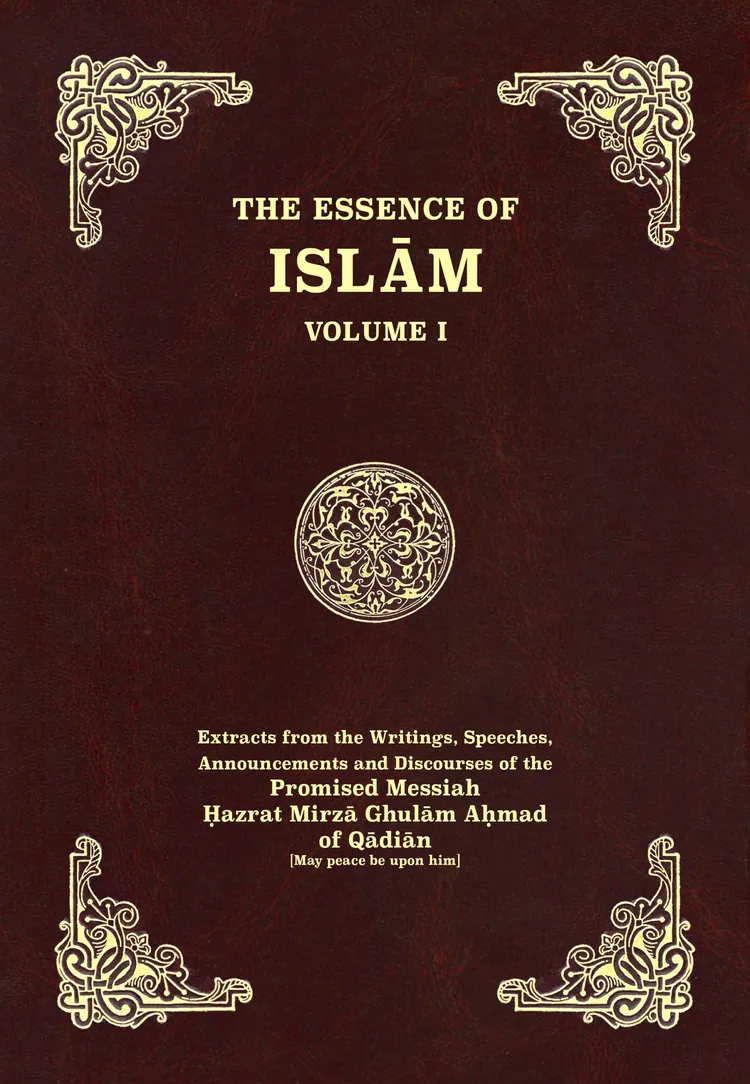
In this discourse from Essence of Islam (Volume 2), Hazrat Mirza Ghulam Ahmad (AS), the Promised Messiah and Mahdi, expounds upon Jihad With the Sword, presenting profound spiritual insights and scriptural verities.
Book Series: Essence of Islam (Volume 2)
Author: Hazrat Mirza Ghulam Ahmad of Qadian (AS)
Section: Part 9: Jihad With the Sword
Navigation: Book Table of Contents | « Previous: The Paying of Zakat | Next: Taking up Arms Against a Just Non-muslim Government Is Not Permitted »
319 The philosophy of Jihad and its true significance is so recondite and profound a matter that the people of this age and those of the middle ages have committed grave mistakes on account of their failure to understand it, which has rendered the teachings of Islam open to the criticism of its opponents, whereas Islam is a holy religion which is a mirror of the law of nature and manifests the glory of God. The root of the Arabic word Jihad means striving and has been metaphorically applied to fighting in the cause of religion…. Why did Islam have to resort to fighting and what is the purpose of Jihad? With the very birth of Islam it was confronted with great difficulties and all peoples conceived enmity against it. It has always been the case that on the advent of a Prophet or a Messenger his opponents, perceiving that his followers are a company of earnest, righteous and courageous people who are likely to march forward quickly, begin to entertain rancour and jealousy against them. More particularly is that the case with the divines and leaders of every religion…. They begin to devise projects to harm the new faith. Very often they feel in their hearts that by persecuting a righteous one of God they have become subject to God’s wrath and their wrongful conduct also betrays that their hearts feel guilty, yet the fierce fire of jealousy drives them into the pits of enmity. These were the causes which not only 113
[Government Angrezi Aur Jihad, Ruhani Khaza’in, vol. 17, pp. 3-6]
[Essence of Islam, Vol. 2, p. 319]
If the Christian missionaries would listen to me I would counsel them to refrain from raising objections which can be directed against their own scriptures also. For instance, one of their principal criticisms of the Holy Prophet (peace and blessings of Allah be on him) is directed against the battles that he had to wage under Divine command against those disbelievers who persecuted him and his companions for thirteen years at Mecca and inflicted every kind of torment upon them, 113 ‘Permission to fight is given to those against whom war is made, because they have been wronged—and Allah indeed has the power to help them. Those who have been driven out of their homes unjustly…’—Al-Hajj, 22:40-41 [Publisher] should be open to criticism because of the clemency extended to the enemy and because they fell short of the severity that characterised the battles of Moses and other Israeli Prophets. Had the battles fought by Islam imposed the same degree of severity upon the enemy as was done in the battles mentioned in the Bible, apparently the Christian missionaries would have accepted these battles also as having been carried out under the command of God Almighty. Now every sensible person can decide whether this attitude is an honest one. On the one hand the Christians proclaim that God is mercy, and even His punishment has an aspect of mercy. Then if the battles of Moses despite their severity are believed to have been directed by God Almighty, how is it that the battles that possessed the fragrance of Divine mercy are not accepted as having been imposed by God Almighty? Why should those who deem the slaughter of suckling babies before the very eyes of their mothers and the merciless slaughter of the mothers within sight of their children as having been carried out under Divine command, not accept as falling in the same category battles which a persecuted people were permitted to fight in order to repel the aggression of their persecutors?
[Arya Dharam, Ruhani Khaza’in, vol. 10, pp. 81-83, footnote]
[Essence of Islam, Vol. 2, p. 321]
If chastisement by the sword is in conflict with Divine attributes then this objection would apply primarily and very strongly to Moses who slaughtered whole peoples and caused rivers of blood to flow and left no room for anyone’s repentance. The battles undertaken according to the teachings of the Holy Qur’an kept the door of repentance open which is in accord with the law of nature and with Divine mercy. We observe that when God Almighty sends His punishment upon the world in the shape of plague or cholera, He, at the same time, bestows upon the physicians knowledge of such herbs and remedies as prove effective in putting out the fire of such epidemics. Therefore, it is the method of warfare adopted by Moses which is open to the objection that it did not permit a way of escape for the enemy according to the law of nature. Even when such a way was permitted, it was partial and not complete. It is clear that it has been the Divine way from the beginning that the wrongdoing enemies of the Prophets have been destroyed by the sword. Then why is a similar commandment in the Holy Qur’an considered as open to objection? Was the God of the time of Moses different from the God of the time of Islam? Or is it that in the time of Moses God loved battle, but now He considers it an evil? Taking Up Arms Against a Just Non-Muslim Government is not Permitted It should also be remembered that Islam permits the taking up of the sword only in opposition to people who themselves take it up first, and it permits the slaughter only of those who embark upon slaughter first. It does not lay down that the Muslims while they are the subjects of a non-Muslim sovereign who deals with them with justice and equity should take up arms against him as rebels. According to the Holy Qur’an this is the way of the wicked and not of the righteous. But the Torah has not made this distinction clear at any place. This shows that the Holy Qur’an in all its commandments, whether of majesty or of beauty, adheres to the straight line of equity, justice, mercy and beneficence and is unique in this respect also among all the scriptures.
[Essence of Islam, Vol. 2]
[Essence of Islam, Vol. 2, p. 323]
Book Series: Essence of Islam (Volume 2)
Author: Hazrat Mirza Ghulam Ahmad of Qadian (AS)
Section: Part 9: Jihad With the Sword
Navigation: Book Table of Contents | « Previous: The Paying of Zakat | Next: Taking up Arms Against a Just Non-muslim Government Is Not Permitted »