
Are Languages the Invention of Man? — Essence of Islam Vol. 2
Introduction
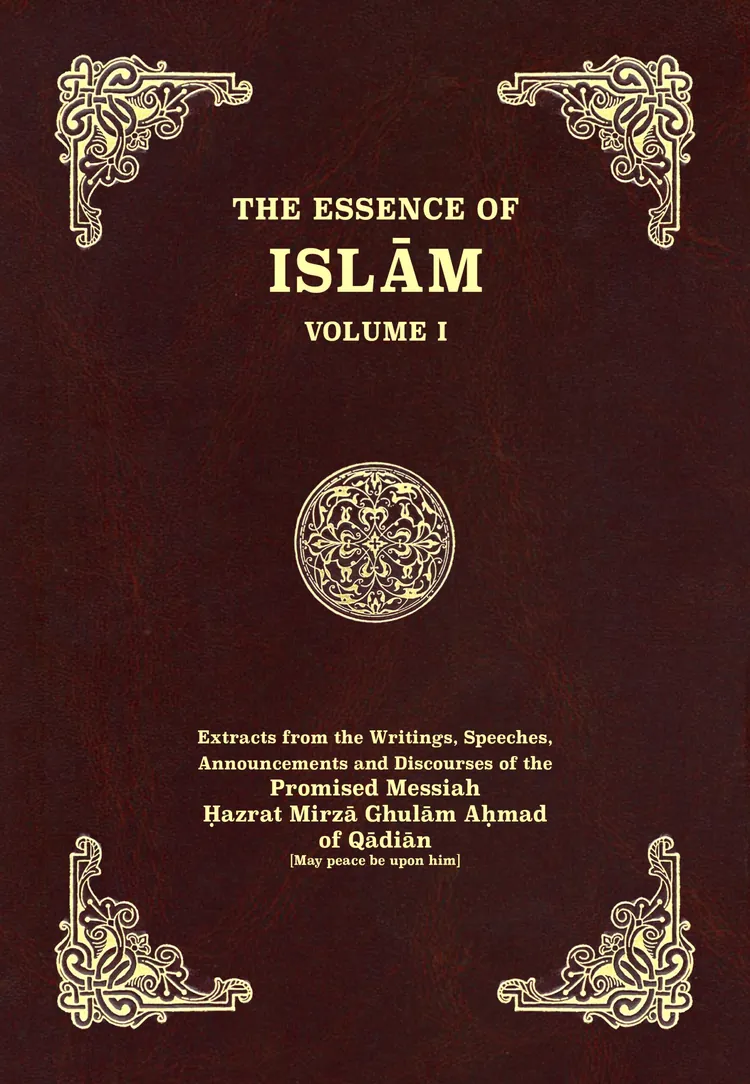
In this discourse from Essence of Islam (Volume 2), Hazrat Mirza Ghulam Ahmad (AS), the Promised Messiah and Mahdi, expounds upon Are Languages the Invention of Man?, presenting profound spiritual insights and scriptural verities.
Book Series: Essence of Islam (Volume 2)
Author: Hazrat Mirza Ghulam Ahmad of Qadian (AS)
Section: Part 1: Arabic, the Mother of Tongues
Navigation: Book Table of Contents | « Previous: Arabic, the Mother of Tongues | Next: Announcement for the Book Minan-ur-Rahman »
about changes in languages, in the beginning languages might have been originated in the same way without the need of revelation? The answer is that in the beginning God had created everything simply through His power. Reflection on heaven, earth, sun, moon and on human nature itself would disclose that the beginning and origin of everything was through the pure operation of Divine power, in which no physical means were involved. Whatever God created was a manifestation of His supreme power, which is beyond the concept of man…. The circumstances of today cannot serve as a precedent for the beginning and origin of creation. For instance, today no child is born without the agency of parents, but if in the beginning the same condition had been essential, man could not have come into being. Moreover, there is a world of difference between changes that naturally occur from time to time in languages and the birth of speech itself in the original void. The two concepts are entirely different.
[Brahin-e-Ahmadiyya, Ruhani Khaza’in, vol. 1, pp. 358-404]
[Essence of Islam, Vol. 2, p. 2]
Some ignorant Aryas, holding Sanskrit as the language of Permeshwar, consider all other languages, which comprise of hundreds of Divine wonders and curiosities, as the invention of man; as if while Permeshwar revealed one language, men invented scores of languages better than that one. We would inquire from the Aryas that if it is true that Sanskrit was issued from the mouth of Permeshwar, and all other languages are the inventions of men and have no relationship with Permeshwar, what are the particular characteristics of Sanskrit which are not to be found in other languages; for the speech of Permeshwar must have superiority over the inventions of men. He is called God because He is Matchless and Supreme in His Being, attributes and works. If we are to suppose that Sanskrit is the language of Permeshwar, which was revealed to the ancestors of the Hindus, and that other languages were invented by the ancestors of other people who were cleverer and wiser than the ancestors of the Hindus, then could we also suppose that those other people were somewhat superior to Permeshwar of the Hindus in that they, through their perfect power, invented hundreds of languages and Permeshwar could invent no more than one? Those whose very natures are permeated with polytheism consider Permeshwar to be an equal entity with themselves in many respects, perhaps because they esteem themselves as uncreated and, therefore, partners in the Godhead. The objection as to why God did not content Himself with the creation of just one language, results from lack of reflection. If a wise person were to observe the diversity of modes and temperaments of people of different countries, he would be convinced that one language would not have suited all of them. The people of some countries can easily pronounce certain letters and words, but for the people of some other countries the pronouncing of those letters and words would be a great hardship. How was it then possible that the All-Wise One, loving only one language, should have ignored the principle of: 1
and should have abandoned that which would have been appropriate for the diversity of temperaments. Would it have been proper that He should have confined people of
different temperaments in the narrow cage of one language? Moreover, the creation of a diversity of languages would have been proof of the multiple power of God Almighty. The praise of God offered by His humble creatures in a variety of languages is in itself a most attractive spectacle.
[Brahin-e-Ahmadiyya, Ruhani Khaza’in, vol. 1, pp. 447-456]
[Essence of Islam, Vol. 2, p. 2]
Book Series: Essence of Islam (Volume 2)
Author: Hazrat Mirza Ghulam Ahmad of Qadian (AS)
Section: Part 1: Arabic, the Mother of Tongues
Navigation: Book Table of Contents | « Previous: Arabic, the Mother of Tongues | Next: Announcement for the Book Minan-ur-Rahman »