
Faith Without Understanding Is Not Enough for Salvation — Essence of Islam Vol. 2
Introduction
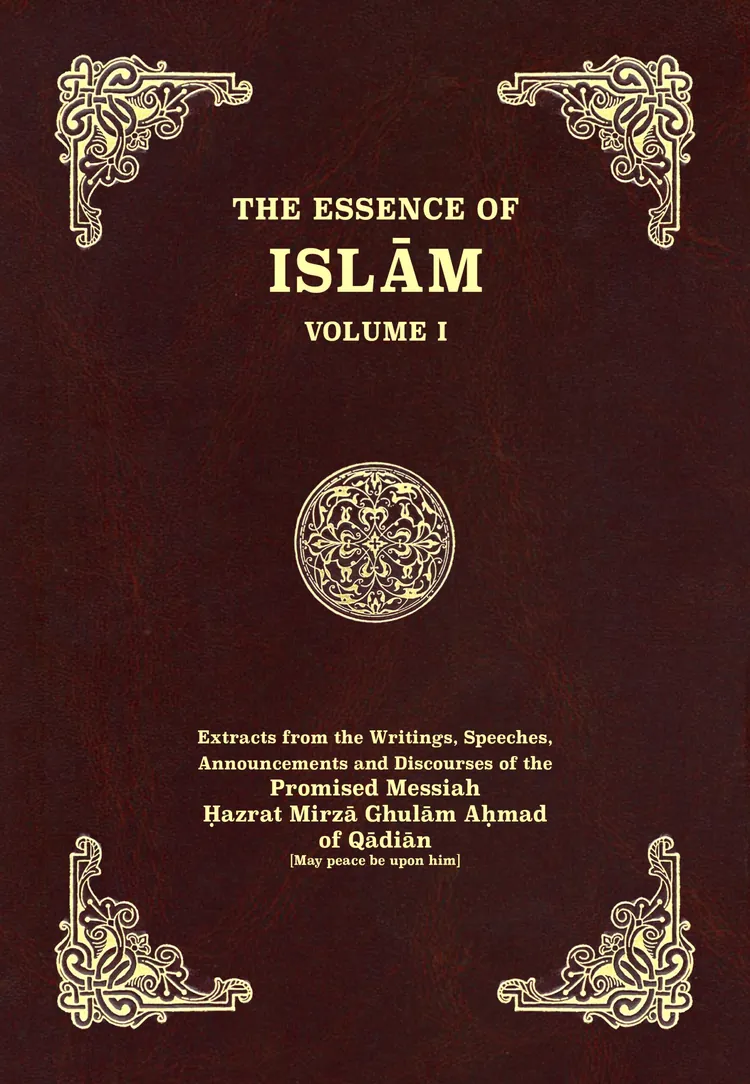
In this discourse from Essence of Islam (Volume 2), Hazrat Mirza Ghulam Ahmad (AS), the Promised Messiah and Mahdi, expounds upon Faith Without Understanding Is Not Enough for Salvation, presenting profound spiritual insights and scriptural verities.
Book Series: Essence of Islam (Volume 2)
Author: Hazrat Mirza Ghulam Ahmad of Qadian (AS)
Section: Part 7: Salvation
Navigation: Book Table of Contents | « Previous: The Cause of Spiritual Decline | Next: Why Sins Are Committed and How They Can Be Avoided »
88
This means that the sacrificial meat you offer cannot reach Me, nor can its blood. On the contrary, the only sacrifice that reaches Me is that you shall fear Me, and be righteous for My sake.
[Lecture Lahore, Ruhani Khaza’in, vol. 20, pp. 150-152]
[Essence of Islam, Vol. 2, p. 254]
this answer many people will exclaim: Do we not believe in God; do we not fear God and love Him; does not the whole world, with few exceptions, believe in God? Then why is it that they commit all manner of sins and appear involved in diverse forms of wickedness? The answer to this is that faith is one thing and understanding is another. I do not mean that a believer avoids sin, but I mean that a man of perfect understanding avoids it, that is to say a person who has tasted both the fear of God and the love of God. Someone might ask: Why is Satan disobedient though he possesses perfect understanding? The answer is that Satan does not possess that perfect understanding which is bestowed upon the fortunate ones. It is part of human nature that man is necessarily influenced by perfect knowledge and that he does not place himself in the way of ruin when he beholds its terrible countenance. Faith only means to believe as the result of thinking well of a thing; but understanding means to behold that in which one has put one’s faith. Thus understanding and sin cannot exist together in a heart as day and night cannot co-exist at the same time. It is your daily experience that when something proves to be useful, one is immediately attracted towards it and when something is proved to be harmful, one begins to fear it. For instance, if a person does not know that what he has in his hand is arsenic he might swallow a large dose of it deeming it to be some useful medicine. But he who knows that it is a fatal poison will not swallow even the smallest quantity of it, for he would realize that by the eating of it he would pass out from this world. In the same way, when a person knows for certain that God undoubtedly exists and that every type of sin is punishable in His estimation, all sins automatically fall away from him. Why Sins are Committed and How they can be Avoided Someone might raise the question that while we know that God exists and we also know that sins will be punished, yet we commit sins, which shows that we need some other way of avoiding sin. Our answer would still be that which we have already given. It is not at all possible that realizing fully that with the commission of a sin its punishment would fall upon you like lightning, you would yet dare to commit sin. This is the philosophy that is not open to any objection or exception. Reflect well that when you are quite certain of being punished for a sin, you will not act contrary to this certainty. Would you thrust your hand into the fire? Would you jump down from the top of a mountain? Would you jump into a well? Would you lie down in front of a running train? Would you thrust your arm into the mouth of a tiger? Would you present your foot to a mad dog? Can you stay somewhere where lightning is striking repeatedly? Do you not run out quickly from a room the roof of which is about to fall down? Is there any one of you who would not jump out of bed on perceiving a poisonous snake in it? Is there anyone who would not run out of a room in which he is sleeping and in which a fire has broken out? Tell me, why do you do this and run away from all these harmful things, but do not run away from the sins to which I have drawn your attention? The only answer that a wise person can give after full reflection is that there is a difference of knowledge in the two cases. In the matter of sins, the knowledge of most people is defective. They consider sins as evil, but do not look
[Essence of Islam, Vol. 2]
[Essence of Islam, Vol. 2, p. 254]
Book Series: Essence of Islam (Volume 2)
Author: Hazrat Mirza Ghulam Ahmad of Qadian (AS)
Section: Part 7: Salvation
Navigation: Book Table of Contents | « Previous: The Cause of Spiritual Decline | Next: Why Sins Are Committed and How They Can Be Avoided »