
Khalq [Creation] and Khulq [Morals] — Essence of Islam Vol. 3
Introduction
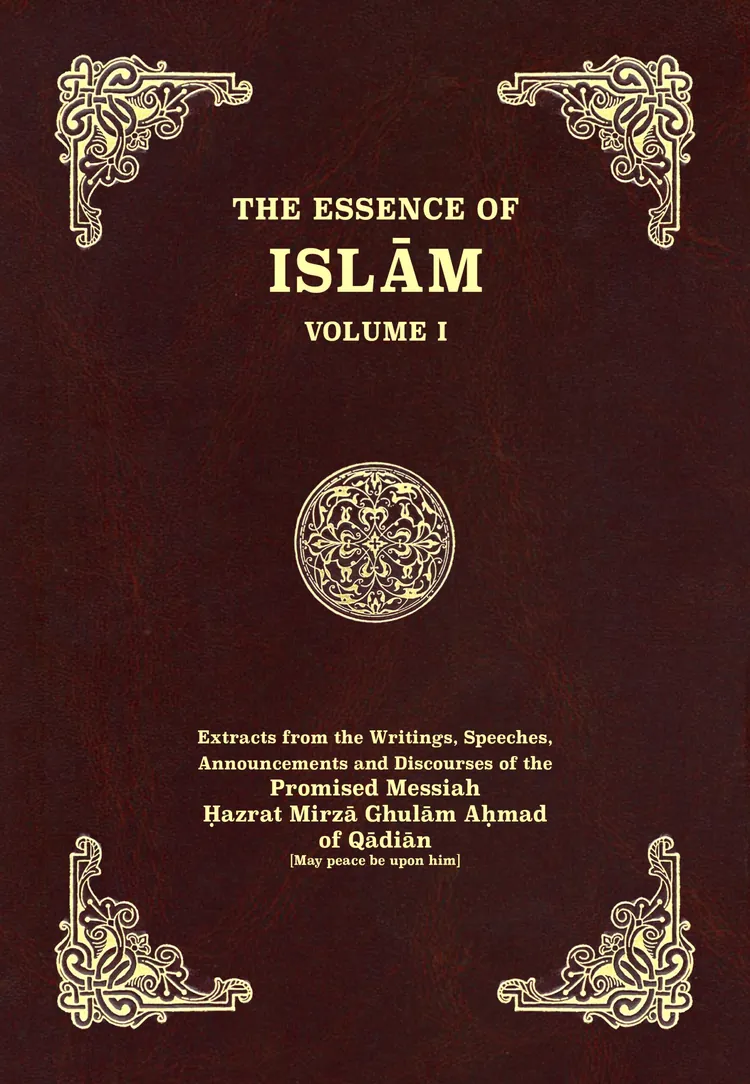
In this discourse from Essence of Islam (Volume 3), Hazrat Mirza Ghulam Ahmad (AS), the Promised Messiah and Mahdi, expounds upon Khalq [Creation] and Khulq [Morals], presenting profound spiritual insights and scriptural verities.
Book Series: Essence of Islam (Volume 3)
Author: Hazrat Mirza Ghulam Ahmad of Qadian (AS)
Section: Part 1: Natural, Moral and Spiritual States of Man
Navigation: Book Table of Contents | « Previous: Three Methods of Reform | Next: Natural States Become Moral by Proper Regulation »
Three Methods of Reform
[Islami Usul ki Philosophy, Ruhani Khaza’in, vol. 10, pp. 327-328]
I have mentioned that there are three sources of human states, namely, Nafs-e-Ammarah [the self that incites to evil], Nafs-e-Lawwamah [the self-reproaching self] and Nafs-e-Mutma’innah [the soul at rest.] Similarly, there are three methods of reform. The first method of reform is that savages should be trained in rudimentary morals so that they follow the etiquette pertaining to social matters like eating, drinking, marriage, etc. They should not go about naked, nor eat carrion, nor exhibit any other ill manners. This is the elementary stage of reform of the natural state. It is the type of reform that should be adopted, for example, when teaching proper manners to a wild savage of Port Blair whom one should start instructing in basic morals and manners. The second method of reform is that, after a person has acquired basic human manners, he should be instructed in higher moral qualities and taught to exercise all human faculties on their proper occasion and place. The third method of reform is that those who have formally learned to exercise morals should be taught to relish the taste of true Love and Communion. These are the three reforms mentioned in the Holy Qur’an.
[Essence of Islam, Vol. 3, p. 8]
People commonly take Khulq [morals] to means meekness, courtesy and humility. They are wrong. The truth is that corresponding to every physical action there is an inner quality which is called Khulq [moral]. For instance, a person sheds tears through the eyes and, corresponding Natural, Moral and Spiritual States of Man 9 to this action, there is an inner quality called tenderness which takes on the character of a moral quality when exercised on its proper occasion and under the control of God-given wisdom. In the same way, a person defends himself against the attack of an enemy with his hands, and corresponding to this physical action there is an inner quality called bravery. When a person shows bravery on its proper occasion, it becomes a moral quality. In the same way, sometimes a person tries to save the oppressed from the oppressors, wishes to make some provisions for the indigent and the hungry, or seeks to serve humanity in some other way, and corresponding to such an action there is an inner quality called mercy. Sometimes a person punishes a wrongdoer, and corresponding to this action there is an inner quality called retribution. Sometimes a person is attacked, but he does not want to retaliate in kind and condones the wrong of a wrongdoer, and corresponding to this action there is an inner quality called forgiveness and forbearance. Sometimes a person uses his hands or feet, or employs his head or heart or his wealth to promote the welfare of his fellow beings, and corresponding to this action there is an inner quality called generosity. When a person exercises all these qualities at their proper time and place, they are called moral qualities. Addressing our Holy Prophet (peace and blessings of Allah be upon him), Allah the Glorious, says: 5
That is, ‘Yours is indeed the most exalted moral station.’
[Islami Usul ki Philosophy, Ruhani Khaza’in, vol. 10, pp. 332-333]
[Essence of Islam, Vol. 3, p. 8]
Natural States Become Moral by Proper Regulation Natural states are not something apart from moral states. When employed temperately on their proper place and occasion, and regulated by reason, natural states acquire the character of moral states. When exercised without the control and advice of reason and understanding, they are not truly moral; however much they may resemble them, they are no more than the involuntary exercise of natural impulses. For instance, if a dog or a goat shows love or docility towards its master, the dog will not be considered moral nor will the goat be called civilized, nor, for that matter, will we describe a wolf or a tiger as immoral on account of its savage nature. As we have already said, a moral quality emerges only when reflection and regard for the appropriate time and occasion come into play. A person who does not exercise reason and prudence is like the suckling whose mind and intellect are not yet governed by reason, or like the insane who have lost their reason and intelligence. Sometimes a suckling or an insane person does appear to act in a manner which looks ethical, but no sensible person would call them moral as such behaviour does not spring from discretion and propriety but is a natural response to stimuli. For example, a human baby seeks its mother’s breast immediately after it is born; a chicken runs to pick up grain as soon as it is hatched; a newly hatched leech behaves like a leech; a baby snake acts like a snake; and a tiger cub conducts itself like a tiger. Particularly, one should carefully observe a human baby to see how, immediately after it is born, it begins to behave like humans, and these natural habits become more pronounced after a year or so. For instance, its crying be-
[Essence of Islam, Vol. 3]
[Essence of Islam, Vol. 3, p. 9]
Book Series: Essence of Islam (Volume 3)
Author: Hazrat Mirza Ghulam Ahmad of Qadian (AS)
Section: Part 1: Natural, Moral and Spiritual States of Man
Navigation: Book Table of Contents | « Previous: Three Methods of Reform | Next: Natural States Become Moral by Proper Regulation »