
Meaning and High Station of the Seal of Prophethood — Essence of Islam Vol. 1
Introduction
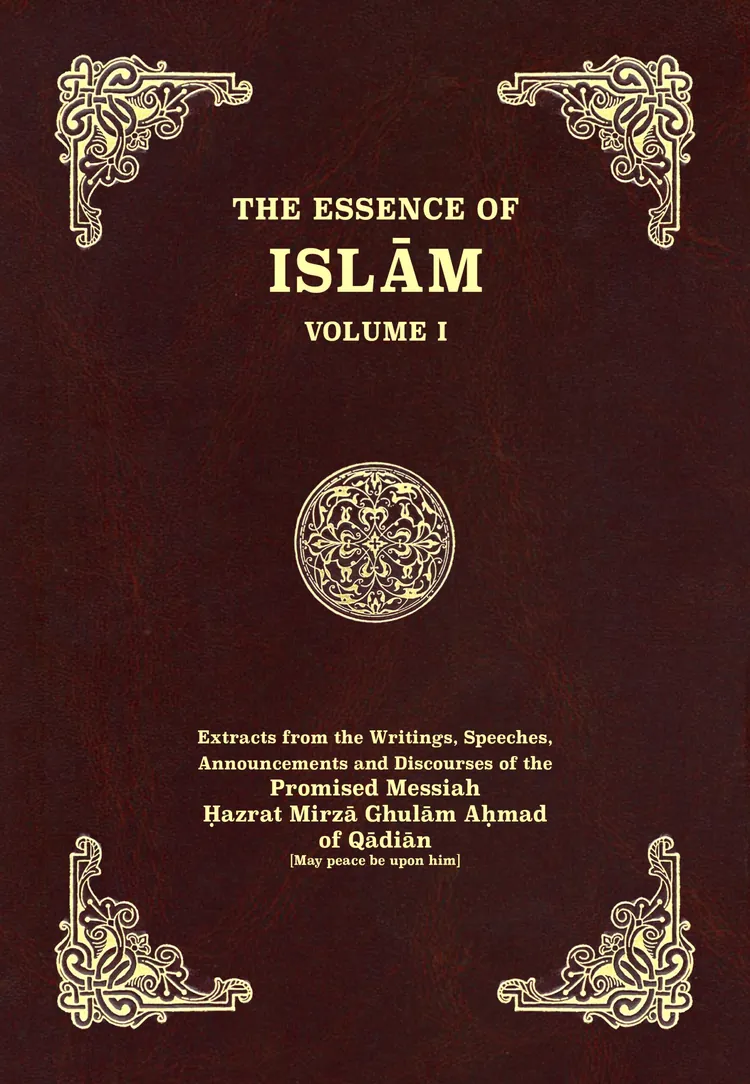
In this discourse from Essence of Islam (Volume 1), Hazrat Mirza Ghulam Ahmad (AS), the Promised Messiah and Mahdi, expounds upon Meaning and High Station of the Seal of Prophethood, presenting profound spiritual insights and scriptural verities.
Book Series: Essence of Islam (Volume 1)
Author: Hazrat Mirza Ghulam Ahmad of Qadian (AS)
Section: Part 3: The Holy Prophet (sa)
Navigation: Book Table of Contents | « Previous: Spiritual Ascent of the Holy Prophet (sa) | Next: Istighfar of the Holy Prophet (sa) »
The perfect man to whom the Holy Qur’an was revealed, was not limited in his vision, nor was there any deficiency in his sympathy in the sharing of sorrows. Both from the point of view of the time and of the place, his soul was charged with perfect sympathy. He was, therefore, bestowed a full share of the manifestations of nature and he was made Khatam-ul-Anbiya’, which did not mean that no one would from then on receive any spiritual grace from him, rather that he possessed the seal of Prophethood and that without the attestation of that seal, no grace can reach anyone, and that for his people, the
door of converse with the Divine would never be closed. Beside him, there is no Prophet who possesses the seal of Prophethood. It is only by the testimony of his seal that a Prophethood can be bestowed for which it is a condition that the recipient must be a follower of the Holy Prophet [peace and blessings of Allah be on him]. His high courage and sympathy did not wish to leave his people in a condition of deficiency and were not reconciled to the door of revelation, which is at the root of all understanding, being closed. Yet, in order to preserve the sign of the closing of Prophethood, he desired that the grace of revelation should be bestowed through obedience to him and that this door should be closed to anyone who was not his follower. God appointed him Khatam-ul-Anbiya’ in this sense.
[Haqiqat-ul-Wahi, Ruhani Khaza’in, Vol. 22, pp. 29-30]
Thus it was established till the Day of Judgement, that a person who does not prove being his follower through true obedience and who does not devote his full being to obeying him, cannot become the recipient of perfect revelation. Direct Prophethood has been ended with the Holy Prophet [peace and blessings of Allah be on him]; but Prophethood by way of reflection, which means the receipt of revelation through the grace of Muhammad [peace and blessings of Allah be on him] will continue till the Day of Judgement, so that the door of perfection of mankind should not be closed and this sign should not disappear from the world that the high resolve of the Holy Prophet [peace and blessings of Allah be on him] desired that the doors of converse with the Divine should remain open till the Judgement Day and the understanding of the Divine, which is the basis of salvation, should not disappear.
[Essence of Islam, Vol. 1, p. 254]
I affirm it with full confidence that the excellences of Prophethood attained their climax in the Holy Prophet [peace and blessings of Allah be on him]. The person who sets up a movement in opposition to him and puts forward some verity outside his Prophethood and withdraws from the fountain of Prophethood is false and an impostor. I say it plainly that a person who believes in anyone as a Prophet after the Holy Prophet [peace and blessings of Allah be on him] and breaks the seal of his Prophethood, is accursed. That is why no Prophet can arise after the Holy Prophet [peace and blessings of Allah be on him] who has not with him the seal of the
[al-Hakam, 10 June 1905, p. 2]
Muhammadi Prophethood.
The Muslims who are opposed to us are involved in the error that they believe in the coming of an Israeli Prophet, who would break the seal of Prophethood. I say that it is a manifestation of the spiritual power of the Holy Prophet [peace and blessings of Allah be on him] and of his everlasting Prophethood that 1,300 years after him, the Promised Messiah has appeared under his training and instructions with the same seal of Prophethood. If this doctrine is kufr, I hold this kufr dear. But those whose reason has been darkened and who have not been bestowed any share in the light of Prophethood cannot understand this and hold it as kufr; whereas, this is a matter which proves the perfection of the Holy Prophet [peace and blessings of Allah be on him] and his everlasting life.
[Essence of Islam, Vol. 1, p. 256]
There is no need to follow the Prophethoods and Books which passed before the Holy Prophet [peace and blessings of Allah be on him] as Muhammadi Prophethood comprises all
of them, and beside it all ways are closed and all verities are included in it. No new verity will arrive after it as there was no verity before it which is not included in it. Therefore, all Prophethood ends with this Prophethood; and so it should have been, for everything that has a beginning, has also an end, but the Muhammadi Prophethood is not deficient in beneficence. It is more beneficent than all other Prophethood. Following this Prophethood, one reaches God in a very easy manner, and by following it one is bestowed the bounty of Divine love and Divine converse more than was possible before.
[al-Wasiyyat, Ruhani Khaza’in, Vol. 20, p. 311]
Its perfect follower cannot be called simply a Prophet for this would be an insult to the perfect Muhammadi Prophethood. He can be called a follower of the Holy Prophet and a Prophet, both together, for in this there is no insult of the perfect Muhammadi Prophethood, but its grace shines forth even to a greater degree.
[Essence of Islam, Vol. 1, p. 256]
We affirm that the person who moves away in the slightest degree from the law of the Holy Prophet [peace and blessings of Allah be on him] is a kafir. When anyone who turns away from following the Holy Prophet [peace and blessings of Allah be on him] is a kafir in our estimation, then what about one who should claim to bring a new law, or should make a change in the Holy Qur’an and the Sunnah of the Holy Prophet [peace and blessings of Allah be on him] or should abrogate any commandment?
In our estimation only that person is a believer who truly follows the Holy Qur’an, and believes it to be the last revealed Book, and accepts the law that the Holy Prophet [peace and blessings of Allah be on him] brought into theworld, as everlasting, and makes not the slightest change in it, and loses himself wholly in following it, and devotes every particle of his being to its cause, and does not oppose it intellectually or by his conduct. It is then that he would be a true Muslim.
[al-Hakam, 6 May 1908, p. 5]
[Essence of Islam, Vol. 1, p. 257]
Istighfar of the Holy Prophetsa
Most Christians, on account of their ignorance of the reality of Maghfirat—forgiveness—imagine that a person who seeks Maghfirat, is disobedient and sinful. A deep reflection over the meaning of Maghfirat makes it clear that it is the one who does not seek Maghfirat of God Almighty who is disobedient and vile. As every true purity is bestowed by Him and He alone safeguards one against the storm of passion, it should be a preoccupation of His righteous servants to constantly seek Maghfirat from that True Guardian and Protector.
[Essence of Islam, Vol. 1]
If we were to seek an illustration of Maghfirat in the physical world the best illustration would be that Maghfirat is a strong and unbreakable dam which is erected to hold back a flood. As all strength and all power belongs to God Almighty, and a man is weak in his soul as he is in his body, and seeks water from the Eternal Being all the time for the nurture of the tree of his being, and cannot keep alive without His grace, Istighfar, in its meaning that we have set out, becomes necessary and essential. As a tree puts forth its branches in all directions, as if it spreads its hands towards the surrounding spring of water, pleading for help that its greenness should not decline and that the time of its flowering and putting forth fruit should not be lost, the same is the case with
[Essence of Islam, Vol. 1, p. 258]
Book Series: Essence of Islam (Volume 1)
Author: Hazrat Mirza Ghulam Ahmad of Qadian (AS)
Section: Part 3: The Holy Prophet (sa)
Navigation: Book Table of Contents | « Previous: Spiritual Ascent of the Holy Prophet (sa) | Next: Istighfar of the Holy Prophet (sa) »