
Characteristics of the Holy Qur’an — Essence of Islam Vol. 2
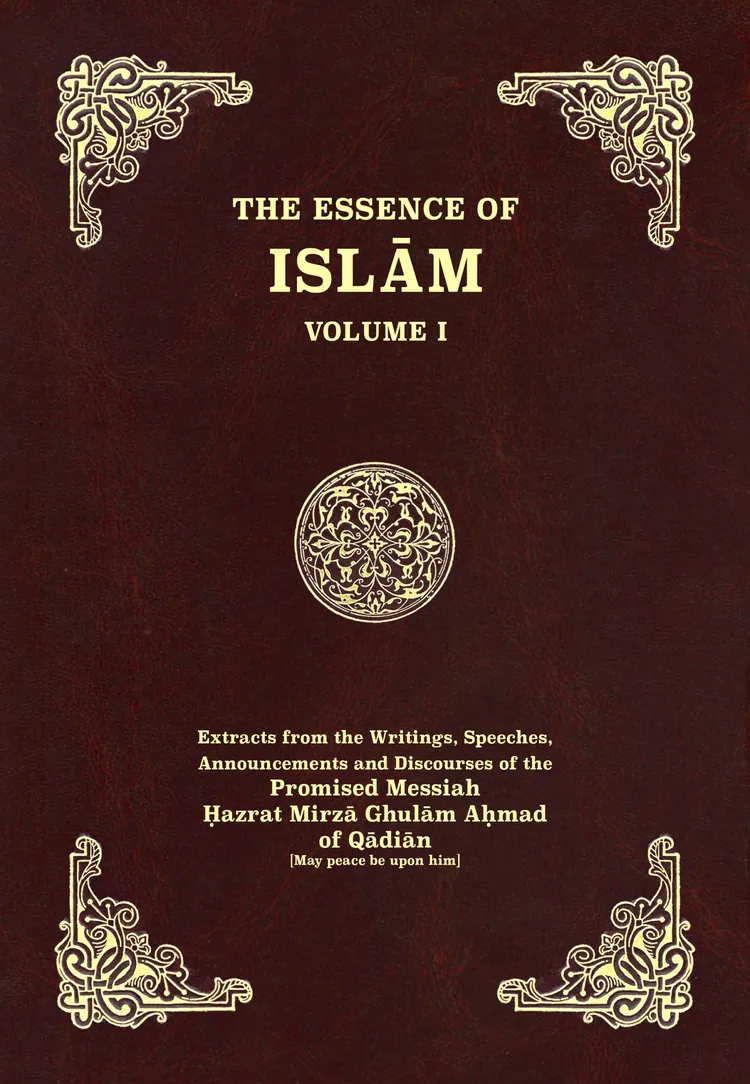
Introduction
In this discourse from Essence of Islam (Volume 2), Hazrat Mirza Ghulam Ahmad (AS), the Promised Messiah and Mahdi, expounds upon Characteristics of the Holy Qur’an, presenting profound spiritual insights and scriptural verities.
Book Series: Essence of Islam (Volume 2)
Author: Hazrat Mirza Ghulam Ahmad of Qadian (AS)
Section: Part 1: Arabic, the Mother of Tongues
Navigation: Book Table of Contents | « Previous: Why Arabic is Superior to Other Languages? | Next: Special Characteristics of Arabic »
(5) Arabic has the full capacity for the exposition of all human feelings and thoughts. Now everyone is at liberty after the publication of our book to try, if possible, to prove these qualities in Sanskrit or any other language.
[Dia-ul-Haq, Ruhani Khaza’in, vol. 9, pp. 250,320-321]
[Essence of Islam, Vol. 2, p. 6]
The Holy Qur’an is such a brilliant ruby and a glorious sun that the rays of its truth and the flashes that indicate its Divine origin are being manifested not only in one aspect, but in thousands of them. The more the opponents of Islam strive to put out this Divine light, the stronger becomes its manifestation, and the more it attracts the hearts of those who possess insight, with its beauty and loveliness. Even in this dark age, when the Christian missionaries and the Aryas have spared no effort to denigrate it and to bring it into contempt, and have on account of their sightlessness attacked this light in every form that could be employed by the bigoted and the ignorant, this eternal light has furnished every type of proof of its being from God. One of its grand characteristics is that it sets forth its claims with respect to its guidance and its excellent qualities and itself furnishes the proof of those claims. This grand characteristic is not possessed by any other book. Out of the reasons and proofs that it has set forth in support of its Divine origin and its high-grade superiority, one great proof is that for detailed exposition of which we have compiled this book. It is a product of the holy spring of the mother of tongues, whose water shines like the stars, slakes the thirst of those who are thirsty for comprehension, and washes out the dirt of doubt and suspicion. No previous book has set forth this proof in support of its truth. If the Vedas or any other book has set forth such proof, then the followers of such a book should present the claim for such proof in the words of that book. The purport of this proof is that a comparative examination of different languages discloses that all languages are related to each other.
Further and deeper study establishes that the mother of all these related languages is Arabic, from which all these languages have emerged. A complete and comprehensive research then discloses that its extraordinary qualities compel the acknowledgement that Arabic is not only the mother of tongues but is a revealed language which the first man was taught by the special design of God Almighty, and that it was not invented by any man. This leads to the conclusion that Arabic alone is suited for the complete and perfect Divine revelation, inasmuch as it is necessary that the Divine Book that has been revealed for the guidance of the whole of mankind should be expressed in a revealed language which should be the mother of tongues so that it should have a natural relationship with every language and the speakers of every language, and that being revealed it should possess the blessings with which everything that proceeds from the blessed hands of God Almighty is invested. But as the other languages were also not deliberately framed by men and have all emerged under Divine direction from this holy language, and have been corrupted but are all the progeny of this language, it was not inappropriate that for particular people guidance should have been revealed in those languages. Yet it was necessary that the highest and most perfect Book should be revealed in Arabic because Arabic is the mother of tongues and is the true revealed language, having issued from the mouth of God First stage: Proof that all languages are interrelated. Second stage: Proof that Arabic is the mother of tongues. Third stage: Proof that on account of its extraordinary qualities Arabic is a revealed language…. The interrelation of languages has been established so clearly in this book that no further research in this respect can be imagined….
The second issue is that out of interrelated languages, Arabic alone is the mother of tongues, the proof of which has been set out in detail, and we have established that one of the special qualities of Arabic is that it possesses a natural pattern and displays the beauty of Divine manufacture in the same way as the other works of God Almighty. We have also established that all other languages present a distorted picture of the Arabic language. To the degree to which this blessed language has been preserved in those languages in its true form, to that degree they shine like a ruby and attract the hearts with their charming beauty. But to the degree to which a language has been corrupted, to that degree its beauty and attractions have been reduced. It is obvious that a thing that proceeds from the hand of God continues to display extraordinary characteristics so long as it retains its original form, and man is not able to produce its match. But as soon as it falls away from its original condition, its shape and beauty are debased….
The Arabic language operates like the wise person of refined taste who can express his meaning in diverse ways. For instance, a clever and intelligent person can sometimes accomplish with the movement of a brow, nose or hand that which normally requires expression in words; that is to say, he can convey his meaning through delicate nuances. This is a method also employed by Arabic. Sometimes by the use of the definite article it conveys a meaning that would need several words in other languages. Similarly vowel points often serve a purpose which would require long phrases in other languages. Some brief words have surprisingly rich connotations; for instance, ‘aradtu means ‘I have visited Mecca and Medina and their environs’, and tahfaltu means ‘I am accustomed to eating bread made of Cheena2 and have decided not to eat any other kind’….
One of the characteristics of Arabic is that all the miscellaneous qualities of other languages are comprised inArabic…. Thus as careful study and deep research reveal that Arabic is comprehensive of all the miscellaneous qualities of other languages, it has to be acknowledged that all other languages are branches of Arabic. Some people raise the objection that if one language is acknowledged as the root of all languages, it becomes difficult to accept that within three or four thousand years languages, which had emerged from one root, became so diverse. This objection is an instance of a fallacy upon a fallacy. In the first place, it is not definitely established that the world is only four or five thousand years old and that heaven and earth had no existence before. On the contrary, there are clear indications that the earth has been peopled since a very long time. Besides, distance in time or place is not the only cause of diversity in language. A powerful cause of this diversity is that every region of the earth affects the throats, tones and pronunciation of its inhabitants in a particular way in consequence of its latitudinal situation, or its juxtaposition vis- à-vis other planets, or on account of some other unknown causes, and these factors produce a particular form of speech. That is why the peoples of certain countries are not able to pronounce Z or R properly. As complexions, spans of life, manners, morals and constitutions differ from country to country, likewise speech also differs, for the same causes affect speech also; and the degree of difference is determined by the degree of the causes. This difference is not arbitrary but is determined by physical laws. Thus a change, which occurs in the shape, or manners, or morals, or thinking of people under the influence of earthly or heavenly causes, also affects their speech. If a foreign word or phrase finds its way into their language, they change it about. This is clear proof that speech is affected by earthly and heavenly causes.
[Essence of Islam, Vol. 2]
The Jews and the Christians are compelled to acknowledge that Arabic is the mother of tongues as the Torah clearly affirms that there was only one language in the beginning…. Some people raise the objection that the relationship of some languages with Arabic, for instance that of Hebrew, is much closer than that of other languages like Sanskrit or European languages. The answer is that despite this difference it has been ascertained that the elementary words and phrases of these languages have been derived from Arabic and have been further developed through natural changes.
[Essence of Islam, Vol. 2, p. 6]
Book Series: Essence of Islam (Volume 2)
Author: Hazrat Mirza Ghulam Ahmad of Qadian (AS)
Section: Part 1: Arabic, the Mother of Tongues
Navigation: Book Table of Contents | « Previous: Why Arabic is Superior to Other Languages? | Next: Special Characteristics of Arabic »