
Special Characteristics of Arabic — Essence of Islam Vol. 2
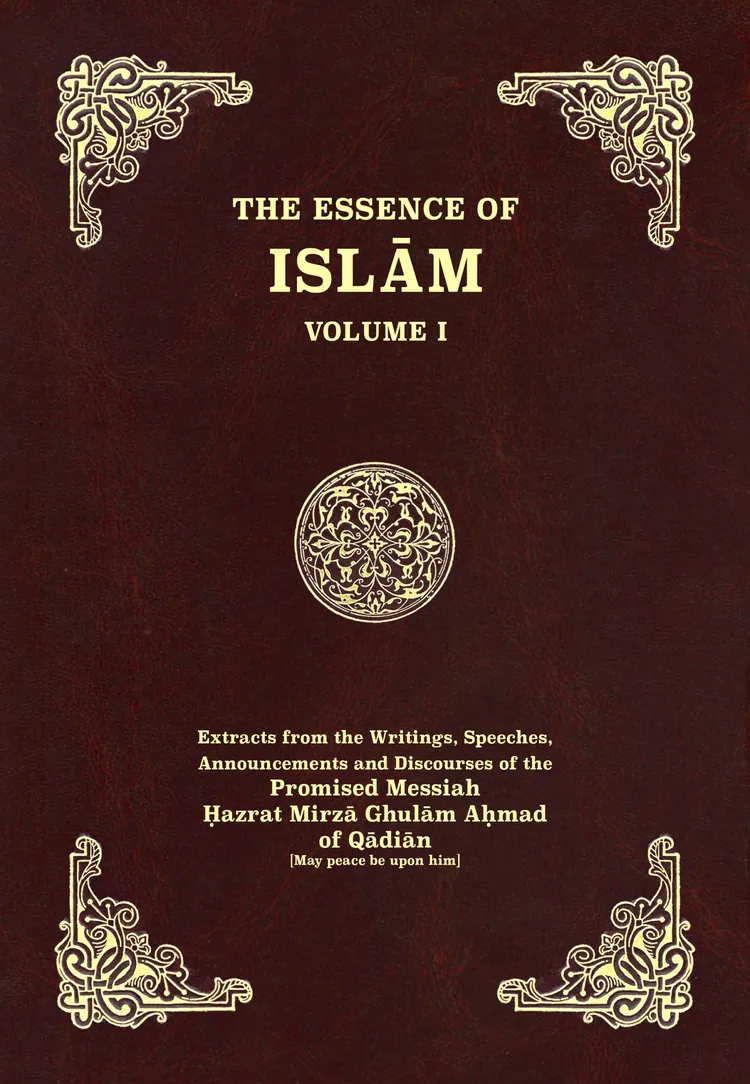
Introduction
In this discourse from Essence of Islam (Volume 2), Hazrat Mirza Ghulam Ahmad (AS), the Promised Messiah and Mahdi, expounds upon Special Characteristics of Arabic, presenting profound spiritual insights and scriptural verities.
Book Series: Essence of Islam (Volume 2)
Author: Hazrat Mirza Ghulam Ahmad of Qadian (AS)
Section: Part 1: Arabic, the Mother of Tongues
Navigation: Book Table of Contents | « Previous: Characteristics of the Holy Qur’an | Next: Faculty of Speech Is the Basic Reality of Man »
that speech is affected by earthly and heavenly causes.
[Minan-ur-Rahman, Ruhani Khaza’in, vol. 9, pp. 128-142]
The Jews and the Christians are compelled to acknowledge that Arabic is the mother of tongues as the Torah clearly affirms that there was only one language in the beginning…. Some people raise the objection that the relationship of some languages with Arabic, for instance that of Hebrew, is much closer than that of other languages like Sanskrit or European languages. The answer is that despite this difference it has been ascertained that the elementary words and phrases of these languages have been derived from Arabic and have been further developed through natural changes. There are five special characteristics of Arabic, which prove conclusively that Arabic is a revealed language, which we shall expound in detail in their proper places. These are: First Characteristic: Arabic has a perfect pattern of roots, which is suited to human needs. Other languages lack this pattern. Second Characteristic: The names of God, and of heavenly bodies, vegetables, animals, solids, and human limbs in Arabic comprise great wisdom. Other languages cannot compete with Arabic in this respect. Third Characteristic: The Arabic system of elementary words is perfect, and comprises all nouns and verbs of the same roots, and illustrates their mutual relationship by arranging them in a wise pattern. This characteristic is not found in other languages in the same perfect degree. Fourth Characteristic: In Arabic idiom a few words comprise extensive meanings. Arabic conveys extensive connotations through the use of the definite article and vowel points and sequence, for which purpose other languages have to employ several phrases and sentences. Fifth Characteristic: Arabic possesses such roots and idioms as furnish a perfect means for the expression of the most subtle of human thoughts and reflections. As we have undertaken to prove and illustrate all these special characteristics of Arabic, it is necessary that we should do so in Arabic, thereby furnishing illustrations of all of them in that language, so that we might require anyone, who may claim another language to be revealed and the mother of tongues, to illustrate these characteristics in the same way…. If we should be proved false in our claim that Arabic possesses those five characteristics to a special degree, and any scholar of Sanskrit or any other language should succeed in proving that their language partakes of these characteristics to the same or even to a greater degree than Arabic, then we make a firm and definite promise that we shall immediately pay him five thousand rupees….
What we demand from the advocates of other languages is that they should prove that their respective languages possess the qualities that we have established in the case of Arabic. For instance, it is indispensable that a language, which is described as revealed and the mother of tongues should comprise a full stock of roots, for the purpose of transmuting human thinking into words in such a manner that when a person should desire to make a detailed exposition of a subject, for instance, of the Unity of God, or polytheism, or the obligations due to God, or the rights of man, or religious doctrines and the reasoning supporting them, or love and human intercourse, or rancour and hatred, or the praise and glory of God and His holy names, or the refutation of false religions, or stories and biographies, or commandments and penalties, or the hereafter, or commerce and agriculture and employment, or astrology or astronomy, or physics, medicine, or logic, etc., the roots of the language should be capable of helping him in such a way that there should be available a root against every idea that may arise in his mind. This is necessary so that it may be established that the Perfect Being Who created man and his ideas also created from the very beginning roots for the expression of those ideas. Our sense of justice would compel us to acknowledge that if this characteristic is found in a language—that it comprises in itself a beautiful pattern of roots corresponding to the natural structure of human ideas, and is capable of illustrating in words every subtle distinction between acts, and its roots are adequate to fill all the needs of ideas—then that language is, without a doubt, a revealed language, inasmuch as it can only be the act of God Almighty that, having invested man with the capacity of expressing a complex diversity of ideas, he should have been supplied with a stock of verbal roots corresponding to his ideas, so that the word and the work of God Almighty should correspond to each other at the same level. However, to possess the quality of utilizing roots in particular formations in the expression of ideas is not the speciality of any particular language. Many languages suffer from the defect that they are compelled to employ compounds in place of elementary words, which shows that those compounds were formed at the time of need by those who used those languages for the conveyance of their 3
[Essence of Islam, Vol. 2, p. 11]
3 There is no strength or power except through Allah, the Exalted, the Almighty. [Publisher]
[Essence of Islam, Vol. 2]
[Essence of Islam, Vol. 2, p. 14]
Book Series: Essence of Islam (Volume 2)
Author: Hazrat Mirza Ghulam Ahmad of Qadian (AS)
Section: Part 1: Arabic, the Mother of Tongues
Navigation: Book Table of Contents | « Previous: Characteristics of the Holy Qur’an | Next: Faculty of Speech Is the Basic Reality of Man »