
Correct Meanings of Nuzul — Essence of Islam Vol. 3
Introduction
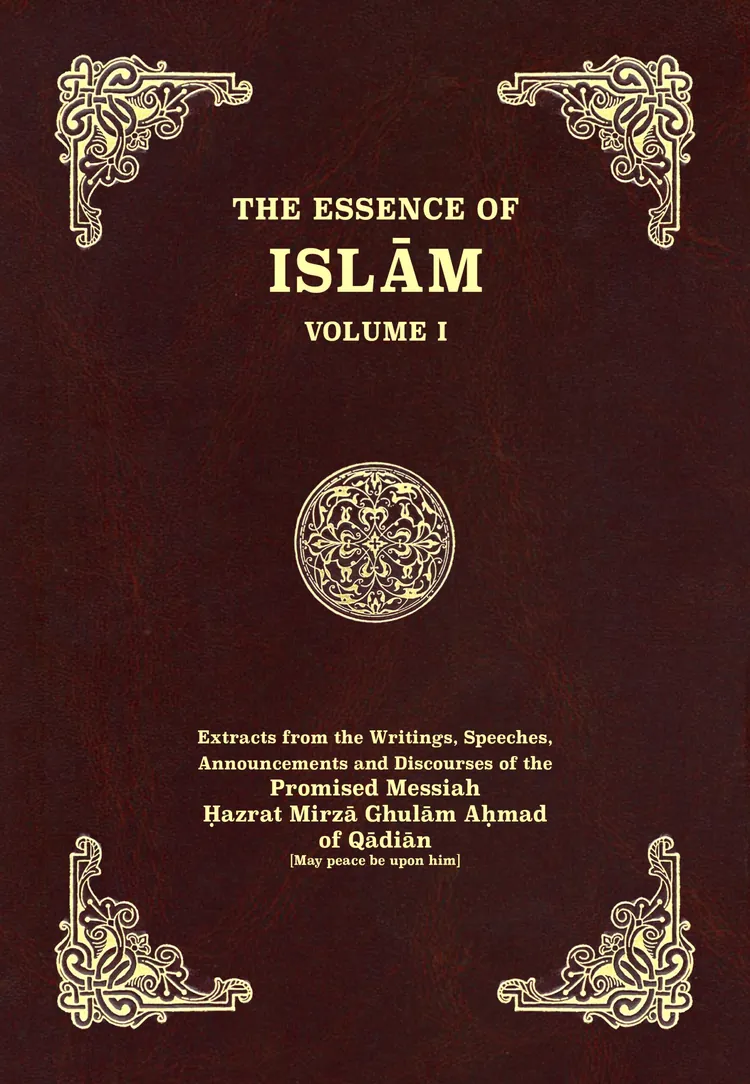
In this discourse from Essence of Islam (Volume 3), Hazrat Mirza Ghulam Ahmad (AS), the Promised Messiah and Mahdi, expounds upon Correct Meanings of Nuzul, presenting profound spiritual insights and scriptural verities.
Book Series: Essence of Islam (Volume 3)
Author: Hazrat Mirza Ghulam Ahmad of Qadian (AS)
Section: Part 6: The Messiah and His Second Coming
Navigation: Book Table of Contents | « Previous: Misguidance About Jesus Caused by the Antichrist | Next: Evidence Regarding the Death of Jesus »
The Messiah and his Second Coming 185 and desired to fulfil itself through him. In this sense his being became the being of Jesus and the passionate intentions of Jesus descended upon it, a descent that was metaphorically described as the descent of Jesus. It is a spiritual mystery that sometimes so firm a spiritual relationship is established between the holy ones who have passed away and those who are living, through the reflection of their attention and the unity of their thinking, that those in heaven regard those on earth as their spiritual substitutes. The designs generated in their hearts in heaven are correspondingly generated by God’s command in the hearts of their reflections on earth. A soul which is thus united with one on earth is bestowed the capacity to communicate its designs fully to that soul. This transfer takes place under Divine direction. This is the Divine way in which Prophets and the holy ones who have passed away descend upon the earth. It was thus that Prophet Elijah descended in the form of John the Baptist. This is also the true meaning of the descent of Jesus, which has been revealed to me. If anyone should still persist in denial I would be ready to enter into a Mubahalah [Prayer duel] with him.
[A’ina-e-Kamalat-e-Islam, Ruhani Khaza’in, vol. 5, pp. 254-256]
[Essence of Islam, Vol. 3, p. 185]
It is asked: how can we reject the clear and obvious statements of the Ahadith which expressly state that Jesus, son of Mary, would descend from heaven near the eastern minaret of Damascus with his hands on the shoulder of two angels? The answer is that descent in this context does not mean descent from heaven in a physical body. The Ahadith do not even employ the word ‘heaven’. The Arabic word Nuzul [descent] is commonly used to connote arrival. A person who arrives at one place from another is described as having descended at that place. For instance, it is said that an army or a camp has descended at such and such a place. This does not mean that the army or the camp have descended from heaven. The Holy Qur’an has also employed the expression Nuzul [descent] for the Holy Prophet (peace and blessings of Allah be upon him). It is also stated in a verse that iron has descended from heaven.151 It is thus obvious that this descent does not connote what people have imagined.
[Izala-e-Auham, Ruhani Khaza’in, vol. 3, pp. 132-133]
[Essence of Islam, Vol. 3, p. 185]
The word Nuzul is being deliberately misinterpreted. In the idiom of scriptures, he who comes from God is described as having descended from heaven (see John 1:38.)152 The same is indicated in the verses: 153
154
Common people, whose thinking is earthy, interpret everything in a physical sense. They do not stop to reflect that as according to their conception Jesus will descend from heaven in the company of angels, in the same way they also believe that the Holy Prophet (peace and blessings of Allah be upon him) had ascended to heaven in the company of angels, indeed there was also a burraq at his service. But did anyone observe the ascent and descent of
153 ‘Surely, We sent it down on the Night of Destiny.’— Al-Qadr, 97:2 [Publisher] 154 ‘Allah has sent down to you a Reminder—A Messenger.’— Al-Talaq, 65:11-12 [Publisher] The Messiah and his Second Coming 187 the Holy Prophet (peace and blessings of Allah be upon him) or did anyone see the angels and the buraq? It is obvious that the disbelievers did not see the Holy Prophet (peace and blessings of Allah be upon him) being carried to heaven by the angels nor did they see him descending therefrom. That is why they asserted that the spiritual ascent of the Holy Prophetsa was not a fact. How misguided, therefore, are those who are waiting to see Jesus descend from heaven in the company of angels. If the Chief of the Prophets was not seen ascending to or descending from heaven, then will they see Jesus descending therefrom? 155
Did Abu Bakr Siddiq observe the Holy Prophet (peace and blessings of Allah be upon him) ascend or descend from heaven in the company of angels on the night of Me‘raj? Did ‘Umar Faruq enjoy the privilege of such observation? Did ‘Ali Murtada partake of such spectacle? Then who are you and what is your standing that you would see the Promised Messiah descending from heaven in the company of angels? The Holy Qur’an rejects the very idea of such a spectacle.
[Majmu‘ah Ishtiharat, vol. 3, pp. 326-327]
[Essence of Islam, Vol. 3, p. 186]
Muslims should beware of the dangerous situation in which the Jews placed themselves by insisting on the literal fulfilment of the prophecy concerning the second coming of Elijah. It is sheer folly to insist upon something of which there has been no instance before and the falsity of which has been repeatedly demonstrated. God Almighty has said:
156
‘Ask the Jews and the Christians for an example of the ways of Allah, if you do not know.’
[Kitab-ul-Bariyyah, Ruhani Khaza’in, vol. 13, p. 43]
[Essence of Islam, Vol. 3, p. 187]
The Hadith of Sahih Muslim which says that the Messiah would descend near the white eastern minaret of Damascus has throughout puzzled the scholars, for it is not clear what relationship Messiah has with Damascus….
A little attention resolved this difficulty in my mind and it was disclosed to me, in a clear vision, that the intimation in the compilation of Abu Dawud that a person designated Harith or Harrath [a cultivator] ill appear is correct and is identical with the prophecy of the second advent of the Messiah and that both have reference to me.
It has been disclosed to me that the word Damascus in the prophecy means a town which is home to a people who resemble Yazid and think and act like him. Their hearts feel no love for Allah or His Messenger and they do not esteem Divine commandments. They worship their selfish desires and are so committed to the dictates of their evil egos, that they esteem the blood of the pure and the holy lightly. They do not believe in the hereafter; and the existence of God Almighty is for them a mystery which they cannot understand. Just as a physician is needed for the sick, it was necessary that the Messiah should appear among such people. It has been disclosed to me that the word Damascus here indicates a place which possesses this important characteristic peculiar to Damascus. The use of this word in connection with theThe Messiah and his Second Coming 189 place of the appearance of the Messiah is an indication that the Messiah does not mean Jesus who was given the Gospel but he is someone from among the Muslims who, in his spiritual condition, resembles both the Messiah and Imam Hussain…. The word Damascus clearly indicates that Jesus in not the Messiah who was to come, but as the Yazidis resemble the Jews in the same way the Messiah who is to come resembles Jesus and possesses the temperament of Hussain. This is a very subtle point: the word Damascus has been used metaphorically. As the tragedy of Imam Hussain was an enormity in the estimation of God Almighty and resembled closely the tragedy of Jesus, as even the Christians would acknowledge, therefore, God Almighty desired that the coming generations may be apprised of its enormity and its resemblance to the tragedy of Jesus. Damascus has been metaphorically mentioned in this context so that the readers might be reminded of the time when the beloved grandson of the Holy Prophet (peace and blessings of Allah be upon him) was, like Jesus, put to the sword most tyrannically by the wretches of Damascus. Thus God Almighty particularly mentioned Damascus, wherefrom such tyrannical directions had issued and which was the home of such hard-hearted and darkminded people, as an indication that the place which resembled Damascus would now become the headquarter for the propagation of faith and justice.
[Izala-e-Auham, Ruhani Khaza’in, vol. 3, pp. 134-137, footnote]
[Essence of Islam, Vol. 3, p. 188]
I would now like to draw attention to the Hadith narrated by Abu Dawud in his compilation. It contains a prophecy that a person designated as Harith, or a cultivator, will appear from Transoxiana, that is to say, from the direction of Samarkand, who will lend support to the descendants of the Holy Prophetsa and it would be obligatory on every believer to help and support him. It has been revealed to me that this prophecy and the prophecy of the advent of the Promised Messiah, who will be one of the Muslims and will be their Imam, relate to the same event and both have reference to me. The prophecy that relates to the Promised Messiah has two special aspects. One is that through his true teaching he will reform the spiritual condition of the Muslims which will be utterly corrupt at the time of his advent and; he will totally remove their spiritual poverty and inner indigence and present them the jewels of knowledge, verities and comprehension in excess of their need. No seeker after truth from among them will remain spiritually poor and indigent. All those who hunger and thirst for truth will be provided in abundance with the wholesome food of truth and the sweet drink of comprehension. Their pockets will be filled with the pearls of true knowledge and they will be given phialae filled with the perfume of the true meaning of the Holy Qur’an. The second special aspect of the prophecy, which relates to the advent of the Promised Messiah, is that he will break the cross, slaughter the swine and kill the one-eyed Antichrist. Every disbeliever who is touched by his breath will die instantly. The spiritual interpretation of this special aspect is that the Promised Messiah will crush under his feet all the glory of the religion of the cross, that he will destroy with the weapon of conclusive arguments those who are afflicted with shamelessness like swine, and who devour filth like pigs, and that he will wipe out with the sword of clear proofs the opposition of those who possess only the eye of the world and are bereft of the eye of the faith in place of which they The Messiah and his Second Coming 191 have only an unsightly taint. Not only such one-eyed ones, but also every disbeliever who views Islam with contempt will suffer spiritual extinction through the glorious breath of Messianic reasoning. In short all these signs are metaphoric, the significance of which has been fully revealed to me. Some may not appreciate it at this time but after waiting for sometime, and despairing altogether of the hopes that they now entertain, all of them will accept it.
[Izala-e-Auham, Ruhani Khaza’in, vol. 3, pp. 141-143 footnote]
[Essence of Islam, Vol. 3, p. 189]
It is an absurdity to interpret literally the Hadith of Sahih Muslim which says that when the Messiah descends from heaven he will be wearing yellow robes. There appears no reason for this peculiarity. If this indication is interpreted according to the principles of the interpretation of dreams, it would mean that when the Promised Messiah announces his claim he would not be in good health.
[Izala-e-Auham, Ruhani Khaza’in, vol. 3, pp. 142-143]
[Essence of Islam, Vol. 3, p. 191]
The account of the Me‘raj [spiritual ascent of the Holy Prophetsa] set out in Bukhari, which describes his meeting with some of the Prophets, makes no mention that Jesus was there in his physical body. The meeting of the Holy Prophetsa with Jesus is described in exactly the same terms as his meeting with Abrahamas and Mosesas. His dialogue with Mosesas is set out in detail. There can, therefore, be no doubt that if on the basis of this Hadith Jesusas had been raised bodily to heaven so must Abrahamas and Mosesas have been bodily raised, inasmuch as the Holy Prophet (peace and blessings of Allah be upon him) saw all of them in the same condition. He did not observe any particular dress or other sign of a bodily ascent about Jesus, which was not visible with regard to the other Prophets.
[Izala-e-Auham, Ruhani Khaza’in, vol. 3, pp. 153-154]
[Essence of Islam, Vol. 3, p. 191]
Nowhere does the Holy Qur’an mention the bodily ascent of Jesus to heaven. His death, on the other hand, is specifically mentioned at several different places. One of these contains Jesus’ own confession of his death: 157
As his death is established, it follows that his body must have been buried in the earth like the bodies of all dead people. The Holy Qur’an expressly states that it was his soul that ascended to heaven and not his body. That is why, in the verse just cited, he clearly acknowledged his death. Had he ascended to heaven alive in his physical body, he would not have said that he had departed the earth after his death. And, obviously, if it was only his soul which had ascended to heaven, then how can he possibly descend in his physical body?…
[Izala-e-Auham, Ruhani Khaza’in, vol. 3, pp. 125-127]
If we were to assume that he had ascended to heaven in his physical body, we would have to acknowledge that, like all human and animal bodies, his body must also be affected by the passage of time and that one day he must die. Thus he may have died in heaven having lived out his normal span of life and may have been interned in a graveyard on some planet which is now supposed to be capable of supporting human life. On the other hand, if we are to assume the impossible—that he is still physi- 157 ‘And I was a witness over them as long as I remained among them, but since Thou didst cause me to die, Thou hast been the Watcher over them; and Thou art Witness over all things.’—AlMa’idah, 5:118 [Publisher] The Messiah and his Second Coming 193 cally alive, then, after the passage of so many centuries, he must have arrived at extreme old age and will no longer be capable of performing any religious function or service. His descent upon earth in such a condition would serve no useful purpose and would only put him to unnecessary travail.
[Essence of Islam, Vol. 3, p. 192]
Book Series: Essence of Islam (Volume 3)
Author: Hazrat Mirza Ghulam Ahmad of Qadian (AS)
Section: Part 6: The Messiah and His Second Coming
Navigation: Book Table of Contents | « Previous: Misguidance About Jesus Caused by the Antichrist | Next: Evidence Regarding the Death of Jesus »