
Death Is Not the Fruit of Sin — Essence of Islam Vol. 2
Introduction
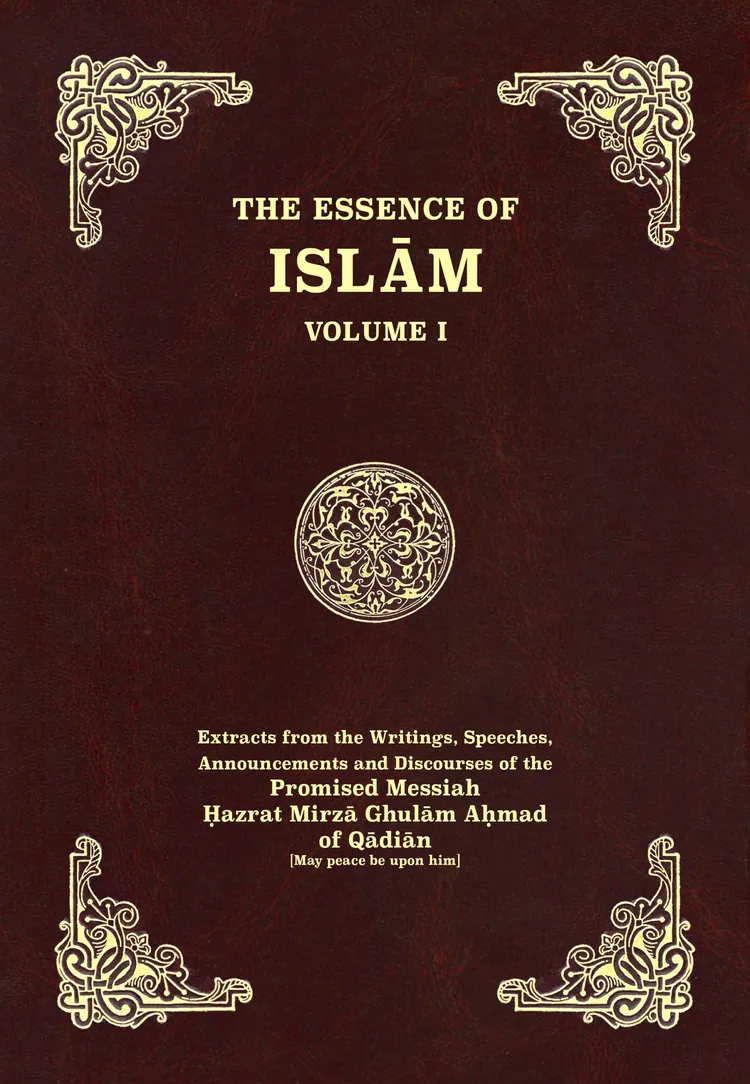
In this discourse from Essence of Islam (Volume 2), Hazrat Mirza Ghulam Ahmad (AS), the Promised Messiah and Mahdi, expounds upon Death Is Not the Fruit of Sin, presenting profound spiritual insights and scriptural verities.
Book Series: Essence of Islam (Volume 2)
Author: Hazrat Mirza Ghulam Ahmad of Qadian (AS)
Section: Part 7: Salvation
Navigation: Book Table of Contents | « Previous: No Contradiction Between Divine Justice and Mercy | Next: Was Jesus Free From Inherited Sin? »
the whole world and had no regard for His own justice. This shows that their God cares not at all for justice. What a spectacle is this that what was sought to be escaped was adopted in its worst form. The great concern was that somehow justice should not be contravened and mercy may also be fulfilled. But by the slaughter of an innocent one, neither justice was established nor was mercy fulfilled.
[Kitab-ul-Bariyyah, Ruhani Khaza’in, vol. 13, pp. 72-74]
The notion that justice and mercy cannot subsist together in the Being of God Almighty, inasmuch as justice demands punishment and mercy demands forbearance, is an error in which short-sighted Christians are involved through lack of reflection. They do not reflect that the justice of God Almighty is also mercy…. It should be borne in mind that the basic attribute of God is mercy. Justice comes into play after reason and law have been established. Justice is also mercy in another form. When a person is bestowed reason and through it he becomes aware of the limits and laws of God Almighty, he becomes subject to the demand of justice. But for mercy there is no condition of reason and law. As God Almighty desired to exalt mankind through mercy, He laid down the rules and limits of justice. Thus it is ignorance to imagine that there is contradiction between justice and mercy. The Christians say that the death of man and all animals is the fruit of sin, but this is open to two objections. In the first place, it cannot be denied that there was a creation before Adam and that they were subject to death. There was no Adam at the time nor was there his sin. Then how did death come about? Secondly, there is no doubt that with the exception of one fruit Adam ate everything in the garden and so he must have eaten meat. This also shows that animals were killed before the sin of Adam. Even apart from this, Adam drank water, for eating and drinking go together, and research has established that every drop of water contains thousands of germs. Thus there can be no doubt that before the sin of Adam, millions of germs used to die. One is, therefore, compelled to affirm that death is not the fruit of sin and this refutes the thesis of the Christians.
[Essence of Islam, Vol. 2, p. 283]
According to their principle, the Christians attach no importance to righteous conduct; in their view the atonement of Jesus is a sufficient means for the attainment of salvation. We have shown that the atonement of Jesus did not rescue the Christians from sin, nor is it true that because of the atonement every vice has become permissible for them. There is, however, one further matter which is worthy of note, that reason proves that righteous conduct has an effect that bestows the fruit of salvation upon the pious. Even the Christians acknowledge that vice has an effect whereby a person guilty of it is condemned to hell forever. If that is so, one has to make allowance for the corresponding law of nature that good also has an effect and that he who practices it can become heir to salvation.
[Essence of Islam, Vol. 2]
[Essence of Islam, Vol. 2, p. 284]
Book Series: Essence of Islam (Volume 2)
Author: Hazrat Mirza Ghulam Ahmad of Qadian (AS)
Section: Part 7: Salvation
Navigation: Book Table of Contents | « Previous: No Contradiction Between Divine Justice and Mercy | Next: Was Jesus Free From Inherited Sin? »