
Was Jesus Free From Inherited Sin? — Essence of Islam Vol. 2
Introduction
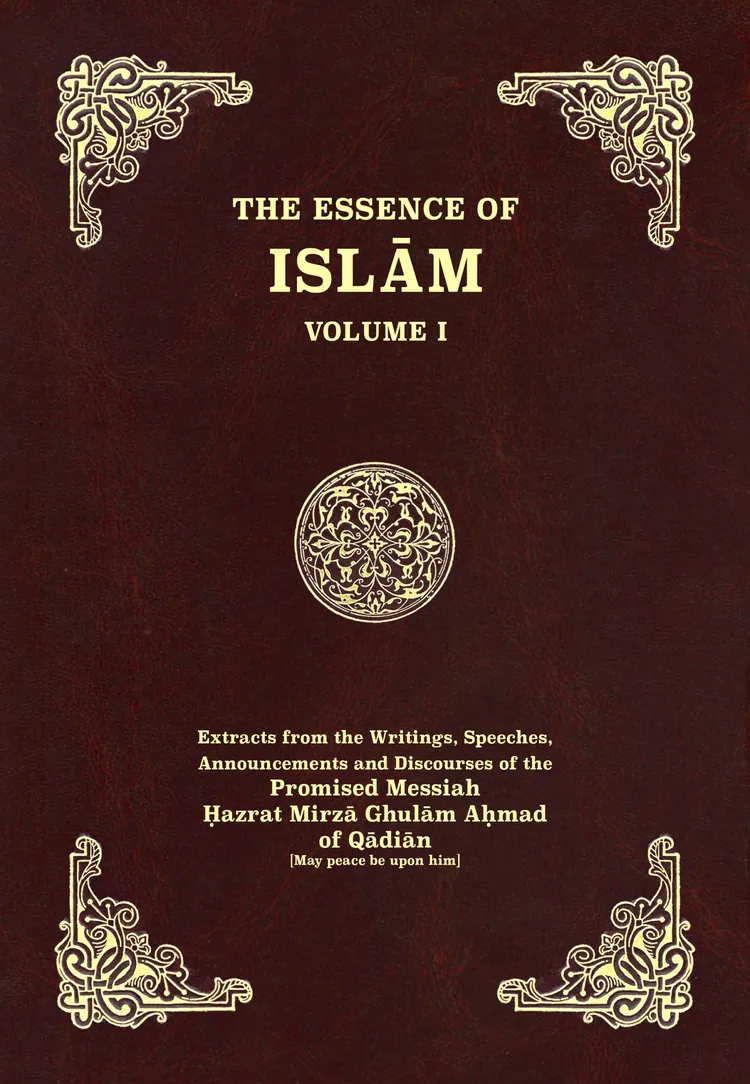
In this discourse from Essence of Islam (Volume 2), Hazrat Mirza Ghulam Ahmad (AS), the Promised Messiah and Mahdi, expounds upon Was Jesus Free From Inherited Sin?, presenting profound spiritual insights and scriptural verities.
Book Series: Essence of Islam (Volume 2)
Author: Hazrat Mirza Ghulam Ahmad of Qadian (AS)
Section: Part 7: Salvation
Navigation: Book Table of Contents | « Previous: Death Is Not the Fruit of Sin | Next: Did Crucifixion Save Christians From Sin? »
no doubt that with the exception of one fruit Adam ate everything in the garden and so he must have eaten meat. This also shows that animals were killed before the sin of Adam. Even apart from this, Adam drank water, for eating and drinking go together, and research has established that every drop of water contains thousands of germs. Thus there can be no doubt that before the sin of Adam, millions of germs used to die. One is, therefore, compelled to affirm that death is not the fruit of sin and this refutes the thesis of the Christians.
[Kitab-ul-Bariyyah, Ruhani Khaza’in, vol. 13, pp. 72-74]
[Essence of Islam, Vol. 2, p. 284]
According to their principle, the Christians attach no importance to righteous conduct; in their view the atonement of Jesus is a sufficient means for the attainment of salvation. We have shown that the atonement of Jesus did not rescue the Christians from sin, nor is it true that because of the atonement every vice has become permissible for them. There is, however, one further matter which is worthy of note, that reason proves that righteous conduct has an effect that bestows the fruit of salvation upon the pious. Even the Christians acknowledge that vice has an effect whereby a person guilty of it is condemned to hell forever. If that is so, one has to make allowance for the corresponding law of nature that good also has an effect and that he who practices it can become heir to salvation. Another objection we had put forward was that the expiation that the Christians set forth is opposed to the eternal Divine law of nature. There is no instance in the law of nature that to safeguard the inferior the superior might be put to death. We have before us the Divine law of nature which proves that the inferior is always sacrificed to safeguard the superior. All animates, even the germs in the water, are sacrificed for the preservation of man, who is the noblest of creation. The sacrifice of Jesus is contrary to this obvious law. Every reasonable person can understand that for the protection of that which is dearer and more valuable, that which is inferior to it has to be sacrificed. God Almighty lets millions of animates be sacrificed for the preservation of man, and we, by our very nature, follow the same law. You can thus understand how inconsistent is atonement, in which the Christians believe, with the Divine law of nature.
[Essence of Islam, Vol. 2]
Another objection that we had raised was that the claim of the Christians that Jesus was free from hereditary as well as acquired sin is obviously unfounded. The Christians admit that Jesus had acquired his body from his mother and that she was not free from sin. The Christians also acknowledge that all pain and hurt are the fruit of sin and there can be no doubt that Jesus felt hunger and thirst and might have suffered from chickenpox and smallpox in his childhood and would have borne the pain of teething and would have suffered from seasonal fevers. According to the Christians, all these are the fruits of sin. Then how could Jesus be regarded as a sinless sacrifice? Besides, according to the Christians, only that person can establish a relationship with the Holy Spirit who is wholly free from sin. Then how did the Holy Spirit establish a relationship with Jesus who was not free from hereditary sin nor escaped the fruit of sin? Apparently, Melchisedec was more deserving of a relationship with the Holy Spirit, for according to the Christians he was free from every kind of sin.
[Essence of Islam, Vol. 2, p. 284]
Book Series: Essence of Islam (Volume 2)
Author: Hazrat Mirza Ghulam Ahmad of Qadian (AS)
Section: Part 7: Salvation
Navigation: Book Table of Contents | « Previous: Death Is Not the Fruit of Sin | Next: Did Crucifixion Save Christians From Sin? »