
Did Crucifixion Save Christians From Sin? — Essence of Islam Vol. 2
Introduction
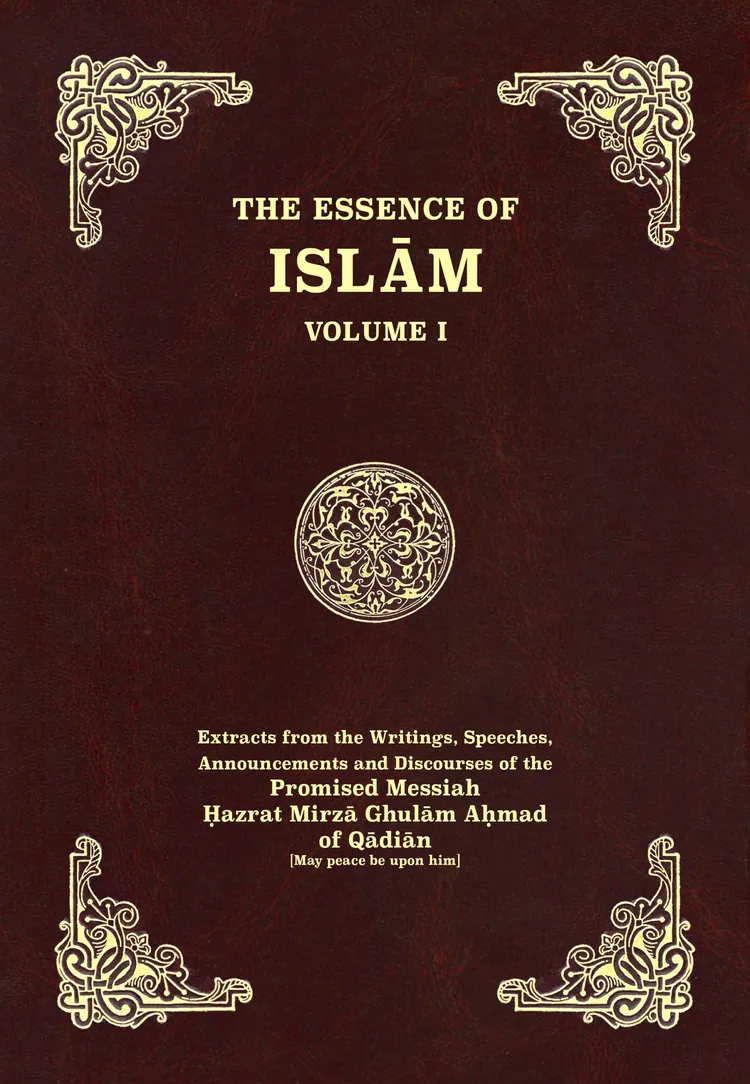
In this discourse from Essence of Islam (Volume 2), Hazrat Mirza Ghulam Ahmad (AS), the Promised Messiah and Mahdi, expounds upon Did Crucifixion Save Christians From Sin?, presenting profound spiritual insights and scriptural verities.
Book Series: Essence of Islam (Volume 2)
Author: Hazrat Mirza Ghulam Ahmad of Qadian (AS)
Section: Part 7: Salvation
Navigation: Book Table of Contents | « Previous: Was Jesus Free From Inherited Sin? | Next: Belief in Kalimah »
word means to incline away and to move away from the centre. It acquired the connotation of sin, inasmuch as by turning away a person leaves the spot where Divine light falls and moving away from it puts himself at a distance from the light that can be obtained in the original position. In the same way Juram (crime), which also connotes sin, means cutting asunder. Thus an offender cuts asunder all his relationship with God. Juram is thus more serious than Junah, for the latter merely means a wrong inclination, but the former signifies that a person deliberately commits an offence by breaking God’s law and being heedless of any relationship with Him. That being the reality of true purity, the question arises whether those lights which a person loses through his love of darkness can be acquired by believing in the crucifixion of anyone. The answer is that such a notion is false. The truth is that for the acquiring of those lights it is the eternal law that we should open the windows that face the true sun and the rays that had been averted by shutting them would be revived again. This is borne out by the physical law of nature that we cannot get rid of darkness till we open the windows that let in the direct rays of the sun. Doubtless, therefore, the only correct course that appeals to reason is that those windows should be opened whereby not only shall we obtain light, but shall also behold the Source of all light.
For the removal of the darkness of sin and neglect, it is necessary to obtain light. This is indicated by God, the Glorious, in the verse:وَمَن كَانَ فِي هَٰذِهِۦٓ أَعۡمَىٰ فَهُوَ فِي ٱلۡأٓخِرَةِ أَعۡمَىٰ وَأَضَلُّ سَبِيلٗا
“But whoso is blind in this world will be blind in the Hereafter, and even more astray from the way.” (Surah Bani Isra’il, 17:73)
He who is blind in this world shall be blind in the hereafter and even more astray. This means that the eyes for beholding God and the senses for discovering Him are bestowed in this life and that he upon whom they are not bestowed in this life will not find them in the hereafter. The righteous who will see God on the Day of Judgement will carry with them the senses through which they will see Him, and he who does not hear the voice of God in this world will not hear it in the next. To recognize God as He is without any error and to obtain true understanding of His Being and attributes in this world is the source of all light. It is thus obvious that those who believe that God is subject to death and distress and misery and ignorance, and that He can become accursed and can be deprived of true purity and mercy and true knowledge, flounder in the pit of misguidance, and are unaware of true knowledge and insight which are the basis of salvation. The Christians are guilty of gross error in thinking that salvation is freely available and that good deeds are irrelevant in that context. He whom they have deified observed forty fasts. Moses also observed fasts in Sinai. If good deeds are nothing, why did these two exalted ones pursue this vain purpose? As it is clear that God Almighty is disgusted with vice, we can understand that He is greatly pleased with virtue. In this way, virtue becomes an atonement for vice. When a person after being guilty of a vice performs a good deed that pleases God, it follows that the previous condition has been replaced by the subsequent one; otherwise, it would be disrespect. Accordingly, God the Glorious says in the Holy Qur’an: 100
Surely good deeds do away with evil deeds. We can also say that vice has a poisonous quality, which destroys, and that virtue has the quality of an antidote that rescues from death. For instance, to shut all the doors of a room is a vice, the necessary consequence of which is darkness. Opposed to this is the opening of the doors that face the sun. This is the virtue the necessary consequence of which is that the light that had been shut off will re-enter the room.
[Kitab-ul-Bariyyah, Ruhani Khaza’in, vol. 13, pp. 76-81]
[Essence of Islam, Vol. 2, p. 287]
Book Series: Essence of Islam (Volume 2)
Author: Hazrat Mirza Ghulam Ahmad of Qadian (AS)
Section: Part 7: Salvation
Navigation: Book Table of Contents | « Previous: Was Jesus Free From Inherited Sin? | Next: Belief in Kalimah »