
Evidence From Buddhist Scriptures — Essence of Islam Vol. 3
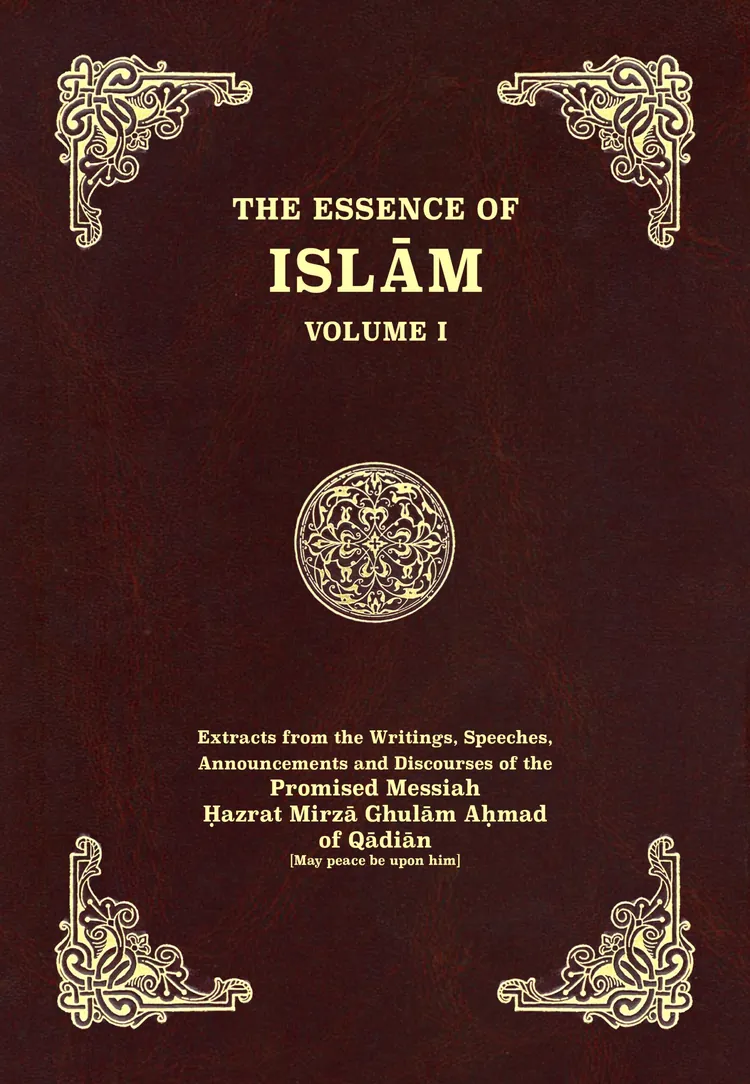
Introduction
In this discourse from Essence of Islam (Volume 3), Hazrat Mirza Ghulam Ahmad (AS), the Promised Messiah and Mahdi, expounds upon Evidence From Buddhist Scriptures, presenting profound spiritual insights and scriptural verities.
Book Series: Essence of Islam (Volume 3)
Author: Hazrat Mirza Ghulam Ahmad of Qadian (AS)
Section: Part 6: The Messiah and His Second Coming
Navigation: Book Table of Contents | « Previous: Jesus in Kashmir | Next: Breaking of the Cross by the Promised Messiah »
The Messiah and his Second Coming 267 and preached to the Children of Israel who had settled in Kashmir after the Babylonian dispersal. He died in Srinagar at the age of 120 years and was buried in the quarter of Khanyar. He came to be known as Prophet Yuz Asaph, through some confusion of names.
[Raz-e-Haqiqat, Ruhani Khaza’in, vol. 14, p. 161, footnote]
[Essence of Islam, Vol. 3, p. 267]
The tomb of Jesusas in Kashmir, which is said to be about 1900 years old, constitutes evidence of the highest quality to prove this point. It is probable that there may have been some tombstones with this grave which now lie hidden.
[Raz-e-Haqiqat, Ruhani Khaza’in, vol. 14, p. 163, footnote]
[Essence of Islam, Vol. 3, p. 267]
I have discovered various kinds of evidence from Buddhist scriptures, the collective appraisal of which definitely and conclusively establishes that Jesus (peace be on him) travelled to the areas like Punjab and Kashmir. These are as follows…. First, the titles bestowed on the Buddha bear a strong resemblance to the titles given to Jesus, and some events in Buddha’s life closely resemble the events in the life of Jesus. Here I mean the Buddhism which prevails in areas around Tibet, like Leh, Lhasa, Gilgit and Hims, which are proved to have been visited by Jesus. As regards titles, Jesus (peace be on him) in his teachings called himself ‘the Light’, similarly Gautama was called Buddha, which in Sanskrit means ‘Light’. Jesus is also called ‘Teacher’ in the Gospels, similarly the Buddha is called Sasta, which means ‘Teacher’. Jesus is called ‘Blessed’ in the Gospels, and in the same way one of the names of Buddha is Sagpat, which means ‘Blessed’. Jesus is called ‘Prince’ and so is the Buddha. One of the names of Jesus in the Gospels connotes that he would fulfil the purpose of his advent, and the Buddha has been called Sadhartah, which means one who fulfils the purpose of his advent. One of the titles of Jesus is the Refuge of the weary, and one of the names of Buddha is Asran Sam, which means the Shelter for the shelterless. Jesus has been called ‘King’ in the Gospels though what he meant was the kingdom of heaven; likewise the Buddha has also been called ‘King’. The similarity of events in the lives of the Buddha and Jesus appears from the following. It is stated in the Gospels that Jesus (peace be on him) was tempted by the devil, who said to him, ‘If you will worship me, you will have all the riches and kingdoms of the world.’ The Buddha was tempted in the same way and the devil said to him, ‘If you obey me and return home renouncing your ascetic ways, I shall confer the glory of kingdom on you.’ Just as Jesus did not obey the devil, neither did the Buddha….
[Essence of Islam, Vol. 3]
Another resemblance between the Buddha and Jesus is that, according the Buddhist chronicles, the Buddha fasted for forty days when he was tempted by the devil. Readers of the Gospels know that Jesus also observed a forty-day fast.
Anyone who is acquainted with the teachings of both the Buddha and Jesus will also marvel at the close similarity between the moral teachings of the two…. Just as Jesus sent his disciples to different countries and himself travelled to another country, the same is recorded of the Buddha. It is recorded in Buddhism by Sir Monier Williams that the Buddha sent his disciples to different parts of the world to convey his message, and addressed The Messiah and his Second Coming 269 them as follows: “Go forth and wander everywhere, out of compassion for the world and for the welfare of gods and men. Go forth, one by one, in different directions. Proclaim a life of perfect restraint, chastity and celibacy.” He added: “I will go also to preach this doctrine.” He went to Benares and there he performed many miracles. He delivered a very moving sermon on a hill just as Jesus did on the mount. It is also recorded in the same book that the Buddha often taught in parables and used to discuss spiritual matters in terms of physical phenomena….
The exact adoption by Buddha of this method of preaching through parables, especially those recorded in the Gospels, is indeed most surprising…. Buddhist records also show that Gautama Buddha had prophesied the coming of a second Buddha whom he named Metteyya. This prophecy is contained in Lagavati Satta,198 a Buddhist record to which reference is made on page 142 of Oldenberg’s book. It reads as follows: He will be the leader of a band of disciples numbering hundreds of thousands, as I am now the leader of bands of disciples, numbering hundreds. It should be remembered that the Pali name ‘Metteyya’ is the same as ‘Mashiha’ in Hebrew …. The future Metteyya prophesied by Buddha is none other than the Messiah himself. One strong evidence in support of this is that the Buddha himself prophesied that the faith he had founded would not endure on earth for more than five hundred years, and that at the time of the decline of the 198 This seems to be a misprint in the original Urdu text. The correct name should be Cakkavatti Suttanta. [Publisher] faith and its teachings, the Metteyya would appear in this country and re-establish these moral teachings in the world. We find that Jesus appeared 500 years after the Buddha and, just as the Buddha had foretold the time for the decline of his faith, Buddhism suffered deterioration and decadence. It was then that Jesus, having escaped from the cross, travelled to these areas where the Buddhists recognized him and treated him with great reverence…. It must be noted that the name Metteyya in Buddhist literature undoubtedly refers to the Messiah. On page 14 of the book Tibet, Tartary, Mongolia by H.T. Prinsep, it is written about the Metteyya Buddha, who in reality is the Messiah, that the first Christian missionaries, having heard and seen at first conditions obtaining in Tibet, came to the conclusion that in the ancient books of the Lamas there were to be found traces of the Christian religion. On the same page it is stated that there is no doubt about it that these earlier writers believed that some disciples of Jesus were still alive when the Christian faith reached there. On page 171 it is stated that there is not the slightest doubt that at that time everybody was eagerly waiting for the great Saviour to appear. Tacitus says that the Jews were not the lone holders of this belief, Buddhism too was responsible for laying the foundations of this expectation, inasmuch as it prophesied the coming of Metteyya. The author of the English work has moreover added a note to the effect that the books Pitakattayan and Attha-katha contain a clear prophecy about the advent of another Buddha who would appear a thousand years after Gautama or Sakhiya Muni. Gautama states that he is the twenty-fifth Buddha and that the Bagwa Metteyya is still to come, that is why after he has gone, The Messiah and his Second Coming 271 one whose name will be Metteyya and who will be fairskinned will come….This is why the followers of Buddhism had all along been waiting for the Messiah to appear in their country. The Buddha, in his prophesy about the future Buddha, called him Bagwa Metteyya. Bagwa in Sanskrit means ‘white’. Jesus, being of Syrian origin, was Bagwa—of white of complexion. The people of the land where this prophecy was made, i.e., Magadh, where Raja Griha was located, were dark-skinned and Gautama Buddha himself was dark. Therefore, the Buddha related to his followers two distinct signs of the future Buddha: first that he would be Bagwa—of white complexion, and secondly, he would be Metteyya—a traveller who would arrive from a foreign land…. We can never approve of the method adopted by European scholars who are so eager to prove one way or the other that the teachings of Buddhism had already reached Palestine by the time of the Messiah. It is most unfortunate that while the very name of Jesus is to be found in the ancient books of Buddhism, these researchers adopt the devious course of trying to find traces of Buddhism in Palestine. Why do they not rather try to find the blessed footprints of Jesusas on the mountains of Nepal, Tibet and Kashmir? I know that it was not for the likes of them to uncover by themselves such a great truth which lay hidden behind thousands of veils of darkness. It was for God Himself to do so, for He watched from on high that creature worship was running rampant in the earth and that worship of the cross and the supposed sacrifice of a human being had alienated the hearts of millions from the True God. Then, in His indignation, he sent to the world His servant in the spirit of Jesus of Nazareth in order to demolish the creed of the cross.
[Essence of Islam, Vol. 3, p. 267]
Book Series: Essence of Islam (Volume 3)
Author: Hazrat Mirza Ghulam Ahmad of Qadian (AS)
Section: Part 6: The Messiah and His Second Coming
Navigation: Book Table of Contents | « Previous: Jesus in Kashmir | Next: Breaking of the Cross by the Promised Messiah »