
Jesus in Kashmir — Essence of Islam Vol. 3
Introduction
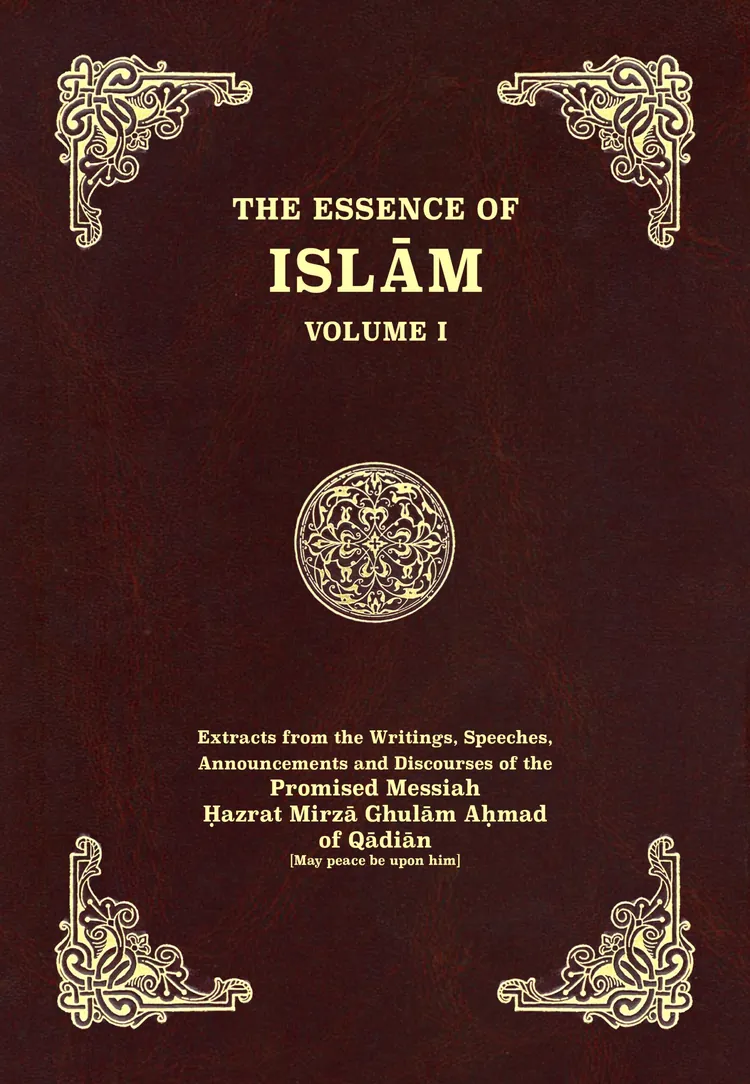
In this discourse from Essence of Islam (Volume 3), Hazrat Mirza Ghulam Ahmad (AS), the Promised Messiah and Mahdi, expounds upon Jesus in Kashmir, presenting profound spiritual insights and scriptural verities.
Book Series: Essence of Islam (Volume 3)
Author: Hazrat Mirza Ghulam Ahmad of Qadian (AS)
Section: Part 6: The Messiah and His Second Coming
Navigation: Book Table of Contents | « Previous: Jesus in Search of the Lost Sheep | Next: Evidence From Buddhist Scriptures »
The Messiah and his Second Coming 263 lose their credibility.
[Masih Hindustan Meiń, Ruhani Khaza’in, vol. 15, pp. 56-61]
[Essence of Islam, Vol. 3, p. 263]
Jesus in Search of the Lost Sheep It was extremely important for Jesus (peace be on him) to travel to the Punjab and its neighbouring lands in order to discharge his Prophetic functions. This was because ten tribes of Israel, who have been designated in the Bible as ‘the lost sheep of the house of Israel’, had settled there— a fact which no historian can deny. It was, therefore, necessary for Jesusas to travel to these lands, seek out the lost sheep and convey God’s message to them. Unless he did that, the purpose he had been sent for would have remained unfulfilled. His mission was to preach to the lost sheep of Israel, if he had died without seeking them, or, having found them, failing to teach them the way to salvation, he would have been like the man who was appointed by a king to go to a certain tribe in the desert and dig a well to provide them water, but he spent three or four years roaming in other places and returned without doing anything to find the people to whom he had been sent. Could it be said of him that he carried out the command of his master? Certainly not. In fact he cared too much for his own comfort to do anything for the people.
[Masih Hindustan Meiń, Ruhani Khaza’in, vol. 15, pp. 93-94]
[Essence of Islam, Vol. 3, p. 263]
One of the verses of the Holy Qur’an clearly indicates that Jesus and his mother travelled to Kashmir after the incident of crucifixion. It is said
وَجَعَلۡنَا ٱبۡنَ مَرۡيَمَ وَأُمَّهُۥٓ ءَايَةٗ وَءَاوَيۡنَٰهُمَآ إِلَىٰ رَبۡوَةٖ ذَاتِ قَرَارٖ وَمَعِينٖ
“And We made the son of Mary and his mother a Sign, and gave them refuge on an elevated land of green valleys and springs of running water.” (Surah Al-Mu’minun, 23:51)
‘We gave Jesus and his mother shelter at a plateau which was an abode of peace and was provided with springs of clear water.’
[Kashti-e-Nuh, Ruhani Khaza’in, vol. 19, p.17, footnote]
In this verse God Almighty has drawn an accurate picture of Kashmir. The expression Awa in Arabic is used for providing shelter against calamity of misfortune; and before the crucifixion Jesus and his mother underwent no period of hardship as would require shelter. It is thus established that it was only after the incident of the crucifixion that God Almighty led Jesus and his mother to this plateau.
[Essence of Islam, Vol. 3, p. 263]
I am the humble one who has been sent to sow the seed of true purity in the hearts of men, like the holy servant of God in the time of the Roman Empire nearly nineteen hundred years ago, who was sent to preach true salvation to the people of Galilee. Having endured great suffering at the hands of the Jews at the time of Pilate, he had to migrate from Judea, according to the eternal way of God Almighty. He came to India to convey the message of God to the Jews, who after the dispersal of Babylone, had come to these countries. At the age of 120, he departed from this mortal world and returned to his True Beloved, and Kashmir had the great honour of being his burial place. How fortunate are Srinagar, Anmoza and the Mohalla of Khanyar, unto whose blessed dust that eternal prince and righteous Prophet of God committed his holy body, and enabled many a dweller of Kashmir to partake of true salvation and eternal life. May the glory of God be with him forever, Amin. [Kashf-ul-Ghita’, Ruhani Khaza’in, vol. 14, pp. 191-192]. The truth is that when Jesus (peace be upon him), after The Messiah and his Second Coming 265 his deliverance from the hands of the unfortunate Jews, honoured the Punjab with his presence, God Almighty invested him with great honour and prestige in this country and he found himself amongst the ten lost tribes of Israel. It appears that after settling in these countries most of them had become Buddhists and some had taken to a low form of idol worship. With the coming of Jesus, a large majority of them reverted to the straight path. As Jesus had prepared them to accept the Prophet who was to come, the ten tribes, who came to be known as Afghans and Kashmiris, all became Muslims in the end. Thus Jesus was greatly honoured in this land.
[Masih Hindustan Meiń, Ruhani Khaza’in, vol. 15, pp. 53-54]
Recently a coin has been found in the Punjab on which the name of Jesus (peace be on him) is inscribed in Pali characters. The coin is of the time of Jesus. This confirms that Jesusas was bestowed royal honour in this country. This coin was probably struck in the reign of a monarch who believed in Jesus. Yet another coin has been found which bears the fac-simile of an Israeli male. This is most probably the fac-simile of Jesus. The Holy Qur’an also contains a verse to the effect that God had blessed Jesus wherever he went.196 These coins also show that he was greatly blessed and did not die till he was bestowed royal honours.
[Essence of Islam, Vol. 3, p. 264]
Jesus (peace be on him) came to the Punjab via Afghanistan with the ultimate intention of going to Kashmir. The fact is that Chitral and a part of the Punjab separate Kashmir from Afghanistan. If we travel from 196 The reference is to the verse: ‘And He has made me blessed wheresoever I may be.’—Maryam, 19:32 [Publisher] Afghanistan to Kashmir through the Punjab, it is a distance of about 80 kose, which is equal to 130 miles, and if we go through Chitral, it is about 100 kose. Jesus wisely chose the Afghanistan route so that the lost tribes of Israel known as the Afghans may also benefit from his presence. The eastern boundary of Kashmir touches Tibet. From Kashmir he could easily go there. By travelling through the Punjab, Jesus could easily visit other parts of India before proceeding to Kashmir and Tibet. As some ancient records indicate, it is even probable that Jesus visited Nepal, Benares and other places, and later travelled to Kashmir via Jammu or Rawalpindi. Since he belonged to a cold region, he must have stayed in these parts through the winter and left for Kashmir at the end of March or beginning of April. As Kashmir resembles Sham,197 he must have settled down there permanently. It is also possible that he may have spent some time in Afghanistan and it is not unlikely that he married there. One of the Afghan tribes is known as ‘Isa-Khel. It would not be surprising if they are the descendants of Jesus. It is a great pity that the history of the Afghans is very ambiguous and it is very difficult to arrive at anything definitive by studying their tribal chronicles. There is no doubt however that the Afghans too are Israelites like the Kashmiris. [Masih Hindustan Meiń, Ruhani Khaza’in, vol. 15, pp. 69-70]. Research has disclosed that after his deliverance from the cross Jesus (peace be on him) travelled to India and Nepal and continued on to Tibet, from where he eventually came to Kashmir, where he stayed for quite some time,
The Messiah and his Second Coming 267 and preached to the Children of Israel who had settled in Kashmir after the Babylonian dispersal. He died in Srinagar at the age of 120 years and was buried in the quarter of Khanyar. He came to be known as Prophet Yuz Asaph, through some confusion of names.
[Raz-e-Haqiqat, Ruhani Khaza’in, vol. 14, p. 161, footnote]
[Essence of Islam, Vol. 3, p. 265]
The tomb of Jesusas in Kashmir, which is said to be about 1900 years old, constitutes evidence of the highest quality to prove this point. It is probable that there may have been some tombstones with this grave which now lie hidden.
[Raz-e-Haqiqat, Ruhani Khaza’in, vol. 14, p. 163, footnote]
[Essence of Islam, Vol. 3, p. 267]
Book Series: Essence of Islam (Volume 3)
Author: Hazrat Mirza Ghulam Ahmad of Qadian (AS)
Section: Part 6: The Messiah and His Second Coming
Navigation: Book Table of Contents | « Previous: Jesus in Search of the Lost Sheep | Next: Evidence From Buddhist Scriptures »