
Faith and Certainty — Essence of Islam Vol. 3
Introduction
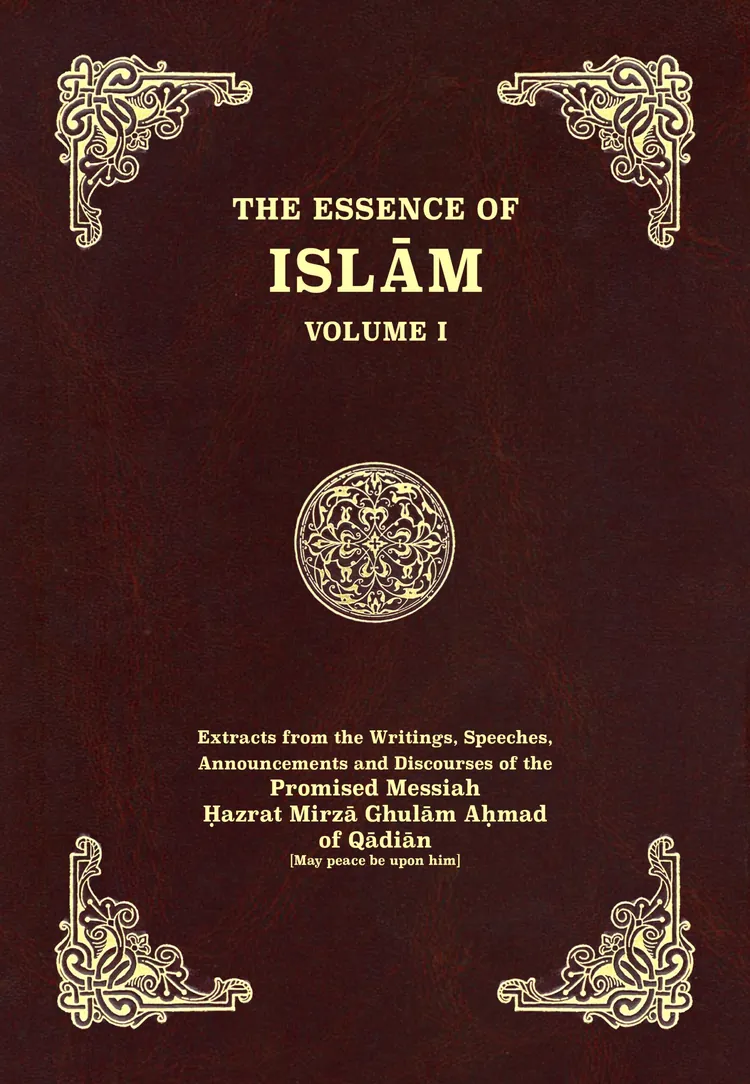
In this discourse from Essence of Islam (Volume 3), Hazrat Mirza Ghulam Ahmad (AS), the Promised Messiah and Mahdi, expounds upon Faith and Certainty, presenting profound spiritual insights and scriptural verities.
Book Series: Essence of Islam (Volume 3)
Author: Hazrat Mirza Ghulam Ahmad of Qadian (AS)
Section: Part 2: Faith, Certainty and Insight
Navigation: Book Table of Contents | « Previous: Faith in the Unseen Taught by Prophets | Next: Salvation Depends on Faith »
the superior ones do not consider them worthy of the honourable appellation of a philosopher.
[Surmah Chashm-e-Arya, Ruhani Khaza’in, vol. 2, pp. 83-88, footnote]
[Essence of Islam, Vol. 3, p. 46]
I desire to lead these theoretical philosophers, who are unaware of the love for the Divine and are negligent in their appreciation of His Exalted Being, to the straight path through such persuasive arguments as I am capable of. I have observed that their spiritual condition has become very weak, and unwarranted freedom and weakness of faith have seriously undermined their sincerity, religious resolve, and spiritual condition. They have confused truth with falsehood in an odd manner. The roots of the blessings of religion are faith, confidence, goodwill, obedience of true spiritual guides, and the Divine word, but these people misunderstand religion on account of their wrong philosophy.
[Surmah Chashm-e-Arya, Ruhani Khaza’in, vol. 2, pp. 70-80]
It is, therefore, incumbent upon them to discard prejudice and self-approval, and reflect in a simple way upon the question: What is faith and why is it expected to confer any benefit? Be it known, therefore, that faith means a sincere declaration of the acceptance of the message of a Prophet, out of righteousness and as a matter of wise precaution, purely on the basis of goodwill. That is to say, to proclaim acceptance whole-heartedly, finding that certain reliable factors point in that direction, without waiting for perfect and conclusive proof. The stage when perfect reasons and conclusive arguments become available in support of the truth is designated the stage of certainty through knowledge. When God Almighty, out of His special bounty, should in an extraordinary manner Faith, Certainty and Insight 47 bestows the lights of guidance, and should acquaint a creature of His with His favours and bounties, and should bestow reason and knowledge from Himself, and opening the doors of visions and revelation should disclose the wonders of Divinity, and should reveal His beauty as the Beloved, that stage is designated understanding, or in other words, certainty by sight and is also called guidance and insight. When, in consequence of the profound effect of all these experiences, the heart of a lover of God is surcharged with love and devotion to a degree where his whole being is saturated with delight, and heavenly light totally envelops his heart and excludes all darkness and constraint, so that, on account of the perfection of his love and devotion and the climax of his sincerity and loyalty, misfortunes and calamities become a source of delight and sweetness for him, that stage is designated as the stage of being at rest. It is also called salvation, deliverance or certainty by realization. All these ranks are granted after arriving at the stage of faith. One who is firm in one’s faith progressively achieves these ranks. But one who does not adopt the way of faith and demands conclusive, certain, and patent proof of every verity before accepting it, has no relationship with the way of faith and can never become the recipient of the grace of that Almighty and Self-Sufficient Being.
It has ever been the way of Allah—and this is a fine point of the appreciation of the Divine over which the fortunate ones should reflect—that merit and heavenly grace follow only upon faith. The true philosophy of this way is that in the primary stage of faith a person should avoid a long series of doubts and denials regarding the acceptance of the Absolute Self-Sufficient One, and His power and His promise, and His warning, and His revelations, and His mysteries. For the maintenance of the condition of faith, on which all merit depends, it is necessary that God Almighty should not display all matters of faith as plainly as other realities become apparent to everyone.
[Essence of Islam, Vol. 3, p. 46]
Faith means acceptance at a stage when knowledge is not yet complete, and the struggle with doubts and suspicions is still in progress. He who believes, that is to say, has faith, on the basis of probability and likelihood and despite weakness and the lack of perfect means of certainty, is accounted righteous in the estimation of the Supreme One. Thereafter, perfect understanding is bestowed on him as a bounty, and he is given to drink of the cup of understanding after partaking of faith. When a pious one, on hearing the call of a Messenger, a Prophet or a commissioned one of God, does not just go about criticizing, but takes that portion which he can recognize and understand on the basis of clear proof the means of acceptance and faith, and considers that which he is unable to understand as metaphorical or allegorical, and thus removing all contradiction out of the way, believes simply and sincerely, then God Almighty, having pity on him and being pleased with his faith, and hearing his supplications, opens the gates of perfect understanding for him and leads him to perfect certainty through visions, revelation and other heavenly signs.
[Ayyam-us-Sulh, Ruhani Khaza’in, vol. 14, p. 261]
[Essence of Islam, Vol. 3, p. 48]
The Word of God directs us: Have faith and you will be delivered. It does not tell us: Demand philosophical Faith, Certainty and Insight 49 reasons and conclusive proofs in support of the doctrines that the Holy Prophet (peace and blessings of Allah be upon him) has presented to you, and do not accept them until they are established like mathematical formulae. It is obvious that if the teaching of a Prophet is to be accepted only after being tested by the canons of current knowledge, that would not be faith in the Prophet; inasmuch as every verity when it is established clearly, becomes binding, whether it is set forth by a Prophet or by anyone else. Even if expounded by a vicious person it has to be accepted. That which we would accept by putting our trust in a Prophet, and by affirming his righteousness, must be of a nature which possesses a probability of truth in the estimation of reason and yet leaves room for a foolish person to incline towards its rejection as false; so that by taking the side of truth and affirming the righteousness of a Prophet we may be rewarded for our well-thinking, penetrating intelligence, respectfulness and faith. This is the purport of the teaching of the Holy Qur’an that we have set forth. But thinkers and philosophers have never followed this way and have always been heedless of faith. They have always been in search of the kind of knowledge which is demonstrated to them as being immediate, incontrovertible and certain.
[Essence of Islam, Vol. 3]
It should be remembered that God Almighty, by demanding faith in the unseen, does not wish to deprive the believers of certainty of understanding the Divine. Indeed, faith is a ladder for arriving at this certainty of understanding, without which it is in vain to seek true understanding. Those who climb this ladder surely experience for themselves the pure and undefiled spiritual verities. When a sincere believer accepts Divine commands and directions for the only reason that God Almighty has bestowed them upon him through a righteous bearer, he becomes deserving of the bounty of understanding. That is why God Almighty has established a law for His servants that they should first acknowledge Him by believing in the unseen, so that all the problems they face may be resolved through the bounty of true understanding. But it is a pity that a hasty one does not adopt these ways. The Holy Qur’an contains the promise of God Almighty that if a person, who accepts the call of the Holy Prophet (peace and blessings of Allah be upon him) on the basis of faith, seeks to comprehend its reality and strives after such comprehension, the reality will be disclosed to him by means of visions and revelations and his faith will be elevated to the stage of the understanding. [A’ina-e-Kamalat-e-Islam, Ruhani Khaza’in, vol. 5, pp. 251-253, footnote].
[Essence of Islam, Vol. 3, p. 48]
Book Series: Essence of Islam (Volume 3)
Author: Hazrat Mirza Ghulam Ahmad of Qadian (AS)
Section: Part 2: Faith, Certainty and Insight
Navigation: Book Table of Contents | « Previous: Faith in the Unseen Taught by Prophets | Next: Salvation Depends on Faith »