
Faith in the Unseen Taught by Prophets — Essence of Islam Vol. 3
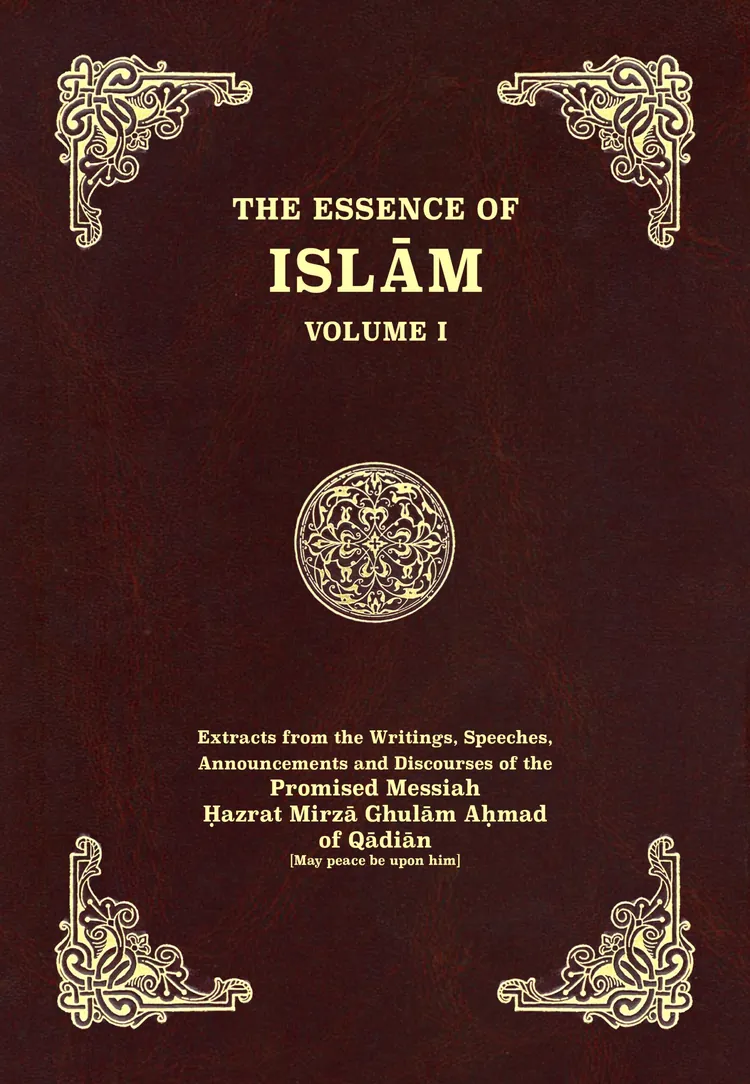
Introduction
In this discourse from Essence of Islam (Volume 3), Hazrat Mirza Ghulam Ahmad (AS), the Promised Messiah and Mahdi, expounds upon Faith in the Unseen Taught by Prophets, presenting profound spiritual insights and scriptural verities.
Book Series: Essence of Islam (Volume 3)
Author: Hazrat Mirza Ghulam Ahmad of Qadian (AS)
Section: Part 2: Faith, Certainty and Insight
Navigation: Book Table of Contents | « Previous: The Reality of Love | Next: Faith and Certainty »
2 FAITH, CERTAINTY AND INSIGHT As far as the belief in God Almighty, the question of metaphors, and the phenomena of here and the hereafter is concerned, the approach of philosophers is very different from that of Prophets. The main principle followed by the Prophets is that faith proves fruitful only if the unseen is accepted as unseen, and the self-evident testimony of physical senses and absolute mathematical proof is not insisted upon inasmuch as all spiritual merit and worthiness of nearness to the Divine depends upon righteousness, and he alone possesses true righteousness who safeguards himself against the extremes of investigation, multiple denials, and testing every little detail, and is prepared to accept a way that appears safer and preferable to other ways as the truth, out of a sense of precaution. This is faith, and this is what helps open the door of Divine grace and becomes the means of acquiring good fortune here and in the hereafter. When a person establishes himself firmly on faith and then seeks to foster his knowledge through prayer, worship, reflection and observation, God Almighty Himself becomes his Guardian, and, taking him by the hand, leads him from the stage of faith to that of ‘Ain-ul-Yaqin [certainty by sight.] But all this is achieved only through steadfastness, striving, effort and purification of the ego. He who seeks clarification of all details at the very first stage, and is not prepared to abandon his false doctrines and evil ways before such clarification, prevents himself from treading upon the path of righteousness and achieving merit. Faith demands belief in certain matters which are still unseen to some degree, that is to say, they are still in a condition which is not established fully by reason, nor has it been perceived through spiritual vision, but is accepted on the basis of probability. This is the true philosophy of the Prophets by following which, millions of God’s creatures have procured heavenly blessings and countless people have arrived at the stage of perfect understanding and many more continue to do so. The perfect certainties which the philosophers sought to achieve hastily and daringly, and failed to achieve, have not only all been achieved with the utmost ease by the faithful ones, but they have reached the stage of that perfect understanding which has not been heard or seen or conceived by any philosopher. As against this the false and deceptive philosophy, of which the newly educated are so fond, and the ill consequences of which have ruined so many of the simple-minded, demands, that until the root and branch of everything is fully established and is clearly revealed, it should never be acknowledged, whether it be God or anything else. The greater philosophers among them who held fast to these principles, called themselves research scholars, and they are also known as atheists. The doctrine of these great philosophers, resulting from their basic principle, is that whereas the existence of God cannot be established undeniably through reason, nor is the being of God visible to the eye, belief in such a God is utterly contrary to the established philosophic doctrine. Thus at the very first step they set God Almighty aside, and repudiate the angels as they Faith, Certainty and Insight 45 too, like God Almighty, are not visible. Then these philosophers turned their attention to the existence of souls and expressed the view that there was no satisfactory proof that the soul survives death, for it cannot be seen, nor does it disclose its existence in any perceptible manner. On the contrary, souls, after their separation from the body, leave no sign behind, nor do they produce any effect, and belief in their existence is equally contrary to reason. Thereafter, the penetrating sight of the learned philosophers discovered that the limitations of the law and the distinction between lawful and unlawful are contradictory to the basic philosophical principle and express the view that there is no philosophical reason to support the distinction between mother and sister and wife, or the distinction between that which is lawful and that which is unlawful, except in cases in which the harmfulness of something is established by the harm it does. They also opine that nudism is not in any way opposed to reason, and is hygienically beneficial in some respects.
[Surmah Chashm-e-Arya, Ruhani Khaza’in, vol. 2, pp. 83-88, footnote]
These philosophers have set forth other doctrines also but the sum or the substance of their philosophy is that they do not accept anything without conclusive proof. In their philosophical view no type of misconduct need be discarded, unless it is proved to be hygienically harmful or socially disturbing. These are the superior philosophers. But those of a lower degree, being apprehensive of condemnation by the community, have, to some degree, softened their principles and profess a somewhat doubtful acceptance of God and the hereafter and other concepts of this kind. The superior philosophers regard them as utterly foolish and cowardly, and a source of disgrace, since they claim to be philosophers but do not adhere strictly to the basic principles of philosophy. Therefore the superior ones do not consider them worthy of the honourable appellation of a philosopher.
[Essence of Islam, Vol. 3, p. 43]
I desire to lead these theoretical philosophers, who are unaware of the love for the Divine and are negligent in their appreciation of His Exalted Being, to the straight path through such persuasive arguments as I am capable of. I have observed that their spiritual condition has become very weak, and unwarranted freedom and weakness of faith have seriously undermined their sincerity, religious resolve, and spiritual condition. They have confused truth with falsehood in an odd manner. The roots of the blessings of religion are faith, confidence, goodwill, obedience of true spiritual guides, and the Divine word, but these people misunderstand religion on account of their wrong philosophy.
[Essence of Islam, Vol. 3]
It is, therefore, incumbent upon them to discard prejudice and self-approval, and reflect in a simple way upon the question: What is faith and why is it expected to confer any benefit?
[Essence of Islam, Vol. 3, p. 46]
Book Series: Essence of Islam (Volume 3)
Author: Hazrat Mirza Ghulam Ahmad of Qadian (AS)
Section: Part 2: Faith, Certainty and Insight
Navigation: Book Table of Contents | « Previous: The Reality of Love | Next: Faith and Certainty »