
Natural and Moral States of Man — Essence of Islam Vol. 3
Introduction
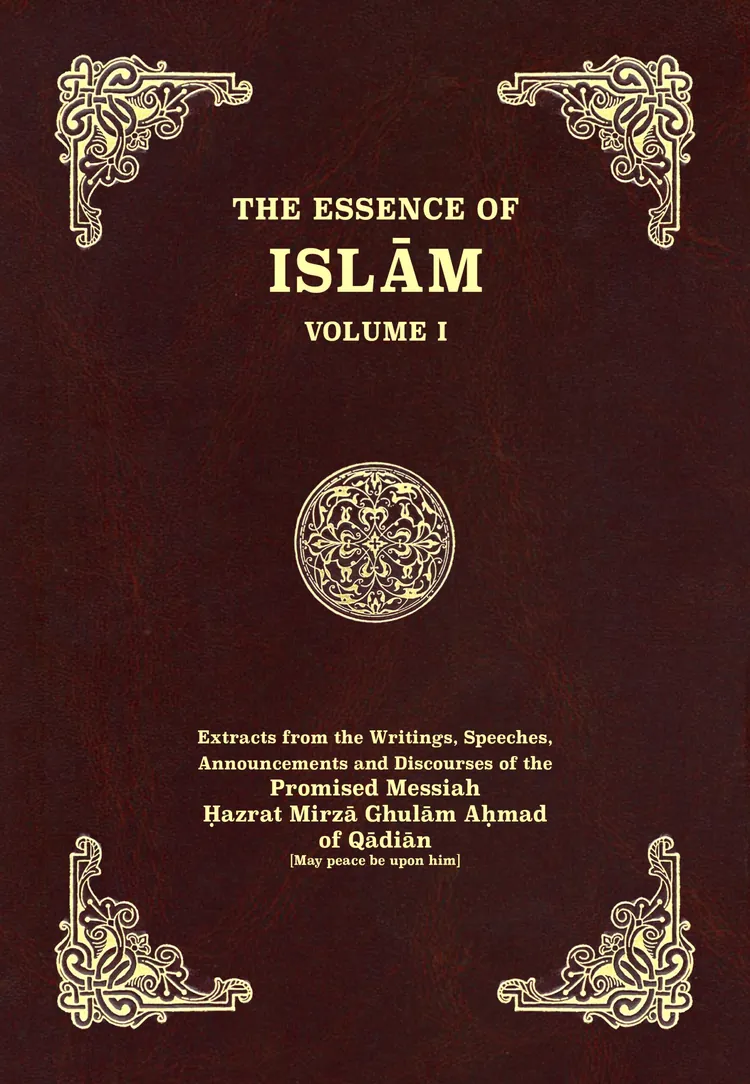
In this discourse from Essence of Islam (Volume 3), Hazrat Mirza Ghulam Ahmad (AS), the Promised Messiah and Mahdi, expounds upon Natural and Moral States of Man, presenting profound spiritual insights and scriptural verities.
Book Series: Essence of Islam (Volume 3)
Author: Hazrat Mirza Ghulam Ahmad of Qadian (AS)
Section: Part 1: Natural, Moral and Spiritual States of Man
Navigation: Book Table of Contents | « Previous: The Third Source: The Soul at Rest | Next: Three Methods of Reform »
Natural, Moral and Spiritual States of Man 5 seeks to retain them, then let it be known that, according to the Holy Qur’an, the physical states of man are closely related to his moral and spiritual states. Even a man’s habits and his way of eating and drinking affect his moral and spiritual states. If the physical states are exercised under the direction of Divine law, then, just as everything becomes salty in a salt mine, these natural states become moral states and have a deep impact on spirituality. That is why the Holy Qur’an has placed so much stress on physical cleanliness, proprieties and temperance in connection with all kinds of worship, as well as on inner purity for the purpose of attaining righteousness and humility. When we ponder over it, it becomes clear that physical conditions deeply affect the soul. We can see that our outward actions, though apparently physical in nature, have a great effect on our spiritual condition. For instance, when our eyes shed tears, even if by way of affectation, the tears immediately affect the heart, which becomes sorrowful. In the same way, when we laugh, even if for show, the heart begins to feel cheerful. It is also observed that physical prostration generates humility in the soul, and when we strut about with our head raised and chest pushed out, this attitude generates a kind of arrogance and vanity. These illustrations demonstrate how physical conditions directly affect spiritual ones.
[Islami Usul ki Philosophy, Ruhani Khaza’in, vol. 10, pp. 316-320]
[Essence of Islam, Vol. 3, p. 5]
As indicated by the Holy Word of God Almighty, natural states, the source of which is Nafs-e-Ammarah [the self that incites to evil] are not something separate from moral states. The Holy Word of God has placed all physical faculties, desires and urges under the category of natural states. These natural states, when consciously regulated, tempered and employed at the right time and place, become moral. In the same way, moral states are not something entirely distinct from spiritual states. Moral states become spiritual when they are combined with absolute devotion to God, complete purification of the self, cutting asunder from the world, turning wholly to God with perfect love, complete devotion, full serenity, contentment, and complete accord with Divine Will. Natural states alone do not make man worthy of praise until they take on a moral complexion, because these states can also be found in other animals and even in physical matter. In the same way, adopting good morals does not bestow spiritual life upon man. A person who denies the existence of God can also exhibit good morals. To be meek or humble or peace loving or shunning evil or avoiding the evildoer, are all natural states. Even an unworthy person, who is entirely unacquainted with the true source of salvation, can attain these states. Many animals are pliable and through conditioning and training do learn to behave peacefully, so much so that they do not retaliate even after being badly beaten; yet you cannot call them human, let alone humans of a higher order. Likewise, a person who holds the worst of views and is even guilty of misconduct can also exhibit these qualities. It is possible that a person may learn to be merciful to such an extreme that he may not even permit himself to kill the germs that infest his own wounds; or he may be so mindful of preserving life that he may not wish to harm the lice in his hair or the worms that are generated in the stomach, intestines, or the brain. I can even imagine that a person may be moved by pity so much so that Natural, Moral and Spiritual States of Man 7 he may even give up eating honey because it is obtained by destroying many lives and by driving away the poor bees from their hives. I can also conceive that a person may avoid using musk, as it is the blood of a poor deer and is obtained by killing the animal and separating it from its young. I would also not deny that a person might stop using pearls or wearing silk because they are both obtained by killing innocent worms. I can even concede that a person suffering from pain may choose to avoid using leeches; he may be prepared to suffer rather than kill the leech. Whether others accept it or not, I can also accept that a person might carry pity so far as to spare even the water worms and risk dying of thirst. I can accept all this, but I can never accept that these natural states could be called moral, or that these alone can wash out a person’s inner impurities, the presence of which is an obstacle in the path of meeting God Almighty.
[Islami Usul ki Philosophy, Ruhani Khaza’in, vol. 10, pp. 325-327]
I can never believe that to be meek and harmless in this manner, in which even some animals and birds excel, could become the means of acquiring a high degree of humanity. In my view, this is opposed to the cardinal virtue of seeking God’s pleasure and it amounts to fighting the law of nature and rejecting the bounties that nature has bestowed upon us. Spirituality can be attained only through the exercise of each moral quality at its proper time and place, treading faithfully in the way of God, and being wholly devoted to Him. He who truly becomes God’s cannot exist without Him. A person who truly understands God is like a fish offered unto the hand of God. Its water is the love of God.
[Essence of Islam, Vol. 3, p. 5]
Book Series: Essence of Islam (Volume 3)
Author: Hazrat Mirza Ghulam Ahmad of Qadian (AS)
Section: Part 1: Natural, Moral and Spiritual States of Man
Navigation: Book Table of Contents | « Previous: The Third Source: The Soul at Rest | Next: Three Methods of Reform »