
Three Conditions for Repentance — Essence of Islam Vol. 2
Introduction
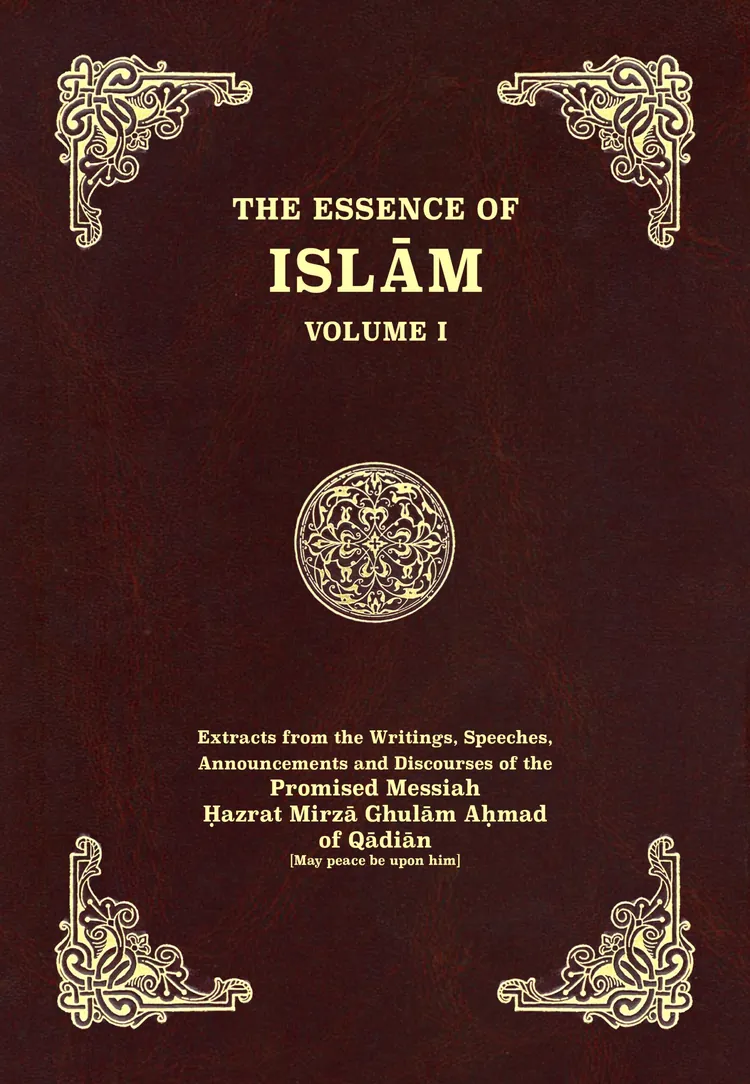
In this discourse from Essence of Islam (Volume 2), Hazrat Mirza Ghulam Ahmad (AS), the Promised Messiah and Mahdi, expounds upon Three Conditions for Repentance, presenting profound spiritual insights and scriptural verities.
Book Series: Essence of Islam (Volume 2)
Author: Hazrat Mirza Ghulam Ahmad of Qadian (AS)
Section: Part 6: Repentance and Seeking Forgiveness
Navigation: Book Table of Contents | « Previous: Man Turns to God With Remorse and God Turns to Man With Mercy | Next: The Meaning of Istighfar »
But can it be the attitude of God, Who without any action proceeding from man, has created thousands of bounties for him upon the earth, that, when weak man, being warned of his heedlessness should turn to Him, a turning which is like death and should put off his old garment and should be consumed in the fire of His love, God should not turn to him with mercy? Is this the law of nature? 79
[Chashma-e-Ma‘rifat, Ruhani Khaza’in, vol. 23, pp. 133-134]
[Essence of Islam, Vol. 2, p. 240]
It should be borne in mind that there are three conditions for repentance, without fulfilment of which true repentance is not achieved. The first condition is to get rid of wicked fancies which arouse evil propensities. Ideas have great influence. Every action is preceded by an idea. Thus, the prime condition for repentance is that evil thoughts and fancies should be discarded. For instance, if a person has an illicit relationship with a woman and desires to repent, it is necessary that he should conceive of her as ugly and should call to mind all her low qualities. As I have just said fancies exercise a powerful influence. I have read that some Sufis carried their fancies to such a length that they saw a person in the form of an ape or pig. Every thing takes on the colour of how you imagine it to be. Thus, the first condition of repentance is that all thoughts, which give rise to evil pleasures, should be discarded altogether.
The second condition is remorse. Everyone’s conscience admonishes him over every evil, but an unfortunate person leaves his conscience suspended. So a sinner should express remorse over his sin and evil action and should reflect that the pleasure to be derived from them is temporary. He should also consider that every time there is a decline in that pleasure and that in the end, in old age when his faculties are weakened, he will perforce have to give up all these pleasures. Then why indulge in that which in the end has to be given up anyhow? Most fortunate is the person who turns in repentance and becomes determined to discard all corrupt thoughts and vile fancies. When he gets rid of this impurity, he should be remorseful. The third condition is a firm resolve that he will not revert to those vices. If he adheres to this resolve, God will bestow upon him the strength for true repentance and he will be rid altogether of his vices which will be replaced by good morals and praiseworthy actions. This is a moral victory. It is for God Almighty to bestow the power and strength for it for He is the Master of all power and all strength, as He has said: 80
[Malfuzat, vol. I, pp. 138-40]
[Essence of Islam, Vol. 2, p. 240]
Book Series: Essence of Islam (Volume 2)
Author: Hazrat Mirza Ghulam Ahmad of Qadian (AS)
Section: Part 6: Repentance and Seeking Forgiveness
Navigation: Book Table of Contents | « Previous: Man Turns to God With Remorse and God Turns to Man With Mercy | Next: The Meaning of Istighfar »