
True Morals — Essence of Islam Vol. 3
Introduction
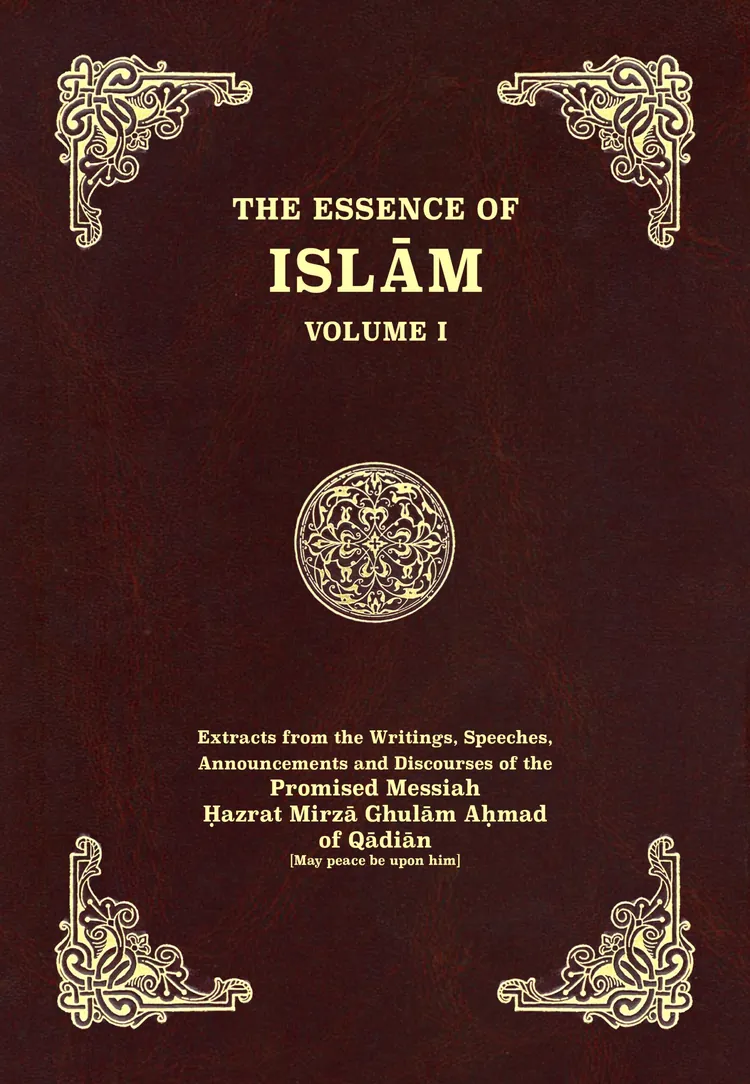
In this discourse from Essence of Islam (Volume 3), Hazrat Mirza Ghulam Ahmad (AS), the Promised Messiah and Mahdi, expounds upon True Morals, presenting profound spiritual insights and scriptural verities.
Book Series: Essence of Islam (Volume 3)
Author: Hazrat Mirza Ghulam Ahmad of Qadian (AS)
Section: Part 1: Natural, Moral and Spiritual States of Man
Navigation: Book Table of Contents | « Previous: Natural States Become Moral by Proper Regulation | Next: Moral State of Man »
Natural, Moral and Spiritual States of Man 11 comes louder, its smile turns into laughter, and its vision becomes more volitional. At this stage, it reveals another natural trait by displaying its pleasure or displeasure through gestures and tries to strike someone or desires to give something to someone. But all these movements are natural impulses. Indeed a savage too is like a child whose share of human reason is very meagre. He too displays natural impulses in his words, actions and movements, and is subject to his natural drives. But nothing proceeds from him in consequence of reflection and deliberation. Whatever takes place inside him continues to issue forth in response to the external stimuli. It is quite possible that his natural impulses, which are exhibited as a reaction to the external stimuli, may not be all bad. Some may look like moral actions, but they are devoid of rational reflection and choice and, even if they seem to some degree so motivated, they cannot be relied upon on account of the domination of natural impulses. In short, we cannot truly attribute morals to a person who is subject to natural impulses like animals or infants or the insane, and who lives more or less like savages. In the true sense, the time of morals, whether good or bad, begins when a person’s God-given reason ripens and he is able to distinguish between good and bad and the degree of good and evil. And he begins to feel sorry when he misses an opportunity of doing good and is remorseful when he has done something wrong. This is the second stage of man’s life, which is designated as Nafs-eLawwamah [the self-reproaching self] in God’s Holy Word. It should, however, be remembered that mere advice is not enough to lead a savage to the stage of the selfreproaching self. It is necessary that he should become conscious of the existence of God to a degree at which he should not consider his own creation as meaningless and without purpose, so that an understanding of the Divine should create true morals in him. That is why God Almighty has drawn attention to the need of understanding the True God and has given the assurance that every action and moral quality has a consequence, which becomes the source of spiritual comfort or spiritual torment in this life and the consequences of which would be fully apparent in the hereafter. In short, at the stage of the selfreproaching self, a person partakes so much of reason and understanding and good conscience that he reproaches himself over evil and is willing and eager to do good. That is the stage at which a person acquires the high moral qualities.
[Islami Usul ki Philosophy, Ruhani Khaza’in, vol. 10, pp. 330-332]
[Essence of Islam, Vol. 3, p. 11]
Addressing the Holy Prophet (peace and blessings of Allah be upon him), God, the Glorious, says:
وَإِنَّكَ لَعَلَىٰ خُلُقٍ عَظِيمٖ
“And thou dost surely possess high moral excellences.” (Surah Al-Qalam, 68:5)
That is, ‘Yours is indeed the most exalted moral station.’ This means that all high moral qualities, such as generosity, bravery, justice, mercy, benevolence, sincerity, courage, etc., were combined in the Holy Prophetsa. In short, all modes of behaviour found in the human person, like courtesy, modesty, integrity, politeness, righteous indignation, steadfastness, chastity, temperance, moderation, sympathy, bravery, generosity, forgiveness,
Natural, Moral and Spiritual States of Man 13 patience, benevolence, sincerity, loyalty, etc., when they find expression at their proper time and place, under the guidance of reason and reflection, are designated moral. All such qualities are in reality the natural states and emotions of the human person and they are designated as such only when exercised at their proper time and place.
[Islami Usul ki Philosophy, Ruhani Khaza’in, vol. 10, p. 333]
[Essence of Islam, Vol. 3, p. 12]
Book Series: Essence of Islam (Volume 3)
Author: Hazrat Mirza Ghulam Ahmad of Qadian (AS)
Section: Part 1: Natural, Moral and Spiritual States of Man
Navigation: Book Table of Contents | « Previous: Natural States Become Moral by Proper Regulation | Next: Moral State of Man »